
The full name of the lens written on its body is Nikon AF-S Nikkor 50mm 1: 1.8G SWM Aspherical, but it is commonly called Nikon 50 / 1.8G.

Nikon AF-S Nikkor 50mm 1: 1.8G SWM Aspherical with hood HB-47
The Nikon 50/1.8G is a fast autofocus 50mm lens from Nikon. "50mm" or "50mm" is a common term for a lens with a focal length of 50mm. This focal length is very popular. Older cameras often featured 50mm lenses as a kit lens, but today, 50mm lenses are attractive due to their low price and excellent image quality.


The Nikon 50/1.8G lens is an upgraded version of the legendary Nikon 50mm 1:1.8D AF Nikkor lens from film cameras. The upgrades include the aperture control method, optical design, and built-in focus motor. The new model is heavier and larger.
All Nikon 50 / 1.8 Autofocus Lenses
- Nikon 50mm 1: 1.8 AF Nikkor (first version, MKI) - the lens was produced only in Japan from 1986 to 1990. It is easy to distinguish by a window with a focusing distance and a narrow plastic focus ring. There are two subversions that are no different:
- MKI first subversion. Weighing 210 grams. It is easy to distinguish by the screw under the inscription '1: 1.8'. From September 1986 to March 1987. Serial numbers start at 2
- MKI second version. Weighing 165 grams. It is easy to distinguish by the absence of a screw under the inscription '1: 1.8'. From 1987 to 1990. Serial numbers start at 3.
- Nikon 50mm 1: 1.8 AF Nikkor (second version, MKII, also known as the 'N', or the 'NEW' version) - the lens was produced in Japan and China. The MK II version was produced from 1990 to 2001. There are three subversions that are no different:
- Nikon 50mm 1: 1.8D AF Nikkor (third version, MKIIIbetter known as 'D'-version) - the lens is available from 2002 to this day. All lenses are made in China.
- Nikon AF-S Nikkor 50mm 1: 1.8G SWM Aspherical (fourth version, MKIVbetter known as '1.8 G'-version or '1.8 AF-S' version) - the lens has been produced since 2011, all lenses are made in China.
- Nikon AF-S Nikkor 50mm 1: 1.8G SWM Aspherical Special Edition (fifth version, MKVbetter known as version 'Special Edition' or 'SE' or version for the camera with a retro design of the case Nikon Df) - the lens has been available since the fall of 2013. All lenses are made in China.
- Nikon Nikkor Z 50mm 1: 1.8 S, from summer 2018, lens for mirrorless cameras with Nikon Z mount... Diagram of 12 elements in 9 groups, 2 ED, 2 ASP.
Details on the Nikon 50mm f/40mm model range can be found in my article ' All Nikon autofocus 50mm f/40mm cameras '.
Main technical characteristics of the Nikon AF-S Nikkor 50mm 1: 1.8G SWM Aspherical
| Review Instance Name | Nikon AF-S Nikkor 50mm 1: 1.8G SWM Aspherical 2153108 |
| Basic properties |
|
| Front Filter Diameter | 58 mm, plastic thread for filters |
| Focal length | 50 mm, EGF for Nikon DX cameras is 75 mm |
| Zoom ratio | 1 X (this is a fixed lens, it does not have a zoom) |
| Designed by | for full-frame digital cameras |
| Number of aperture blades | 7 pieces |
| Tags | focusing distance in meters and feet, depth of field for F / 16, mark of bayonet mount and hood mount |
| Diaphragm | F / 1.8 to F / 16, without aperture ring. |
| MDF | 0.45 m, maximal magnification factor 1: 6.7 |
| The weight | 185 g |
| Optical design | 7 elements in 6 groups, 1 aspherical element (in the optical diagram, the aspherical element is shown in blue). This is Nikon's first fifty kopeck piece to use aspherical elements in its design. The Nikon AF-S Nikkor 50mm 1: 1.8G SWM Aspherical Special Edition has exactly the same optical design. The image is clickable.
|
| Lens hood | Nikon HB-47 |
| Manufacturer country | MADE IN CHINA |
| Period | From April 2011 -> |
| Instructions | See |
| Price |

Nikon hasn't updated its lineup of 50mm f/1.8D lenses in a while, not since the affordable Nikon 50mm 1:1.8D AF Nikkor . Before the release of the Nikon 50mm f/1.8G, the only choice was between expensive f/1.4 models and the older, non-motorized Nikon 50mm 1:1.8D AF Nikkor . With the release of the new, relatively affordable Nikon 50mm f/1.8G, users of non-motorized cameras now have the option of using a fast f/1.8D lens without a significant investment.

Rear view of the Nikon AF-S Nikkor 50mm 1: 1.8G SWM Aspherical
Most importantly, what you need to know about the Nikon 50 / 1.8G:
1. The lens is suitable for both FX and DX cameras . This means it can be used on both full-frame cameras , such as the Nikon D600 , D3s , D800 , D750 , and others, and crop-sensor cameras, such as the Nikon D3300 , D90 , D5200 , and others.

Nikon AF-S Nikkor 50mm 1: 1.8G SWM Aspherical Lens with Two Lids
2. The lens has a Silent Wave Motor (SWM), which means it can be used on all Nikon DSLR cameras . The lens will automatically focus even on entry-level motorless cameras: D40 , D40x , D60 , D3000 , D3100 , D3200 , D3300 , D5000, D5100 , D5200 , D5300 , D5500.

Nikon AF-S Nikkor 50mm 1: 1.8G SWM Aspherical Lens Information Labels
3. The lens is marked "G." This means the Nikon 50/1.8G has no aperture ring. Aperture is controlled entirely by the camera. This prevents the lens from being used on older film cameras or, for example, for macro photography with a reversing adapter . This isn't a flaw, but a sign of the times. Almost all lenses now come without an aperture ring. You can read more about "G" and "Non-G" lenses here.

Enlightenment of the front lens and aperture blades Nikon AF-S Nikkor 50mm 1: 1.8G SWM Aspherical
4. The front filter diameter is 58 mm, the same as that of the Nikon 50mm f/1.4G AF-S Nikkor . The lens is made of plastic and is well-built. The bayonet mount is metal . All Nikon 50mm f/1.8G lenses are made in China.
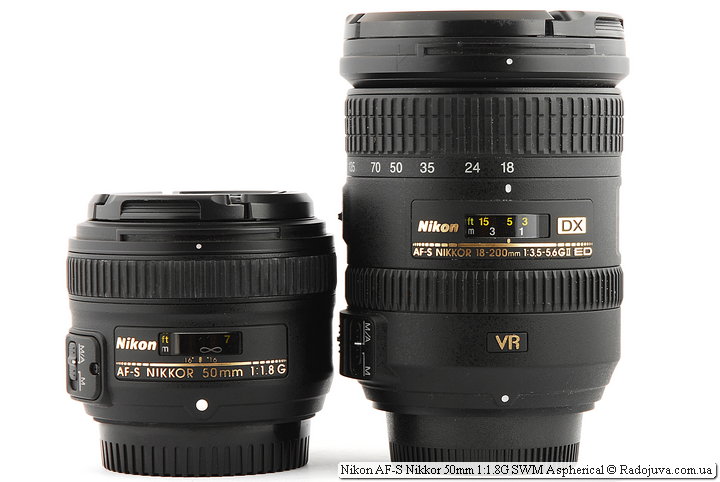
Nikon AF-S Nikkor 50mm 1:1.8G SWM Aspherical prime lens and Nikon DX AF-S Nikkor 18-200mm 1:3.5-5.6GII ED SWM VR IF Aspherical universal lens
5. Focusing method. When focusing, the entire lens unit moves. Crucially, the lens has no internal focusing. However, the focusing method itself is quite unusual : when focusing, the internal part of the lens, located in the center of the pyramidal front barrel, moves. This means the lens barrel does not extend or rotate during focusing.
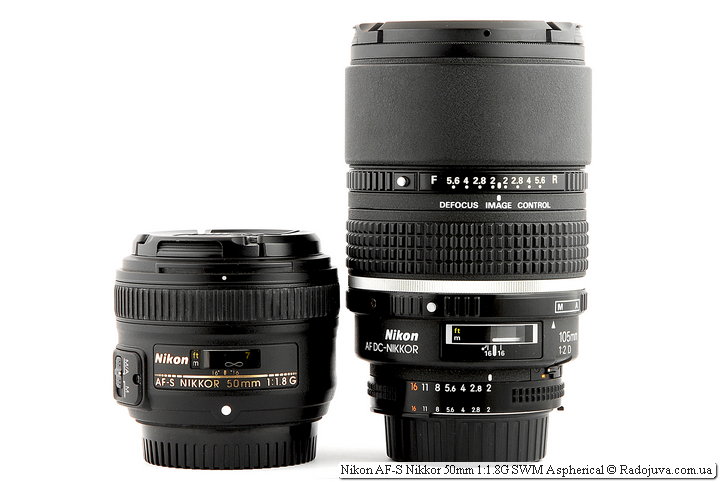
The Nikon AF-S Nikkor 50mm 1:1.8G SWM Aspherical and the Nikon AF DC-Nikkor 105mm 1:2D portrait lens
6. The focusing speed is fast . But always remember that focusing speed and accuracy are also affected by the camera itself and a number of other factors. The lens has a focusing distance scale . The distance is indicated in meters and feet. There is also a depth of field scale for f/16.
7. On the lens barrel, you'll find the 'M/A' focus switch . In the 'M/A' position, automatic focusing is enabled, with manual focus priority always in place. The 'M/A' mode is very convenient and useful—for manual focusing or focus adjustments, there's no need to switch the lens to 'M' mode.
8. The minimum focusing distance is 45 cm. The maximum ratio when magnified is 1: 6.7. You can’t shoot a macro with this lens, but at the same time it’s easy to shoot small objects.
9. When used on crop-sensor cameras with Nikon DX , the angle of view will be narrower than on a full-frame camera. It will appear to have an angle of view equivalent to a 75mm lens on a full-frame camera . This allows the lens to be used on crop-sensor cameras without any problems as a decent portrait lens. However, please note that the Nikon 50/1.8G is actually just a general-purpose fast prime lens and is not designed for portraiture. Furthermore, the classic focal length for portrait photography starts at 80mm.
10. Aperture . Yes, f/1.8 is an excellent aperture for low-light shooting. The lens is truly usable in low-light conditions. But if you want an even faster lens, you should consider its siblings – the Nikon 50mm f/1.4G AF-S Nikkor and the Nikon 50mm f/1.4D AF Nikkor.

This is what the Nikon AF-S Nikkor 50mm 1: 1.8G SWM Aspherical looks like after prolonged use
About the picture (photo quality)
The image is sharp already at f/1.8. Maximum sharpness is achieved around f/5.6. Contrast is very good. The lens handles backlighting and side light well and can sometimes capture hares. The bokeh is smooth and even, not as harsh as that of the Nikon 50mm 1:1.8D AF Nikkor . At closed apertures, the lens creates 14-pointed stars from illuminated objects . At wide-open apertures, fringing is pronounced. Chromatic aberrations are quite strong up to f/2.8, but this is typical for lenses of this type. Incidentally, the Nikon 50mm 1:1.8G is the only Nikon 50mm lens in 2013 to use a special aspherical element . Overall, the image quality is excellent.
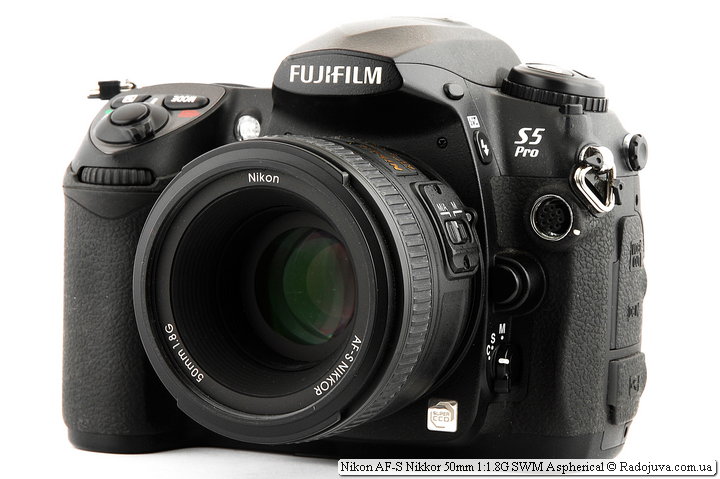
Nikon AF-S Nikkor 50mm 1:1.8G SWM Aspherical on a Fujifilm FinePix S5 Pro
Sample photos on Nikon D5100
All photos from the Nikon D5100 are unprocessed . Size has been reduced and EXIF data has been imprinted.


You'll find many more examples in my post, ' Autumn 2020 on the Nikon D40 and Nikkor 50/1.8G '
Sample photos on Nikon D700


You can read more about all of Nikon's 50mm fast autofocus lenses here.
Sample photos on Fujifilm FinePix S5 Pro
Examples of the legendary Fujifilm FinePix S5 Pro camera (Nikon F mount) can be found here.
Video review
The video review is available at this link or embedded below:
Lens prices
Real prices for the lens in online stores can
- View on E-katalog
- View on Euroset
- View on Outlet
- View on Magazilla
- Look at Ozone
- View on Nadavi
- View in Svyaznoy
- View on M. Video
Conclusions
The Nikon AF-S Nikkor 50mm 1:1.8G SWM Aspherical is a good fast prime lens. It's suitable as a budget portrait lens for DX cameras, offering good sharpness and color rendition. I consider the Nikon AF-S Nikkor 50mm 1:1.8G SWM Aspherical to be the best value 50mm lens for the price.
UPDATE: In 2016, a Chinese copy of this lens appeared at a price two to three times lower than the original. See the review of the YONGNUO 50mm 1:1.8 (YN50mm F1.8N).
If there are any incomprehensible moments on the lens, ask me in the comments.
Comments on this post do not require registration. Anyone can leave a comment.This material was prepared by Arkady Shapoval . The greatest support for the site is if you use links on this site, such as Amazon , when purchasing anything . It costs you nothing, but for this site, and therefore for my family, it's the main source of support.
Lord. Celebration!)
I buy the first mirror. To begin with a whale.
I have already decided on the second one - I will take AF-S 50mm VR right away.
And here I am with a mirror.
Is it worth it to pay extra for the difference and take more
if you choose between D3100 and D3200?
And if you choose between the D3200 and D3300?
Thank you in advance.
My advice to you, do not save on carcass.
Take your camera with a “screwdriver” for compatibility with the vast majority of lenses….
Save on the carcass - you will bite your elbows when you understand the price difference between AF and AFS optics .... :)
And I would recommend the D7100 - a newer model.
I tried “7100” and after that I bought the D7000. The 7100 is not a “newer model”! Don't be confused! This is a DIFFERENT model. And she has a different purpose. For everyday life, for weddings, the device is not suitable for macro. The only thing I would recommend him for is for shooting at a long focus, but with the caveat that you have to take more EXPENSIVE lenses.
Apprat (D7100) is very demanding on lighting. With its shortcoming, the Nikon D7000 will give odds.
Most likely the matter is in the excess number of pixels with equal matrix sizes. This resulted in a very small pixel size for the “7100”. The decision is very dubious for a crop. More pixels means less light sensitivity. But this is not the main thing; understand a simple rule: the smaller the pixel size, the MORE NOISE! In addition, the phenomenon of diffraction on the compressed pixels Nikon “D7100” will manifest itself to a greater extent at the most frequently used apertures. For high sharpness, you have to pinch the hole to the limit.
The D7100 gave out much more for the above reasons. Where I put ISO 800-1000 on a 7100 and shoot, Nikon XNUMX surrenders without a fight.
That's such a disposition.
Yeah. Reasoning)) First of all, you will not see noise on the D7100 with a similar crop frame, unlike the D7000, and it’s noisier than the 7000, tests already have a car and a small cart, why did you get this? I have 5100 more, there is a sensor like in 7000, subjectively at high ISO 7100 it looks just as better. Secondly, the focusing module on the D7000 is sorrow, especially in low light conditions. And the D7100 is great. There are a billion examples of this and it makes no sense to bring them here, the Internet will help you. Third, the D7100 has a wider dynamic range, which is best in class. Plus the lack of an AA filter. Fourthly, there is an exactingness in the resolution of optics, but, for example, Jupiter 37A (I have an MS version) allows the D7100 matrix to be used in excess, what can I say about other modern lenses? A shake is a myth of crooked photographers. The D7100 is a wonderful development of the 7000th, it's like comparing the d90 and D7000. I remember that there was also a lot of pessimism in the noise. But did the 7000 go? I also went 7100. The FF will definitely be the next step. But not soon. While 7100 is satisfied almost completely. The only thing is the crop, which means that the control of the depth of field has been cut down (And I can’t get the same Soviet lenses like Helios 81N (I have them) and Jupiter 37A. And they give such a picture on the FF!
Another couch theorist who has read foolish forums. Buy an old D1H, it seems 2,5 megapixels. She has a huge pixel, you can shoot at 6400 ISO without any noise !!! Well, there will be no diffraction, at least put f500 !!!
I agree. D7100 is worse than 7000 for most of the most important photo positions. But there are also pluses! For example, the constructive is stronger, and the dust and moisture protection of the case, all kinds of "doors".
Full bum!
Bullshit, how tired of the plush specials nikon d7100 is a cut above in detail, focus, resolution, dynamic range.
you have tested poorly 7100, try one more time to understand that 7100 is better in all respects
tell me why this lens on the d90 does not fall into focus? it seems that everything is in focus on the display and the picture is excellent, but on a large monitor the portrait is out of focus, it constantly focuses past….
Focus through the JVI and don't forget about the small depth of field…. :)
1. At the end of the instructions for the lens there is a table with the depth of field at different aperture values.
2. See what focus mode you set. Set the point to adjust the sharpness where you need, taking into account the first point, of course
* Otherwise, the device itself will tune in to the nose or ear))))
For owners of crop cameras (d3100, d5100, etc.) I recommend taking 35 mm, it is more versatile. This will allow you to take full-length or waist-length portraits with the same blur. With fifty dollars you will have to retreat many meters, and the viewing angle will also be smaller. And in general, to begin with, take Helios 81n from your hands for a minuscule one and practice, if you like its focal points - sell it for the same price that you took and buy this fifty kopeck piece from Nikon ...
1. Well, at the expense of "many meters" is certainly too much!))) Not so much. I will say more, for a portraitist this is a plus, because when shooting from very close distances, the subject is pinched, shy more and looks less natural.
Walking a few meters is not so bad. Here is an example of a rustic texture
http://fotki.yandex.ru/next/users/krasilovandrei/album/362714/view/1076542
from a fairly close distance at 50 mm focus. It’s all the more difficult to shoot a child!
2. It is necessary to take into account that the 35th is practically not intended for full-frame, if someone decides later ...
3. The 35-year-old device is simpler and aspherical lenses are not there, so be prepared to fight against unwanted optical effects.
My previous answer, but for some reason the name did not pass))))))))
I agree. I will add. If you have 35, then there is no reason to take 50, especially an expensive one ... It is preferable to dig up and buy a G-85. In such a time you can live beautifully without fifty dollars.
I took 7000mm / 85G for myself on the D1.8 - you can photograph a face from 3-4 meters, a full-length kinder - from 7 meters.
OK! all this is fine, but the question is: I want to buy a De7100 for myself and after 2-3 years change it for a De800 or similar FF, leaving the first CZK as the second (so as not to change the lenses 100 times). I do not consider the Zooms options, except for those that cost more than 15k and with a zoom of no more than 3X, in principle because of the worse quality and a number of other shortcomings compared to fixes. The genre of shooting is mainly a portrait, and in the future, weddings are possible (why I want a spare camera). How, purely from a practical point of view (convenience, for example) to use this lens on a crop? At 1.4, I see no reason to spend money so far, and if so, then only 85mm on FF.
Thanks in advance for an EXCLUSIVE answer!
D7100 for weddings is not an option! The reason is described above! I have already stepped on this rake.
I can share at the expense of fifty fifty. I was tuned to take it exactly (the amount is not critical for me). But!
In the first store, out of the offered 3 copies, I could not choose a single one! One didn’t work at all (the device didn’t see it! The device was fixed!) And two couldn’t tune in to focus under any circumstances. At the same time I tried other lenses - there were no problems with focusing.
In another store, the problem was about the same. Suggested two copies. The window display did not focus, although it tried and during its operation an incomprehensible extraneous noise was heard inside it. And only the second copy from the warehouse earned no complaints.
At the same time, fifty fifty 1,8 worked without problems. I rummaged and found out that 1,4 is more complicated and there are many negative reviews about its unreliability. It is unlikely to be able to use its advantages in aperture, and the range of working apertures for both glasses is almost the same.
Hello! I have a Nikon D3100 and a Nikon 50mm f / 1.8G AF-S Nikkor lens. I really like the photos, but I want something more professional. I can’t decide whether to change the camera to a more expensive one and leave the lens. Or buy another one lens, but leave this camera. Tell me which is better? Thank you in advance.)
Galina, it’s time to change D3100 to FF. Of course you can have some 5100 or 5200, but I would not take the carcass without a screwdriver. Especially when it comes to using 50mm.
better shoot more and learn to shoot.
The quality of work from a change in technology does not usually increase.
It’s so. One side. On the other hand, enthusiasm disappears when you leaf through gray soap for years ... There is no incentive!
I photograph mainly people (portraits and not only). Landscapes are very rare.
then FF and fix 85 1.8, this is the best option, 135 F2 will certainly be better, but there the price * 2
Please tell me what you need to pay attention to when buying this lens? I am a newbie. Thank you in advance.
Good afternoon ... advise I am going to buy a portrait lens as for an amateur ...
Think Nikon 35mm 1.8G or 50mm 1.8G
I have a camera D 3100….
Which is better to buy?
definitely 50 / 1,8 - its distortion will be less
Compared to 35, it is almost gone! )))))
Good afternoon! I plan to buy the first DSLR, the choice fell on the d5100 kit 18-55. After reading various forums, there are questions: 1 is it worth taking glass 18-105 if I understood correctly, then apart from the “zoom” it is no different from 18-55? And if this is really so, then maybe it is better to take this fix 50? I plan to use portraits / sights for photographs on trips / ... “zoom with feet” does not bother me. mostly outdoors on different soap dishes I did it, no macro is planned, but I would not refuse a good bokeh. What do you advise?
If you do not plan to bother a lot with a selection of lenses / a lot of fuss about something, then 18-105 as a whole covers all amateur travel needs and a few portraits of 50-90 mm focal length.
And he is better than 18-55.
Half of the land for travel will be too narrow, perhaps, and 35 - you will need to get used to the frame.
Yes, getting used to fix 35 is extremely difficult. Especially after the standard zoom 10-105. All the time you use the lens, but it doesn't work!
Just don't know how
Something I can do, dear long-growing vyunosh; I can also teach you a little bit ... The trouble is, the vision is already bad (glasses do not save - cataracts), the eyes require a zoom, and the legs.
Hello, I have a nikon d5100 18/55, I want to change the lens, photograph newborn babies, in a room where there is not very much light, please advise what can I pick up?
inexpensive and convenient - Nikon 35 / 1,8g
Hello Arkady!
Please tell me which lens is better for Nikon D7000 for wedding photography 50mm 1,4 or 50mm 1,8. Engaged in photography recently amateur.
Please tell me what you need to pay attention to when buying a lens, how to check that it works properly?
Arkady Good day!
Thank you for your work! Everything is very clear and informative.
Until now, I have not bought or changed lenses. I proceeded from the capabilities of the camera, the lens in the current conditions. But the time came when I wanted a more serious technique. With her came the understanding that a lens was needed. There are two questions:
1. in some places I began to meet a strange belief that Nikon has a special series of lenses - with yellow (gold) information as in the photo of a particular copy of this article and white - ordinary lenses. The former, in turn, are distinguished by the best picture. But I did not see this by the price tag and the declared characteristics.
I could neither repost, nor delete, nor edit my comment :)
Actually the question is, is there such a gold series?
Question two: Have you used, at least once, the aperture ring on lenses mounted on digital cameras? I mean cases when the camera allows you to control the diaphragm.
I choose 50 f1.4. G has a new optical design and aspherical glass. D has the ability to instantly change the aperture.
Arkady Hello! I have a Nikon D7000 with a Nikon AF-S DX Nikkor 16-85mm f / 3.5-5.6G ED VR. It shoots great. I'm satisfied. Recently, I became interested in night shooting. This lens allows you to shoot a night city or landscape with the moon. But to shoot the starry sky, the milky way without the moon is quite difficult. I rent on ISO 3200 and 30 sec. on large Iso, the noise is more noticeable, and star tracks appear. To facilitate his work, he decided to purchase a fast lens, two lenses are available for finance: the first Nikon AF-S DX Nikkor 35mm f / 1.8G and the second Nikon AF Nikkor 50mm f / 1.8D. Which of them do you think is most suitable for shooting the starry sky? Thanks.
You are clearly shooting stars at the short end, why do you need Nikkor 50mm f / 1.8D, which on your camera will turn into 75mm ... Obviously your choice is 35mm.
You should also think about whether the difference in aperture between f / 3.5VR and f / 1.8 will drastically save you ...
I agree with you. I’ll add about a tripod tripod. Necessarily needed.
Hello Arkady, tell me please, is it worth it to change Nikkor 1.8d to 1.8zh thanks in advance
Yes, I forgot to add the Nikon D7100 camera
Arkady, hello, enlighten on this question: if an AF cable fails on an AF-S lens, will autofocus be available on the camera with a screwdriver? thanks
No, it will not.
and if the AF lens has a back or front focus, is this a lack of a camera or lens?
Just rearrange to another carcass or put another lens on this one and it will be clear who has the problem. But most often it’s still a lens
I noticed that there are 8 contacts on the lens, there are 5100 on the D7, does this fact impose any restrictions on the operation of the D5100 and 50 1.8G pairs? Worse focus?
There are no restrictions.
Thank you Arkady! But why then the 8th contact?
I think no one will tell you that :)
Now I won’t calm down until I find the answer!
Arkady, hello, there is a Nikon D3200 camera with a kit 18-55, does it make sense to buy 35mm and 50mm 1.8G lenses, provided that 35mm costs 6000 rubles, and 50mm costs about 8000. But if you take both for the action - 10 rubles. Or is it worth getting one?
Hello, camera 5100D 18-55
I think to take a new 1.8 mm lens for shooting brides and children indoors .. what do you think? Or take 55 mm?