
For providing the Nikon N AF-S Nikkor 70-200mm 1:4G ED SWM VR IF Nano Crystal Coat lens, we would like to express our sincere gratitude to the Fotika.com.ua store , where you can find a huge variety of used photographic equipment, including this lens.
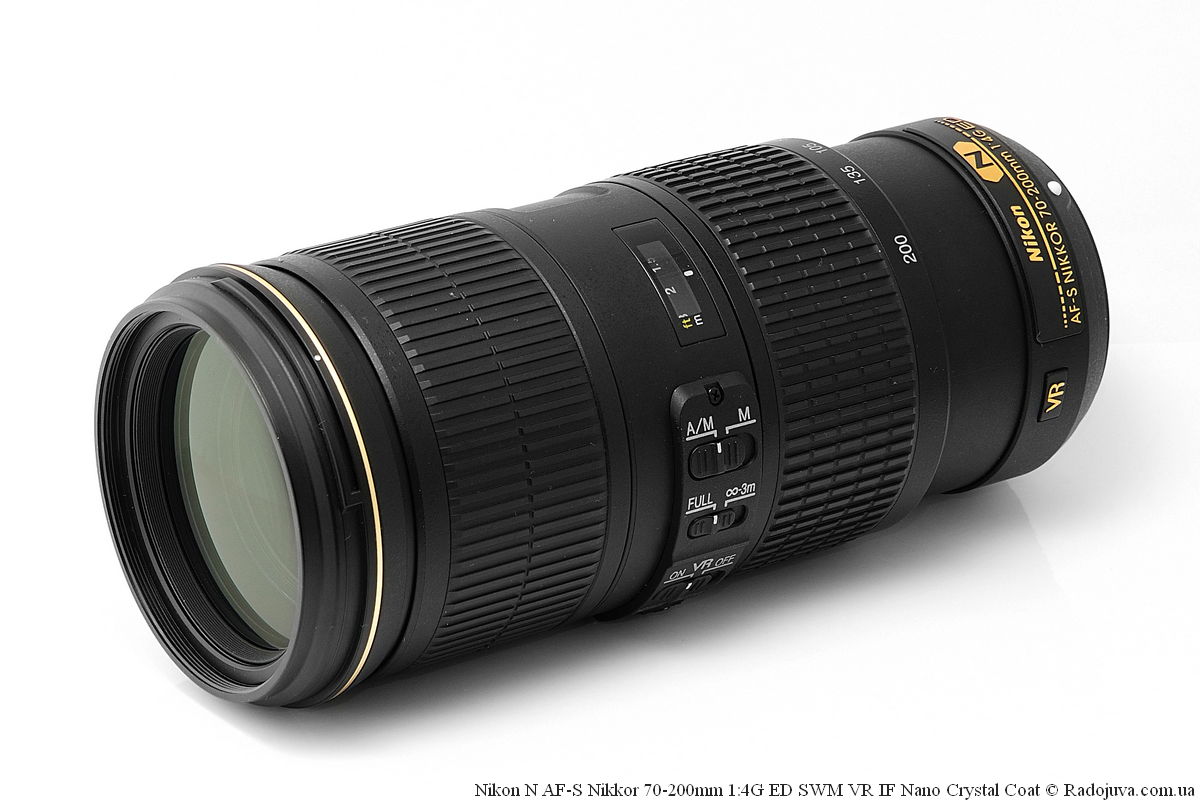
Nikon 70-200mm 1: 4G VR AF-S ED IF N
Navigation
- History
- Main Specifications
- Enlightenment 'N' (Nano Crystal Coat)
- Assembly
- Aperture Features
- Stabilizer
- Focus
- 'A / M-M' switch
- Compatibility and Features
- Image quality
- Sample Photos
- My personal experience with the lens
- Prices
- Similar Original Nikkor Lenses
- Conclusion
- User Comments
- Add your review or question on the lens
History
Back in September of 1986, Nikon introduced a very nice lens – the Nikon AF Nikkor 70-210mm 1:4 . Less than a year later, in April 1987, it was discontinued. After that, the company took a 25-year (!) break from producing similar lenses. Then, in the fall of 2012, a miracle happened again: the very interesting and functional Nikon N AF-S Nikkor 70-200mm 1:4G ED SWM VR IF Nano Crystal Coat (discussed in this review) was introduced.
The appearance of this lens likely stems from the availability of similar lenses from its direct competitor, Canon. Like Nikon, Canon had been producing the Canon Zoom Lens EF 70-210mm 1:4 since May 1987. Unlike Nikon, however, Canon released the Canon Zoom Lens EF 70-200mm 1:4 L USM Ultrasonic in September 1999, which was supplemented by the Canon Zoom Lens EF 70-200mm 1:4 L IS USM Ultrasonic in 2006 , and the Canon Zoom Lens EF 70-200mm 1:4 L IS II USM in 2018.
Nikon N AF-S Nikkor 70-200mm 1: 4G ED SWM VR IF Nano Crystal Coat (abbreviated as Nikon 70-200 / 4G) is part of Nikon Nikkor's line of professional zoom lenses with a maximum aperture of f / 4.
I include only 3 lenses to them:
- Nikon N AF-S Nikkor 24-120mm 1: 4G ED VR SWM IF Aspherical Nano Crystal Coat
- Nikon ED AF-S Nikkor 16-35mm 1: 4G VR N Nano Crystal Coat SWM IF Aspherical
- Nikon N AF-S Nikkor 70-200mm 1: 4G ED SWM VR IF Nano Crystal Coat (from this review)
Optionally, in addition to this line you can put
- sprinkled Nikon DX AF-S Nikkor 12-24mm 1: 4G ED SWM IF Aspherical
- super monster of a completely different weight category Nikon AF-S Nikkor 200-400mm 1: 4G VR ED
- and updating the super monster in the face Nikon AF-S Nikkor 200-400mm 1: 4GII ED VR N Nano Crystal Coat
The Nikon 70-200/4G stands apart from the dark 70-300mm telephoto lenses and the bright 70(80)-200/2.8mm telephoto lenses. And the aging Nikon AF Nikkor 70-210mm 1:4 is in no way related to the subject of this review. Still, I'm inclined to classify the Nikon 70-200/4G as a "dark" lens.

Nikon 70-200mm 1: 4G VR AF-S ED IF N
Main technical characteristics of Nikon N AF-S Nikkor 70-200mm 1: 4G ED SWM VR IF Nano Crystal Coat:
| Review Instance Name | Nikon N AF-S Nikkor 70-200mm 1: 4G ED SWM VR IF Nano Crystal Coat 82018417 |
| Basic properties |
|
| Front Filter Diameter | 67 mm, plastic thread for filters |
| Focal length | 70-200 mm EGF for Nikon DX cameras is 105-300 mm |
| Zoom ratio | 2.86 X (usually just talking about XNUMXx zoom) |
| Designed by | for digital cameras Nikon FX |
| Number of aperture blades | 9 rounded petals |
| Tags | a window with a focusing distance in meters and feet, focal lengths for 70, 85, 105, 135, 200 mm, a bayonet mount mark, an installation and fixation mark for the hood (an additional tripod foot has a mark for horizontal / vertical orientation) |
| Diaphragm | from f / 4 over the entire range of focal lengths to f / 32. The lens does not have an aperture ring (G - lens type) |
| MDF (minimum focusing distance) | 1 m, maximum magnification ratio 1: 3.7 |
| The weight | 850 g |
| Optical design | 20 elements in 14 groups. The scheme includes:
The image of the optical circuit is clickable. |
| Lens hood | Nikon HB-60 (supplied) |
| Transportation | Using the soft cover CL ‑ 1225 (supplied) |
| Manufacturer country | Made in thailand |
| Period | From October 24, 2012 to the present day (at least until the summer of 2015) |
| Instruction (multilingual) | Download, mirror 2. |
| Price |

Of course, it’s a pity that even compared to the ancient Nikon AF Nikkor 70-210mm 1:4, the new Nikon 70-200/4G has lost 10 mm of focal length.
The Nikon 70-200/4G is equipped with a special, very enticing feature—a gold ring near the front element—which qualifies it as a professional lens in the NIKON NIKKOR lineup. Furthermore, it is included in Nikon's NPS professional equipment list . However, whether or not you consider the Nikon 70-200/4G a professional lens is a purely personal matter.

Switch Kit Nikon 70-200mm 1: 4G VR AF-S ED IF N
Enlightenment 'N' (Nano Crystal Coat)
The Nikon 70-200/4G boasts the letter 'N' on its barrel. 'N' stands for 'Nano Crystal Coat,' a nanocrystalline coating used on the lens. This coating effectively controls flare and ghosting, and also produces excellent color rendition. It's likely that only one lens element has this coating. The rest have classic SIC (Nikon Super Integrated Coating).
It is unfortunate that Nikon does not indicate the number of lenses in the optical circuit that have such enlightenment. I, like some other users, believe that the letter 'N' is put more for marketing. In addition, in real conditions, the lens catches a fairly large number of glare and receives a white veil-flare, even when using a lens hood.

Nikon 70-200mm 1: 4G VR AF-S ED IF N
Assembly
Nikon 70-200 / 4G is manufactured in Thailand, which is not a good indicator for a 'professional' lens. It is pleasant and weighty to the touch, weighing almost 900 grams. Unfortunately Nikon 70-200 / 4G uses non-professional 67mm filters.
When using the lens, you get the pleasant feeling that you're actually using a worthy lens. The Nikon 70-200 f/4G feels slightly inferior to the 70(80)-200 f/2.8 series lenses (the full list is here ).
The lens has a special rubber skirt on the bayonet side that protects it from dust and moisture. Official sources don't provide definitive confirmation that the Nikon 70-200/4G is dust- and moisture-resistant. However, I'm inclined to believe that this rubber seal means the lens does have basic dust and moisture resistance . I've covered the dust and moisture resistance of Nikon Nikkor lenses in more detail here.
The focus and zoom rings are rubberized, large, and comfortable to use. The Nikon 70-200/4G has a metal bayonet mount.
It's nice that the inside of the barrel, on the bayonet side, is covered with a special dust-repellent velour or flock. While changing the focal length, the rear element remains stationary, preventing this lens from being subjected to the "vacuum cleaner" effect.
There is a bayonet mount mark and a mark on the case for quick installation of the hood. The lens uses a plastic hood HB-60, which is fixed in special grooves located near the front lens of the lens. The hood can be installed in the opposite direction for transportation. In this position, access to the focus ring is lost.
The Nikon 70-200 / 4G comes with a CL-1225 soft case, and the lens itself is shipped in a small cardboard box with a typical Nikon color scheme.
Important: The lens has a dedicated mounting point for a tripod foot. Unfortunately, the Nikon RT-1 tripod foot is not included and must be purchased separately. This was quite disappointing, as such a useful accessory was not included with a 'professional' lens. A new foot costs around $200, which is disappointing. This same foot also fits the new Nikon N AF-S Nikkor 300mm 1:4E PF ED VR, which was also shortchanged from birth.

Nikon 70-200mm 1: 4G VR AF-S ED IF N
Diaphragm
The lens's diaphragm consists of nine rounded blades , creating a fairly smooth opening. It's nice that Nikon didn't skimp on nine blades. The aperture closes to f/32 throughout the entire focal length range.
Maximum f / 4 aperture is available over the entire range of focal lengths. F / 4 is exactly 1 stop (2 times) less than F / 2.8. The difference between F / 4 and F / 5.6 is also exactly 1 stop (2 times).
One of the hidden advantages of telephoto lenses with a maximum aperture of 1:4 is that they can be used without any problems with teleconverters. For example, the Nikon 70-200 f/4G is compatible with the TC-14E, TC-17E, and TC-20E teleconverters (and possibly others). When used with a 1.4x teleconverter, the lens becomes a 98-280 f/5.6′, enabling automatic focusing on all Nikon DSLR cameras. Even with a 2x teleconverter, the Nikon 70-200 f/4G becomes a 140-400 f/8′ and can focus on some cameras. This setup is compatible with cameras with focus sensors designed for a maximum aperture of f/8; these can be found here . At the same time, when using teleconverters with darker telephoto lenses, things get much worse with autofocus.

Nikon 70-200mm 1: 4G VR AF-S ED IF N
Stabilizer
The Nikon 70-200mm/4G features VR (Vibration Reduction) image stabilization, which, according to the manual, can compensate for 5 stops (!) of shutter speed . This translates to shutter speeds up to 32 times slower than what a lens without VR would require. This lens uses one of the most powerful image stabilization systems (perhaps the most powerful) of all Nikon Nikkor lenses. The stabilization system in the Nikon 70-200mm/4G is third-generation . For example, the Nikon N AF-S Nikkor 70-200mm 1:2.8GII ED VR uses a second-generation stabilization system and compensates for only 4 stops of shutter speed.
The Nikon 70-200/4G lens manual states 5 stops (measured by Nikon), while the official website states 4 stops (measured by CIPA). In any case, the image stabilizer works very well.
The lens has a 'VR ON/OFF' switch to turn the stabilizer on/off . A 'Normal/Active' switch is used to select the mode. The stabilizer can operate in two modes: 'Normal' and 'Active'.
- 'Normal' mode designed for most scenes and avoids movement when camera shake. Theoretically, the 'Normal' mode can still track the movement of the camera to create panoramas.
- Active Mode most suitable for shooting when the camera can not only shake, but also move in different directions. Most often, it is advised to use this mode when shooting in motion.
I was able to take blur-free shots of still objects with great effort at 200mm and 1/10th of a second. And if you really push yourself, you can get a sharp shot even at 1/5th of a second and 200mm. The image stabilization in this lens is more noticeable than in any other I've ever shot with.

Nikon 70-200mm 1: 4G VR AF-S ED IF N with covers
Focusing
The Nikon 70-200/4G focuses quite quietly thanks to the ' SWM ' motor ( Silent Wave Motor ) and is an ' AF-S ' type lens (with a built - in focusing motor ), and therefore will automatically focus on any Nikon DSLR camera.
The minimum focusing distance is just 1 meter, but it can still shoot macro at a magnification of 1:3.7 . The Nikon 70-200/4G has a window with a distance scale in meters and feet. There is no depth-of-field scale, nor is there a marking for infrared operation.
The window with the focusing distance is very small, it seems that Nikon was trying to save on transparent plastic for this window.
The Nikon 70-200 / 4G has an optional 'Full ∞-3m' switch that acts as a focusing distance limiter. The ∞ sign means infinity.
- In the 'Full' position, automatic focusing is available over the entire distance range - from ∞ to 1 meter.
- In the '∞-3m' position, auto focus is available in the range from 3 meters to ∞.
Please note that the limiter does not work during manual focusing.
Autofocus speed is mixed . The lens's autofocus speed varies depending on the focus limiter position and the focal length set. Note: at a 70mm focal length, the lens focuses noticeably faster than at a 200mm focal length. To summarize:
- At '∞-3m' at any focal length, autofocus speed very high, and the lens travel time from infinity to MDF and back is very short.
- At 'Full' and 70mm focal length, focusing speed high enough (closer to average), and the lens run time from infinity to MDF and vice versa is already noticeably increasing.
- 'Full' and 200mm focal length focus speed average, and the running time of the lenses from infinity to MDF and back already allows you to feel some discomfort.
Unfortunately, I must admit that the Nikon 70-200mm/4G's focusing speed is generally several times slower than that of its older brother, the Nikon N AF-S Nikkor 70-200mm 1:2.8GII ED VR . At the same time, I'm more than confident that no amateur will feel a lack of focusing speed with the Nikon 70-200mm/4G. On the Nikon D700 and Fujifilm FinePix S5 Pro, the lens focuses reliably (without losing focus). I was very pleased with the focusing system's performance.
During focusing, the front and rear elements remain stationary, as the lens uses internal focusing , indicated on the barrel by the letters ' IF ' ( for ' Internal Focus '). During zooming, the front and rear elements remain stationary, as the lens has an internal zoom . Therefore, only the internal parts of the lens move during focusing and changing focal length. Any filters, such as polarizing or graduated filters, can be used without any problems.
Nikon 70-200 / 4G suffers greatly from the 'Focus Breathing' effect - changing the angle of view while focusing.

Nikon 70-200mm 1: 4G VR AF-S ED IF N
'A / M-M' switch
The lens has a rather rare 'A/M-M' switch. Typically, similar lenses have the more common ' M/AM ' switch. Nikon likes to confuse users with various obscure autofocus modes.
In fact, the 'A/M' position enables automatic focusing with full manual focus adjustment/correction, but with automatic focus priority. This means that the 'A/M' mode prevents autofocus from being overridden by accidental rotation of the focus ring.
To cancel autofocus and switch to manual focusing during autofocus, you need to turn the focus ring a certain distance . The exact length of this distance is only learned through practice.
In comparison, the ' M/A ' mode disables autofocus immediately after you start rotating the focus ring, while the 'A/M' mode disables autofocus only after you continue rotating the focus ring for some time.
Nikon has made the distinction between 'A/M' and ' M/A ' modes very subtle. To summarize the difference between these modes, it all comes down to how sensitive the focus ring is to disabling autofocus and switching to manual focus. I recommend leaving 'A/M' mode enabled and forgetting about this switch forever. The most complete list of lenses with 'A/M' mode that I was able to find can be found here . You can see the various types of switches used by autofocus lenses here.
The focus ring rotates 135 degrees. When extreme positions are reached, the focus ring does not rest, but continues to slide, without affecting the focus.

Nikon 70-200mm 1: 4G VR AF-S ED IF N with hood HB-60 in transport mode
Compatibility and Features
The lens will work correctly on all Nikon DSLR cameras.
When using the built-in flash, especially with the lens hood installed, photos may have a black shadow.
The equivalent focal length of this lens for Nikon DX cameras is 105-300mm. There is no exact equivalent to the Nikon 70-200mm/4G for Nikon DX cameras. The closest comparable lens in the Nikon DX series is the Nikon DX AF-S Nikkor 55-300mm 1:4.5-5.6G ED VR SWM HRI . This Nikon 70-200mm/4G works wonderfully on cropped cameras and doesn't cause any significant issues due to the equivalent focal length conversion . With telephoto lenses, the crop factor of Nikon DX cameras is generally beneficial.
A list of all Nikon DX series lenses can be found here . A list of all professional Nikon DX series lenses can be found here . Optical diagrams of all Nikon DX lenses can be found here.

Nikon 70-200mm 1: 4G VR AF-S ED IF N with hood HB-60
Image quality
Nikon 70-200 / 4G creates a very high-quality picture. Everything is good or very good.
At f/4, the lens is very sharp in the center throughout the focal length range, and incredibly sharp at stopped down apertures. There's no noticeable drop in sharpness at the extreme focal lengths. Professionals will notice a slight drop in sharpness at the corners and edges, but sharpness remains good. Incidentally, the lens is incredibly good for my 12MP Nikon D700 . The Nikon 70-200/4G was likely designed with newer, higher-megapixel cameras in mind and should perform admirably on the Nikon D800 , D800E, D810 , D810a, and others. Even on my Fujifilm FinePix S5 Pro , which has sharpness issues due to its unique sensor, the lens produces a level of sharpness I couldn't achieve with prime lenses.
Chromatic aberrations are well corrected; I almost never noticed them during my entire shooting period. Fringing (the green and purple tint of out-of-focus areas) is also well corrected. Vignetting is most noticeable at 200mm and f/4, but it disappears when stopping down the aperture. Visually, distortion is difficult to spot in real-life photos, although the Nikon 70-200 f/4G does exhibit some distortion.
The strongest disadvantage of the lens, I think, is not the best work in backlight and side light. In backlight, the lens creates a noticeable set of flares; in side light, it can fill part of the image with a white veil. In this case, the hood does not really help out. Most likely, the average backlight performance is due to the large number of lenses in the optical design of the lens. And, unfortunately, the letter 'N', which is just supposed to deal with flare, is useless in this case. When I was writing this review, I noticed that all class 70 (80) -200 / 2.8 telephones, like this Nikon 70-200 / 4G, do not use aspherical elements in their optical scheme.
Nikon 70-200 / 4G blurs the background well when shooting portraits and has unobtrusive bokeh. Bokeh even on covered diaphragms remains quite pleasant. At times, pictures at 200 mm F / 4 are difficult to distinguish from 200 mm F / 2.8.
Sample photos on Nikon 70-200 / 4G
In the gallery below there are examples of both full-length Nikon FX cameras and Nikon DX cropped cameras:


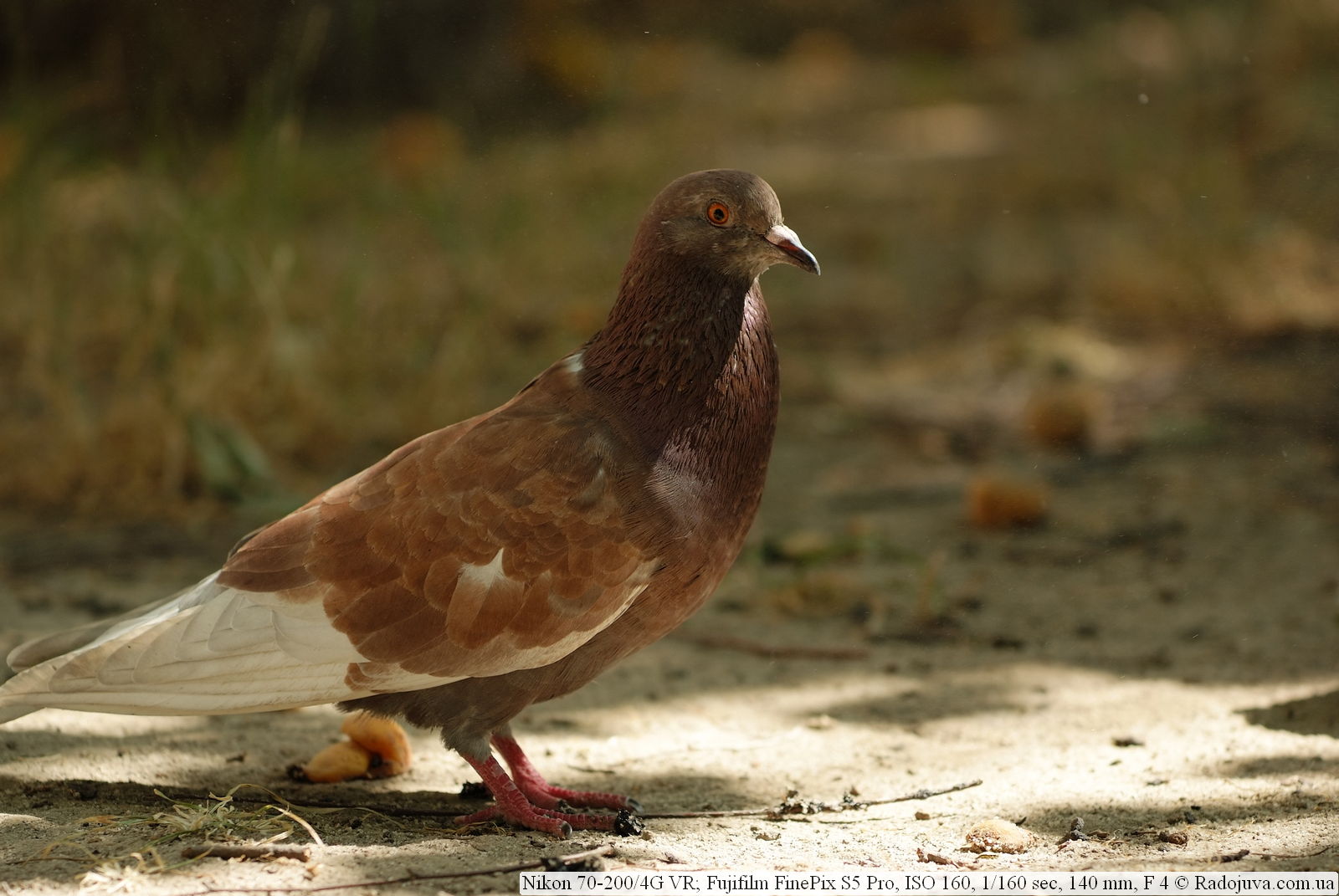





You can download the original RAW files from this link (80 files in .NEF and .RAF formats, 1100 MB). All photos are in-camera JPEG format. All photos were taken with a Nikon D700 and Fujifilm FinePix S5 Pro using a lens hood.

Dimensions Nikon N AF-S Nikkor 70-200mm 1:4G ED SWM VR IF Nano Crystal Coat and Nikon DX AF-S Nikkor 18-200mm 1:3.5-5.6G ED SWM VR IF Aspherical
My experience
I really liked the Nikon 70-200/4G , although it's difficult to surprise or delight me with high-quality optics. In short, the Nikon 70-200/4G is excellent!
For the price of the new Nikon 70-200mm/4G, you can easily buy the new Nikon ED AF Nikkor 80-200mm 1:2.8D MKIII , leaving many users scratching their heads over which lens to buy. On the one hand, the Nikon 70-200mm/4G has incredible image stabilization, a built-in motor, easy focusing, N-coating, and other goodies. On the other hand, the Nikon 80-200mm/2.8D MKIII is 1 stop brighter. Share your thoughts on which lens to choose in the comments.

Nikon N AF-S Nikkor 70-200mm 1: 4G ED SWM VR IF Nano Crystal Coat
All Original Similar Nikon FX Telephoto Lenses
Below is a list of all Nikon Nikkor telephoto lenses without high aperture and with auto focus support:
- Nikon AF Nikkor 70-210mm 1: 4, 1986-1987
- Nikon AF Nikkor 70-210mm 1:4-5.6, 1987-1993
- Nikon AF Nikkor 75-300mm 1:4.5-5.6, 1989-1998
- Nikon AF Nikkor 80-200mm 1:4.5-5.6D, 1991-1999
- Nikon AF Nikkor 70-210mm 1:4-5.6D, 1993-2000
- Nikon AF Micro Nikkor 70-180mm 1: 4.5-5.6D ED, 1997-2005
- Nikon AF Nikkor 75-240mm 1:4.5-5.6D, 1999-2000
- Nikon AF Nikkor 70-300mm 1:4-5.6D ED, 1998-2006
- Nikon AF Nikkor 70-300mm 1:4-5.6D, 1998-2006 (?)
- Nikon AF Nikkor 70-300mm 1:4-5.6G, from 2000 to 2014, black or silver
- Nikon AF S Nikkor 70-300mm 1:4.5-5.6G ED VR IF SWM, from 2006 to 2017
- Nikon AF S Nikkor 70-200mm 1: 4G ED SWM VR IF N Nano Crystal Coat, from 2012 to the present day
- Nikon AF-P Nikkor 70-300mm 1:4.5-5.6E VR ED, 2017 to present
The names of the lenses are indicated according to their spelling on the case.
The most similar modern lens is the Tokina VCM-S AT-X PRO SD 70-200 F4 (IF) FX N/AIS.
Comments on this post do not require registration. Anyone can leave a comment.
Enlightenment lens Nikon 70-200mm 1: 4G VR AF-S ED IF N
Conclusion
Nikon 70-200 / 4G is a great lens, almost perfect. The build quality, visuals and functioning are at a high level. Of the minor flaws, only the work in the backlight and the absence of a tripod foot in the delivery set are striking. In the end, I would like to separately note a very good image stabilizer and an excellent sharp picture.
Have you read the review of this lens to the end or looked at examples of photos? Then be sure to share this information on social networks.
This material was prepared by Arkady Shapoval . The greatest support for the site is if you use links on this site, such as Amazon , when purchasing anything . It costs you nothing, but for this site, and therefore for my family, it's the main source of support.
What are you, I never dragged a barrel on Arkasha, the young one is simply, categorical ... My eldest son is almost like that ...
Photo to the studio. Well, at least one of your masterpieces from any D-eshechki :)
I just want to understand what level you are professional :)
Come on ... Show me yours, I'll give you mine ... Okay ???
Keep quiet about something ... Looks like there is nothing to show ...
I threw test pictures in reviews of 35-70, 70 -300VR ... Not lazy will see ...
Arkady, test Tamrons 24-70 and 70-200. On the D750, the Tamron 70-200 resolves 21 megapixels out of 24, just like the Nikkor AF-S 85mm f / 1.8G. Then tell me - why do I need these fixes ...;)
I compared Tamron 70-200 2.8 and Nikon 80-200 2.8, in ballroom dancing competitions, on the D610.
The light is bad, everyone is moving fast.
Tamron missed stable 2/3 shots. Nikon missed 1/10 shots.
So what's the use of all these laboratory permits?
I have not heard such reviews. The other day I will get 70-200 to my D750. I hope to successfully refute your statement. Since Tamron 24-70 in terms of focusing is simply magnificent. Unsubscribe in the same thread.
SW Passerby, theories are refuted or confirmed. We are talking about the test results, i.e. about the facts. It is impossible to refute them.
However, you really need to do something similar to find out, first of all for yourself, which lens is more suitable for you.
[+] [+] [+] Alexey DV
[+] fotika
finally. In defense of the camera, I’ll say that he was forced to spend 3 days, which means it’s self-defense
Dmitry K plus. Aleksey DV will deduce whoever you want :) He says that he is 47 years old, and according to all his comments you can see youthful maximalism, and the flickering of peep-peaks as someone already said here. It feels like he is 15 years old. Photo on Nikor 80-200mm MK3 focal 200, aperture 2.8
47 to me, he's over 50 and he's retired :)
Aleksey DV is probably like Benjamin Button :) He's got his youth at 50 now :) Oh, I envy him. Young, naughty, in the full dawn of strength, and it's all in 50 years !!! God grant that everyone has fun at 50.
Thank you for your kind words, friends ... Do not be offended if you said something wrong ...
Another photo on Nikor 80-200mm MK3 focal 200 (300mm including crop), aperture 2.8 carcass as in the previous photo D300s
Another photo on Nikor 80-200mm MK3 focal length 200 (300mm including crop), aperture 2.8 carcass D300s / s-male, alpha-male :)
Also focal 200, but already Nikkor 70-200 F4 on the carcass D7100 (exterminator of Alfazamets). Blurring the background in my opinion is not worse, but how are you ????
Another photo on Nikor 80-200mm MK3 focal length 200 (300mm including crop), aperture 2.8 D300s carcass and the same magic bokeh that I like in high-speed televisions, the background is simply blurred into slivers, and the object seems to be cut out of the background, that's why I I adored this lens, this is the thing for the portrait, unlike poltiynikov, and 85ok which, together with the background, blur the ears and do not cut the object from the background.
Really good blur, but the 70-200 at F5,6 is probably not all that bad either. By the way, on the carcass ... Nikon D100 (which by color simply wipes the lower part of its carcass on the alphasamts) .. Did you like it?
And also a beautiful bokeh at 200 mm f2.8 D300s, my opinion is that the lens from the review is good, but on f4 it will not be able to give such a creamy bokeh as on f2.8. I mean that the bokeh on f4 does not blur the background enough, and the details on the background distract from the main subject. After all, this is a telephoto, not a reporter, his vocation to take portraits on the fly, the pictures of Arkady in the review are wonderful, but on f4 in the background distracting undeveloped people and stuff, from the main rider in the frame. My opinion is there is money-f2.8 VR2, there is no money-f2.8D MKIII. With f4, it will always seem to you that you have not got enough, and one way or another you will have to sell f4 and transfer to 2.8, and this is an extra waste of money in our already not rich life. This one is from a number: to have a girl with 2 breast sizes, and dream of a chic beauty with 5th size. Take the best right away to later think not about something better, but only about shooting and composition.
agree
But I doubt it, however…. The truth is not 300s some thread overgrown with moss, but a decent D7100 (in normal hands), the focal length is not even 200, but only 120, hole F4. Bad background blur?
Lens: Nikor 80-200mm MK3.
Focal: 200 mm. Aperture: f2.8 Camera: D300s
Televisions, unlike the 85-s and 50-s, drive into the background very little space, due to which there are less distracting details against the background, this is perfect for portraits, the viewer's attention will definitely not run into the background :)
In this frame, there would be x ... on the top left of the newlyweds with a flash on the take-off - Such a frame would be !!
It's a paradox, but having a Nikor 80-200mm MK3 lens for a whole year, I always shot with it only at 2.8 !!! And when I tried a fast telephoto lens, my Nikkor 50mm f1.4G sits tightly on the shelf up until the days when I gave up commercial photography and sold the telephoto lens. Only then did he put on a poltykiyik again, and realized that after the telephoto 50 and 85, this was not at all the same. Maybe this is my personal opinion, but I think that the combination of focal ranges in the region of 14-24mm and 70-200mm is divine, and everything that is in the region of 24-85mm is dull ... giving a mediocre picture. Yes, I do not argue that a frame can be extended by 50mm due to good expensive props, due to a naked girl, due to large breasts, due to makeup, correct light, composition, but whatever one may say, frames from super shirikov and telephoto cameras are monumental and divine after you have pressed the shutter button, with these lenses you still have a “masterpiece” button on the camera, and you forget what processing is in general.
Again, I agree, everything that is close to the angle of view of the eyes of people is simply tired, each has 2 fifty dollars under the eyebrows :)
I consider it my duty to apologize to Trehsotkovich. There was a sin; - I suspected him of being bad ... But what about big tits - he said, so immediately ... like a stone fell from the soul! Our person. It is necessary to shoot this only on Samyang 14mm F2.8 in focus on a full frame, and 70-200 here seem to be not very ... Dear!
Thanks to Trehsotkovich for 2,8, and Arkady and Fotik - f4 impressed. According to my needs, the principle turns out to be both necessary (heavy sigh). I will remain a cap for the obvious - glasses are for different tasks and each is beautiful in its own way ...
Actually, I was planning to take an 80-200mm MK4, but after an unsuccessful purchase of a used 17-35 and stories about whistling and dying motors ... It's a pity - by eye the 80-200mm MK4 still resembles this f4 from the review in sharpness ...
Star boring. Choose Igor first of all with a wallet. So I was guided by this when I took Nikon 80-200mm f2.8 MK3 for 25.000 rubles. I took the BU but in a chic condition, actively used it for a year, and sold it to the next user. I did not notice any whistling of the motor, but maybe because I am a very accurate user, after each shooting I remove the dust from the lenses with a brush, I never wear a protective filter, but I always wear a hood. As soon as I finished shooting, I put everything in a photo backpack and put on all the covers, both back and front, but I saw a lot of photographers who throw a lens into a backpack without covering it with either a front or back cover, and there is always dust in the backpack, that's it and then the motor may whistle and all that follows. You just need to be careful about the technique, and it will last a long time. She is not worth a penny in fact.
the wallet is the hardest, used prices are +/- the same :)
17-35 f / 2,8 (picture, f2,8, dying whistle) or 16-35 f / 4 (guaranteed sharpness, 3 stops on BP)
80-200 f / 2,8 mk3 (picture) or mk4 (picture + sharpness and whistle again)
And then there's this 70-200 f / 4 sweetie for letf and vaasche (sharpness, 4 stops on BP)
Now I don't understand at all about BP - before everything was simple for me - the brighter, the better, and now I don't even know, especially since I will take Df in Russia in the fall, and there it is transcendental ...
But as for me, the focal 200 eats up space, the picture turns out to be flat. For facial and half-length portraits, this is good, but for everything else ...
For example, the last photograph with a typewriter taken, say, at 50mm 1.4-1.8, would have looked more spatial and voluminous, IMHO I repeat.
MeD, in your own way, you are 100% right, which means your focal length is 50mm. Photographers are all different. Someone, for example, generally likes to take a facial portrait on Fish-eye, well, do not fight with him because of this, and do not be rude as some here do. To each his own. I also only expressed my point of view on the account of televisions, and on account of f4. Although f4 from this review I did not have. I had only Nikon 80-200mm f2.8 MK3 and I really liked him. Perhaps taking off this new f4 from the review, I would also like something about it. In general, all Nikon brand lenses are wonderful, but each is remarkable in its own way, each has its pros and cons. And it’s wonderful that now in the 21st century, with the help of such resources as Radozhiva, you can exchange your good and bad experience regarding different techniques. So to say, before buying, know what it is cool and what are the disadvantages.
In my opinion, focal lengths from 50 to 135 are good for a facial portrait. Longer ones give the effect of a flat face, and shorter ones, on the contrary. ... And some people even go with such a "bulging" face; - the peoples of the Far North and Alaska are very fond of such effects ...
I do not agree with Trekhsotkovich about UG at 24-85, but I will support 2,8 versus 4, because I myself prefer 105mm 2,8, while I would like and want 70-85mm but f4.
Hi Yarkiy, I don’t make you agree so to speak :) I just voiced what I think about this. What I like does not have to please the whole world. We are all so different. The lens, it's like clothes, XXL suits me, but to someone L, well, now don’t kill everyone who doesn’t want to go to XXL in a hoodie :) That's the forum, so that everyone expresses their opinion if everyone like me he painted in detail WHAT he likes the TV set, and for what, and would have attached it from a photograph, it would have been much easier to judge a particular lens. And here there are only disputes sometimes, instead of constructive and objective evidence of their opinions. Photos taken on this lens show especially awesomeness of the lens, here you showed your photos, I really liked them, especially the last ones that you threw a link to Lynx recently. If you, for example, said that you took all those photos on the lens, for example, 24-70mm f2.8, then I would agree that this glass is beyond praise, and I would be imbued with respect for it. Here's how to prove the coolness of a glass. Sometimes a good photograph speaks of the lens for more than 1000 words.
Arkady, good afternoon! Tell me, pliz (you have experience)! In terms of color rendition and sharpness, how much does this lens differ from 70-300 (we are not talking about aperture ratio). The question is simply in finance! Thanks!
Tamron AF 70-300mm f / 4-5.6 Di VC USD
MeD, although I am not Arkady, I will add my own 5 kopecks. Specified by you Tamron g..vno rare cut. It focuses quickly, but almost always by, chromatite always and everywhere, the stabilizer gives out its presence only with a squeak, and does not affect the quality of photos at all ... If we compare it with a lens of 70-300 class, then only with a native one, the one that is VR
Strange, all reviewers speak well of him. But I will not argue, I did not use it myself.
Perhaps there is also a variation in the quality of specific specimens, but I came across a frankly weak lens. Even in comparison with the old Nikkor 70-300mm 1: 4-5.6G this Tampon could only disappoint. Old man Nikon, though not very fast, but very accurately aims, in contrast to the discussed lens, which instantly focused ... into milk. And it also happened and sighted and suddenly let's crawl back and forth from infinity to MDF.
PS I used both glasses on the D7000 and D90.
PPS The person who bought my subject was very pleased (in conjunction with the D800)
Many glasses open on FF, perhaps this. Well, thanks for the tip, I thought about taking such a glass, but I'll think about it for now, because I'm sitting on the crop.
Well, something about the fixes you bent ... his amateur nikkor af-s 85. 1.8g will tear like a rag in detail, sharpness and drawing - that's just the autofocus speed ...
Also interested in comparing two lenses; - 85 1.4G and 70-200 F4 on one carcass, one plot at the same time. So on the F4 we had to look for the difference very, very scrupulously, with a microscope…. As for the clarity of the picture, the majority of votes preferred 85. And well deserved! But!!! This is when photographing with a tripod…. but "from hand" 70-200 F4 as you have deigned to express "tears like Tuzik a rag" not only 85-ku, but also a number of fixes without a stub, if the shutter speed is not shorter than 1/400. The stab is really good. I liked the comparison of 70-200 F4 and 70-200 F2.8 more. Amazing glass; - at 2.8 the clarity of the picture is about the same as that of the other at F4 !!! But I prefer the one that is smaller, lighter, more comfortable ... cheaper ...
To fix
"There is a 'VR ON / OFF' button on the lens to turn on / off the stabilizer"
- again - switch :)
fixed.
Arkady, good day!
I have long been waiting for a review of the 70-200 lens on this site. Cooperation Arkady and Fotika cheers and Thank you.
Arkady, I would still like to hear an opinion about this lens in terms of optical characteristics, usability compared to 70-300 vr, 80-200 (III), 70-200 2.8.
If possible, please add information to the main text of the review, so the review will be more informative and the information in the comment feed will not be lost.
Arkady, I'm still interested in answering my question. The question is not idle because I am the owner of 70-300 vr, and although the lens for today is completely satisfied, sometimes thoughts about a possible replacement flash.
All this is in the reviews. Read
I would not ask if it were in the reviews. Specifically, there is no comparison in this review. A cursory mention that 80-200 per stop is not lighter for comparison.
there is no direct comparison, there is as much data for your own comparison.
I could tell my opinion about the lenses. If you have experience of use and have something to say.
And it would be better not to answer ... Honestly. With the same success, you can send to study performance characteristics.
study TTX.
Your question is initially incorrect.
The question is too voluminous to be answered and answered like this.
Of course the question is not cheap.
But you have experience using these lenses, so I’m sure that there is something to say. Once again, I would like to hear an opinion, I do not count on absolute truth.
Perhaps, if there is strength and desire, it is worth making an article-comparison about autofocus telephones Nikon (something like articles about portraiture and about fifty dollars).
If everyone is happy with 70-300, then use it and enjoy the result. Arkady is right; - it is very difficult to compare because of the many parameters and nuances in working with lenses. Took Nikkor AF-S 70-200mm f / 2.8 G ED VR II (FX) from a friend for comparison with my Nikkor AF-S 70-200mm f / 4 G ED VR, took paired shots (maybe even saved somewhere in the archive) and I can say with confidence that even in the open, the 70-200 F2.8 is exceptionally sharp, light, with excellent color rendering, excellent stub, deserves admiration for the picture quality. Nikkor AF-S 70-200mm f / 4 loses very little to it in resolution and in that there is no hole 2.8 but ... it is MUCH Lighter, smaller in size, faster in focusing. In the Nikkor AF-S 70-200mm f / 4 reportage it will do almost everywhere and without flaws. If the situation allows you to take your time, then the Nikkor AF-S 70-200mm f / 2.8 G ED VR II will be just SUPER, if ... you ignore the price. As for 70-30 vr, of course it loses to the aforementioned Nikkoras both in design, aperture ratio, stabilizer, and in resolution (especially at the long end). But with good quality, the price is acceptable for an amateur! You always want the best ...! Only now you drew attention to the fact that Arkady has quite a lot of beautiful photos, and the lenses and carcasses are very different; - ranging from "ancient" and to expensive super new products. Apparently, a lot is decided by the unusualness of the plot, composition, perspective, light, mood, fantasy in the frame and much more, which creates its attractiveness, and the glass and the carcass are essentially secondary.
Thank you, as always interesting!
TO FIX
on its body, the lens has a special place for installing a tripod cap. Sorry foot
Please advise, for shooting birds and other fast-running wildlife on a sharp crop camera (most likely D7100) it is better to take this lens or an older and heavier, but also lighter Nikon AF-S VR Zoom-Nikkor 70-200mm f / 2.8G IF-ED?
Thank you.
There he is, with a gun.
Serious gun :) And in this nature of the birds still need to search
You will be surprised, as I was in my time, it turns out that in this area and even a little further south, almost in the desert, in the drying up river beds and streams, there are more bird species than in any other place on the planet. This has to do with seasonal migrations and something else that I don't know. It is here that their "routes" are migratory, so in addition to local birds, foreigners also drop in, who just stay and relax, and who and bring offspring. Something like that.
Surprised - it's a fact :)
two hundred is not enough.
“Out of poverty”, at the beginning you can take 70-300, but in general you need something like a light three hundred, plus a good 1,5x or 2x converter in addition.
judging by the reviews, Nikon AF-S VR Zoom-Nikkor 70-200mm f / 2.8G IF-ED has a design flaw - focus shift. the problem is irreparable because it is inherent in the design of the lens.
When buying this lens, consider this feature and how to get around it. The problem has been discussed in forums since 2010))).
it is possible that it was less noticeable on the D700, but on modern FF it is easy to determine.
Actually, for birds, 200 mm will not be enough. Sometimes 300mm is not enough. One friend generally walks with a 600mm fix. Purposefully living creatures in nature removes.
Well, the birds, respectively.
And here's another.
good!
I shot all this season at 300/4 (without AF-S which) for a full 12MP frame.
Switching to a more modern crop will give me the same EGF of 200, but with the convenience of a zoom. And probably with a large aperture of 2.8
Or go to 300/4 AF-S (the focus speed of the previous upset)?
I definitely won’t carry around for weeks with 500-600 mm. And they cost in space, but my idea is not monetized.
So, colleagues:
lightweight 70-200 / 4
light 70-200 / 2,8
or fix 300/4
?
No, dear, you ask difficult questions, and the financial component is not easy. 70-200 2.8 is the same professional for a lot of money, plus versatility compared to 300 mm fix. 70-200 4, this is a budget option of excellent quality. And 300 mm is just an old screwdriver fix, not cheap, by the way.
If you do not often use focal lengths from 70 to 200, then it may make sense to take 300 mm, but you need to look for just that, because the older three hundred are inferior to it optically and do not have autofocus. Although screwdriver autofocus for liveliness, it’s still a pleasure.
Perhaps 70-200 f4 plus 2x tele-converter, the best option for money, quality, speed and convenience.
In the secondary market of zooms 70-200, options 2.8 (MK3 of 2002) and 4 (2012) are comparable.
Which one is sharper in the center and focuses faster? Really F4!?
- At the cost of the new Nikon 70-200 / 4G, you can easily buy the new Nikon ED AF Nikkor 80-200mm 1: 2.8D MKIII, and many users will puzzle over which lens to purchase. On the one hand, the Nikon 70-200 / 4G has an amazing stabilizer, a built-in motor, convenient focusing, N-enlightenment and other goodies, on the other hand, the Nikon 80-200 / 2.8D MKIII is 1 stop lighter .-
I don't have birds - the pool with mermaids and 70-300 is very dark. This is where the question 70-200 / 4 vs 80-200 / 2.8 arises. They are in the same price and the aperture is important for me, but there is one important but - the D610 camera, how the motor works, I did not check all the SWM lenses with me, but all the time I often come across negative information.
Mermaids !!!
Let's start with the bad ones. Heavy lenses cannot be moved quickly. 80-200 is a good lens, but ... 2.8 is "working" on condition of portrait LARGE plan, where special permission is not needed. Long-range group plans will be 2.8 noticeably lower in quality. And then ... the group sex must still be put in the DOF; - also confusing. The point in 2.8 is already dubious. In reality, 80-200 is noticeably inferior to 70-200 in resolution at all focal lengths (at 200 only in the center it is a little better, but loses in the field; - for a full-frame carcass, this is important). The plots are dynamic; - stub 70-200 does NOT save. At the short end, 70-200 is still wider and very sharp, and this is an important detail ... Now about the good; - The D610 allows you to use ISO 3200 without problems, 6400 is sometimes not bad either. Taking into account the “nimble” and stable autofocus, the choice would have stopped in this case at 70-200f4 (with all the sympathy for the 80-200).
Arkady again does not mention the "scourge" of many Nikon lenses - the focus shift problem.
in the version on 2.8, the focus shift is a real problem; in 4 focus, the shift is still noticeable if desired, but due to the greater depth of field the problem is well masked.
I see evidence of focus shift: there may be a tiny touch at shorter subject distances but DOF will have it covered. On a related topic, faster lenses find it easier to focus accurately (shallower DOF and more light = easier focus differentiation) but are more prone to focus shift. Compared to the 70-200 F2.8VRII I think the new lens has a slight advantage because, though it is focussing at F4 and therefore with more DOF and less light, it is not subject to the more notable focus shift of the older lens between focusing aperture at F2.8 and shooting aperture when shooting at F4 or smaller.
When working with this lens, focus shift is the last thing you can gripe about :)
Yes, often everything is perfectly masked by a large DOF.
Arkady, the question is not about what to find fault with, but about the description of the lens features - is this the point of the review? if it is interesting to read only the laudatory, you can open Nikon's ad)))
many nikon lenses have design problems and, as a result, focus shift. before it was hardly noticeable due to 12MP, now it is noticeable at 24MP and 36MP.
if you don’t know what the problem is, you can search for a problem for a long, very long time why the AF worked poorly)))
although the problem is not with AF with a lens feature at all)
how did you get sick
If I want to, I can find any flaw on any lens :)
I don’t think so.
The focus focus problem is one of the most serious in the work of the pros.
it leads to problems with getting into focus and getting technical marriage.
you can correct the distortion, HA, talk about the picture, but if the focus didn’t get where the picture goes to the basket.
as a rule, in serious reviews they do a test for focus shift or at least indicate this feature.
preview, photozone, tests for photolife, camelab, etc.
don't mind if the lens costs $ 100. It's a shame when its price is $ 1500 or more with such a defect.
touches the situation when an amateur spends 1500 dollars or more on a lens and then in a simple test on a tripod sees a "creeping" focus)))
here with the preview. people saw a problem on version 2.8
focus shift is just due to the stopping down of the aperture. Also VR is off.
Did some more testing earlier around 100-130mm at closer focus distances, to quantify how much focus shift there is. Unfortunately it seems that even at 10m and under focus distances, there can be pretty noticeable focus shift. I think that the lens is pretty much unusable at these middle focal lengths at apertures other than f / 2.8, unless you can tolerate a good amount of focus error / front-focusing.
I just did some comparison testing with another copy of the lens .. and preliminary observations suggest that this might be normal behavior for the lens (eg this behavior is built into the design). In other words, there is noticeable focus shift from 100-160mm on stopping down the aperture, that gets worse with more distant subjects.
Ray, I appeal to you! Stop it ... then just mats.
Just a person has no one to talk to. But in another way he does not know how.