
Material on this lens was prepared especially for Radozhiva by Rodion Eshmakov.

Type of adapted lens.
The protagonist of this article is another lens that was never intended to be used for photography. This unnamed super-aperture 50/1.2 lens was designed for use in binocular night vision devices with 1st generation image intensifier tubes, designed to operate in passive (that is, without IR illumination) mode: this is also indicated by the name of the device. TVNE-4 - Tank driver-gunner device for natural lighting, the fourth model of the device. They are equipped with Soviet and Ukrainian tanks and infantry fighting vehicles.

Appearance of TVNE-4B.
The letters B or PA indicate the presence or absence of a built-in power supply within the instrument's body. Each instrument is equipped with two objectives and two B-2 image intensifier tubes with eyepieces, creating a stereoscopic image.

Device device TVNE-4B from the instruction manual. The numbers indicate: 1 - image intensifier tube V-2, 2 - middle body, 3 - shutter with a drive, 4 - body with an image intensifier tube, 5 - power supply, 6 - image intensifier cap, 7 - mirror prism, 8 - lens, 9 - mirror prism , 10 – eyepiece, 11 – image intensifier connector, 12 – image intensifier tube screen.
The manufacturer of this device, as well as the TVNO-2B NVD, whose lens was previously reviewed , is the Izyum Instrument-Making Plant ( Izyum, Ukraine ). This same plant also produced a number of 16KP and 35KP film projection lenses in the USSR.
Technical specifications
Optical design - 9 lenses in 4 groups, "Sonnar";

The proposed optical design of the TVNE-4B lens
Focal length - 50 mm;
Relative hole - F / 1.2;
Estimated field of view angle - 36° (on image intensifier V-2/V-2K);
Covered format - 36×24 mm;
Rear focal line - ~ 4 mm;
Aperture - 15 petals, one of the petals with a protrusion that allows you to completely block the pupil of the lens;
Features - it does not have a focusing mechanism, due to the dimensions of the body and the size of the rear focal length, installation on most cameras is difficult or impossible at all.
Lens construction and adaptation
The lens is a lens block made in a heavy brass body. From the controls - a diaphragm ring with teeth for the drive gear (adjustment is carried out by turning the lever on the device body). The diaphragm itself has an interesting feature - one of its petals differs in shape by the presence of a protrusion that allows you to completely block the pupil of the lens. Disassembly of the lens block for maintenance is possible only from the nose, and the front lens protrudes strongly beyond the nose - you need to be very careful when handling the lens so as not to damage it. I had two lens blocks, below are photos of the lenses in their factory form.


I kept only one of them for experimentation, and the second one was purchased by an American enthusiast, who informed me about the successful installation of the lens on a Sony camera using an additional negative lens in front. But such an alteration is not our option, of course.
The main difficulty when installing the lens unit on a camera is its very short back focal distance, approximately 4 mm. This means the rear of the lens must be in close proximity to the camera's sensor, which is typically surrounded by the shutter mechanism, the mount electronics, and the lens hood. Fortunately, this distance is already sufficient to maintain the ability to use a mechanical shutter (which was unacceptable with a similar, shorter -focus lens from LZOS). However, the diameter of the rear part is still so large that even full-frame Sony cameras cannot mount the lens without modification.
Excess metal around the rear lens group was ground off so that the lens block in one position could move forward in the camera mount to achieve infinity focus. Thus, the strength of the body is preserved, but, moreover, a focusing mechanism with a strictly translational movement of the lens block is required. Another nuance is that the lens can be removed from the camera only when the rear group of lenses has left the sensor shaft (i.e., when focusing at ~1 m). Finally, the third feature - due to the presence of a rectangular matrix shaft, behind which the camera shutter is located, the working area of \uXNUMXb\uXNUMXbthe rear lens is limited, which leads to pronounced irreparable geometric vignetting when focusing at infinity.
Another modification touched the diaphragm: the protrusion of the aperture blade was cut off to ensure the correct shape of the lens pupil. Below are photos of the lens block prepared for installation on the camera.


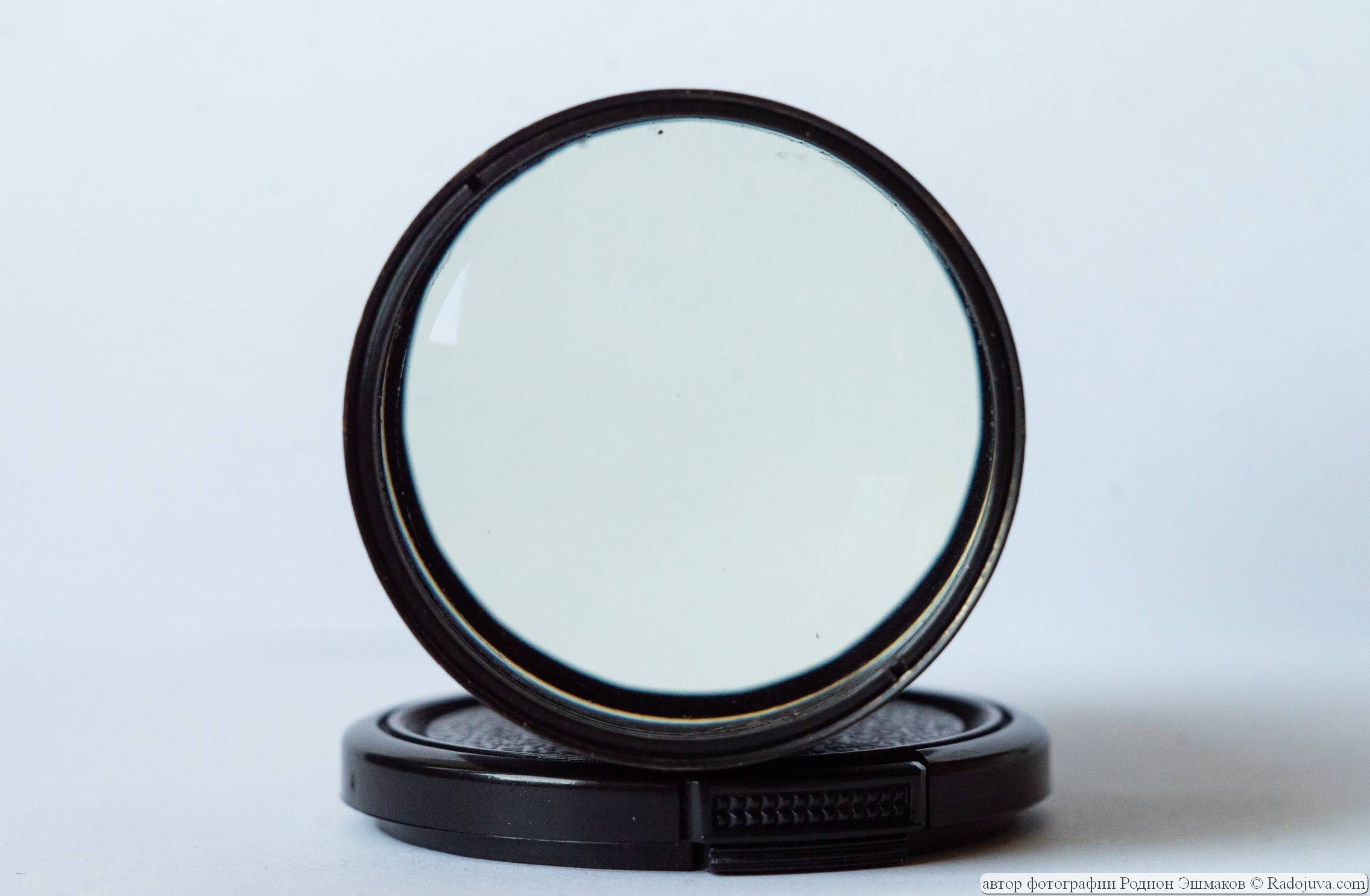


In the course of work, I accidentally damaged the rear lens, but, fortunately, this place is not actually involved in the formation of the image in a large range of distances in my version of adaptation (it is cut off by a frame around the matrix).

To install on a Sony A7s camera, it was necessary to grind the frame of the rear lens group in a special way.
The Chinese macrohelicoid M42-M42 12-19 mm was chosen as the focusing mechanism. Options with M39 thread disappear due to a mismatch between the inner diameter of the mounting thread and the diameter of the back of the lens block. When connecting the helicoid to the camera through a thin M42-NEX ring, it was possible to achieve focusing at infinity.
Further, in order to protect the front lens from damage, a new nose piece was made with a protective edge, combined with a 49 mm thread for filters. After assembly, the lens looked like this:


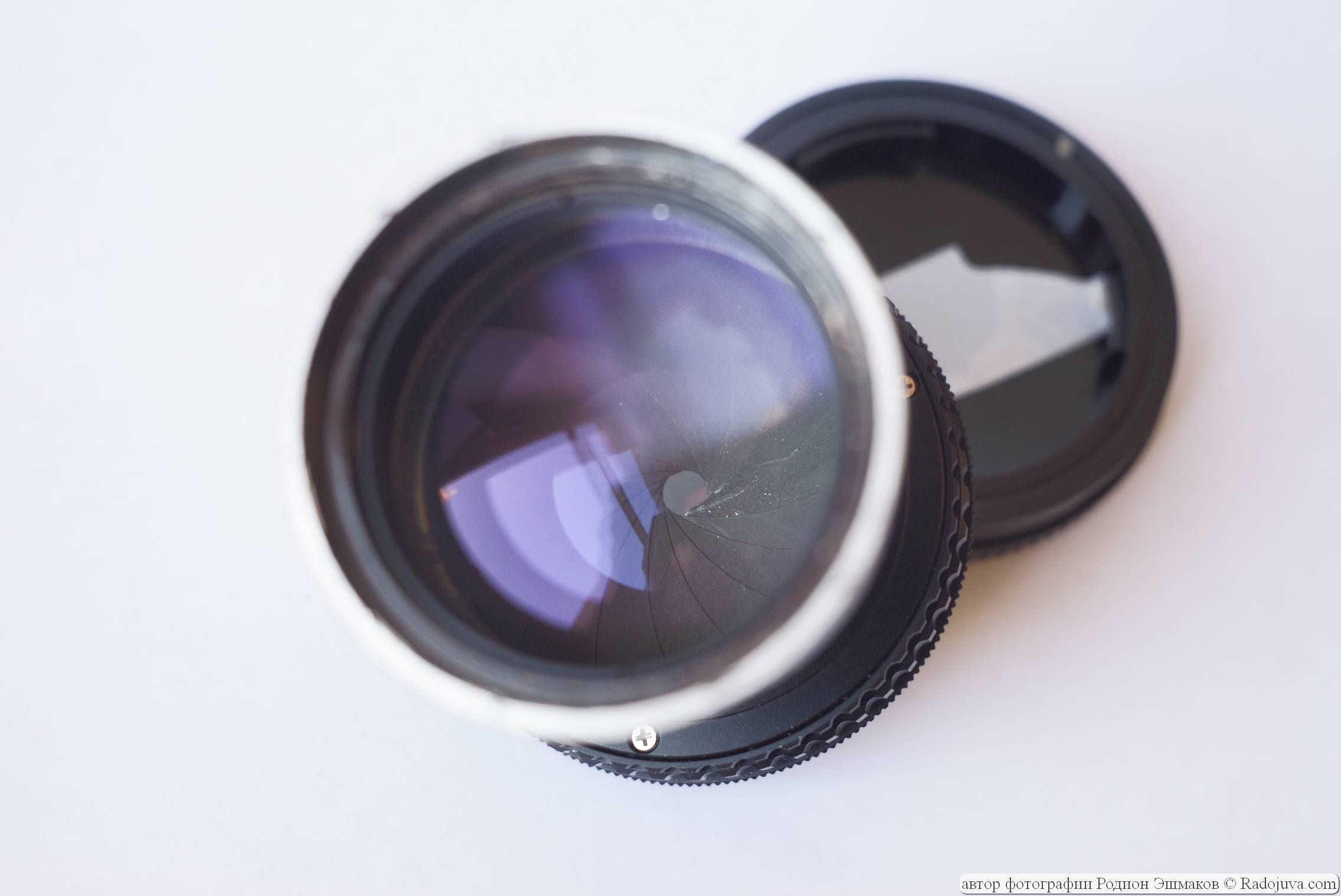


It is worth noting that the dimensions are comparable to those of the ultra-fast modern shooting analogue 7artisans 50/1.1 – the creators of this lens were also inspired by the famous design of L. Bertele.
The photographs also show that the lens slightly distorts color through the lens (even in comparison with some ordinary old photo optics): this, apparently, is the key feature of optics for passive night vision devices that use not only IR, but also the visible range. The light transmission profile confirms the observations: the spectrum appears to be perfectly flat up to the blue-violet region, where the light transmission is reduced. For this reason, a slight yellowness is still present. This time, the experimental conditions were simplified, so the light transmission coefficient of the system was not determined.

The light transmission profile of the TVNE-4B lens ranges from soft UV to near IR.
Of course, this type of anti-reflective coating simplifies the use of the lens for photography, since you won't have to limit your choice of light sources, resort to complex color correction, and other tricks that are necessary when working with real IR optics in the visible range.
Despite certain difficulties associated with the back focal length, this lens has been fully adapted for use with Sony full-frame cameras (compatibility with other camera systems remains to be seen). The process is greatly simplified by the presence of a factory iris diaphragm. It's also very good that the mechanical shutter remains safe to use, preventing flickering artifacts and other issues.
Optical properties
Unlike LZOS 37 / 1.0, this 50 / 1.2 lens is already capable of working with a full-frame matrix, having almost no problems with vignetting at close distances, but definitely requiring 4:3 cropping at infinity.
The level of aberrations, especially spherochromatic ones, was noticeably higher for the Izyum lens than for the Lytkar lens. Most likely, this is due to the fact that the 37 / 1.0 lens uses a more advanced nine-lens scheme - the addition of 3 more parameters contributes to better correction of spherical aberration, and along with it, longitudinal chromatism. At an open aperture, the lens forms a rather soft picture with pronounced chromatism in its most indecent form - blue-orange. With aperture up to F / 1.4, the situation improves noticeably, at F / 2 there are no problems with image quality in the central region of the frame. Field aberrations return to normal on a full frame only to F / 8-F / 11. In general, the image quality is close to 7artisans 50 / 1.1, however, it is noticeably sharper in the center and does not chromate so much.
Image contrast under normal lighting conditions is quite good and often doesn't even require correction. Color distortion is barely noticeable—the camera's automatic white balance adjustment usually handles it well.
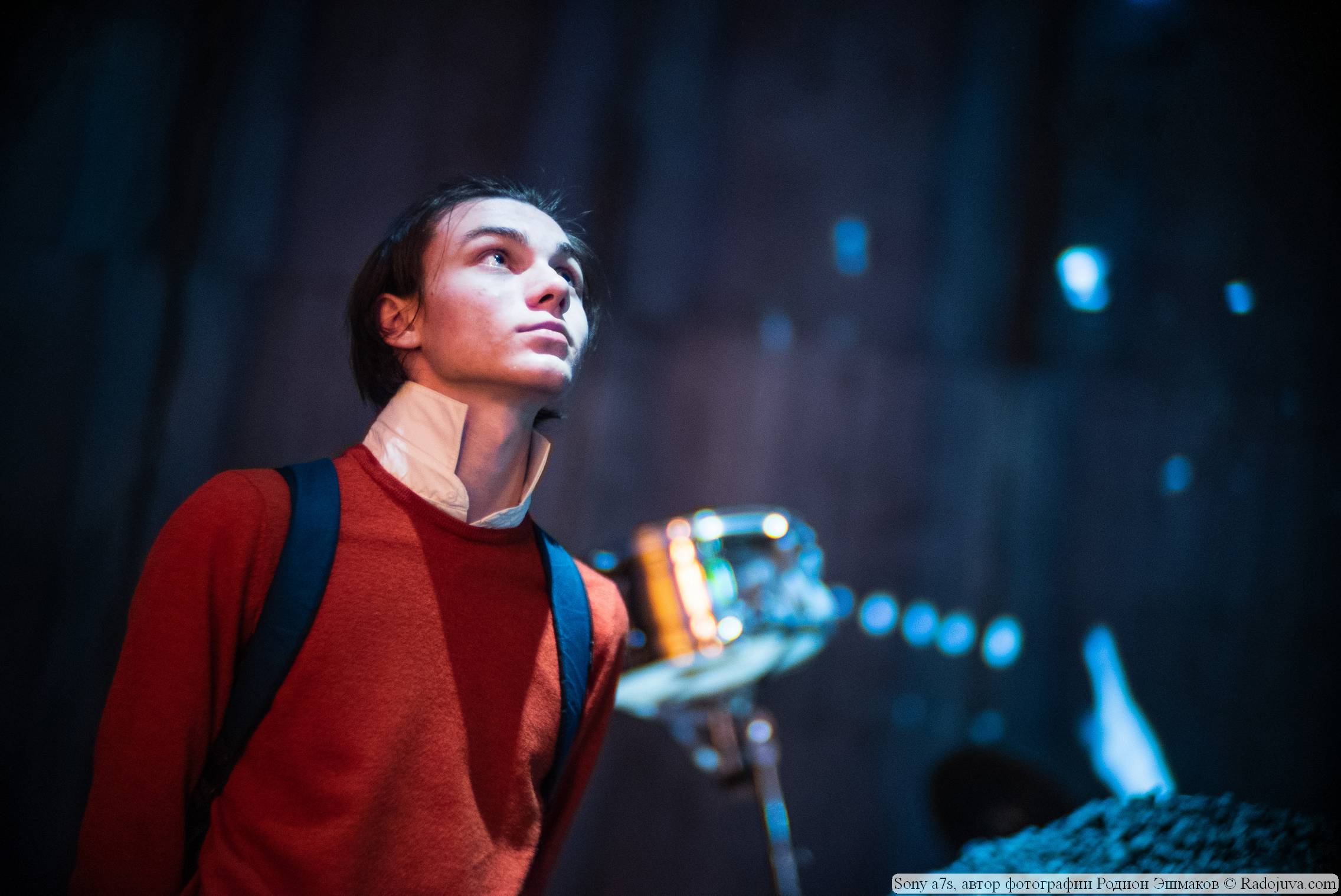
The TVNE-4B lens's bokeh is magical, there's no other way to describe it. It's reminiscent of the 7artisans 50/1.1 and Jupiter-3 , but due to its lower coma, it's noticeably softer and smoother at times—no "scale" effect. Chromatic aberrations cause the discs to have an orange (out of focus) or blue (in focus) fringing.
In general, the picture from the TVNE-4B lens is extremely interesting, but serious problems with chromatism and insufficient sharpness at an open aperture impose certain limitations. In my opinion, this optical scheme is very promising and, after some modifications, can be successfully used to create interesting portrait lenses.
The following are sample photos on the Sony A7s taken in full frame.




Conclusions
The third military Sonnar (the previous two were 1 , 2 ) has been given a civilian life and has once again demonstrated the value of its remarkable optical design, which is used by a variety of high-aperture lenses with an interesting pattern.
I was so impressed by the capabilities of these lenses that just a week before the nightmare began , I spoke with representatives of the Izyum Instrument-Making Plant, telling them about the potential for peaceful photographic applications of some of their lenses. Perhaps we'll be able to return to this dialogue someday; I hope for the best.
You can find more reviews from Radozhiva readers here . All of Rodion's reviews in one place here.

Interesting work, the picture is good, thanks, Rodion.
Rodion, thanks for your work - wonderful work! I liked the picture.
Most likely, this lens in a simplified version without a diaphragm was also installed in the night vision devices (monoculars) PN-3A “Promin” manufactured by IPZ. But this is inaccurate - I did not find any documentation, the conclusion is purely from the geometric parameters of the lens and its appearance.
PN-1 manufactured by IPZ use simpler optics, for the time being I’m clarifying.
Rodion. Thank you. I have already tested one of your lenses. Satisfied with the artistry. Here is the glass 50 mm F / 1.5, the lens of the tank night vision device TVNO-2B, adapted for mirrorless cameras
I would be very interested to see photos from the 77/2 periscope that I made for you. Unfortunately, I didn’t take a single normal shot of them, and I wouldn’t have done it in a month’s time. A semi-steb review of Glavuchtekhprom is already here, but no one has seen such a glavuchtechprom as yours)
Good. Spring photos will be taken...
After removing and examining the rear lens of the lens (I did not touch it at all during the first disassembly), I found out that it is gluing. Thus, this lens is also nine-lens, like Lytkarinsky, but the rear component is more complicated.
The geometry of the lenses in the last gluing is in question, the proposed version was given in the article.