Material specially prepared for Radozhiva by Rodion Eshmakov.
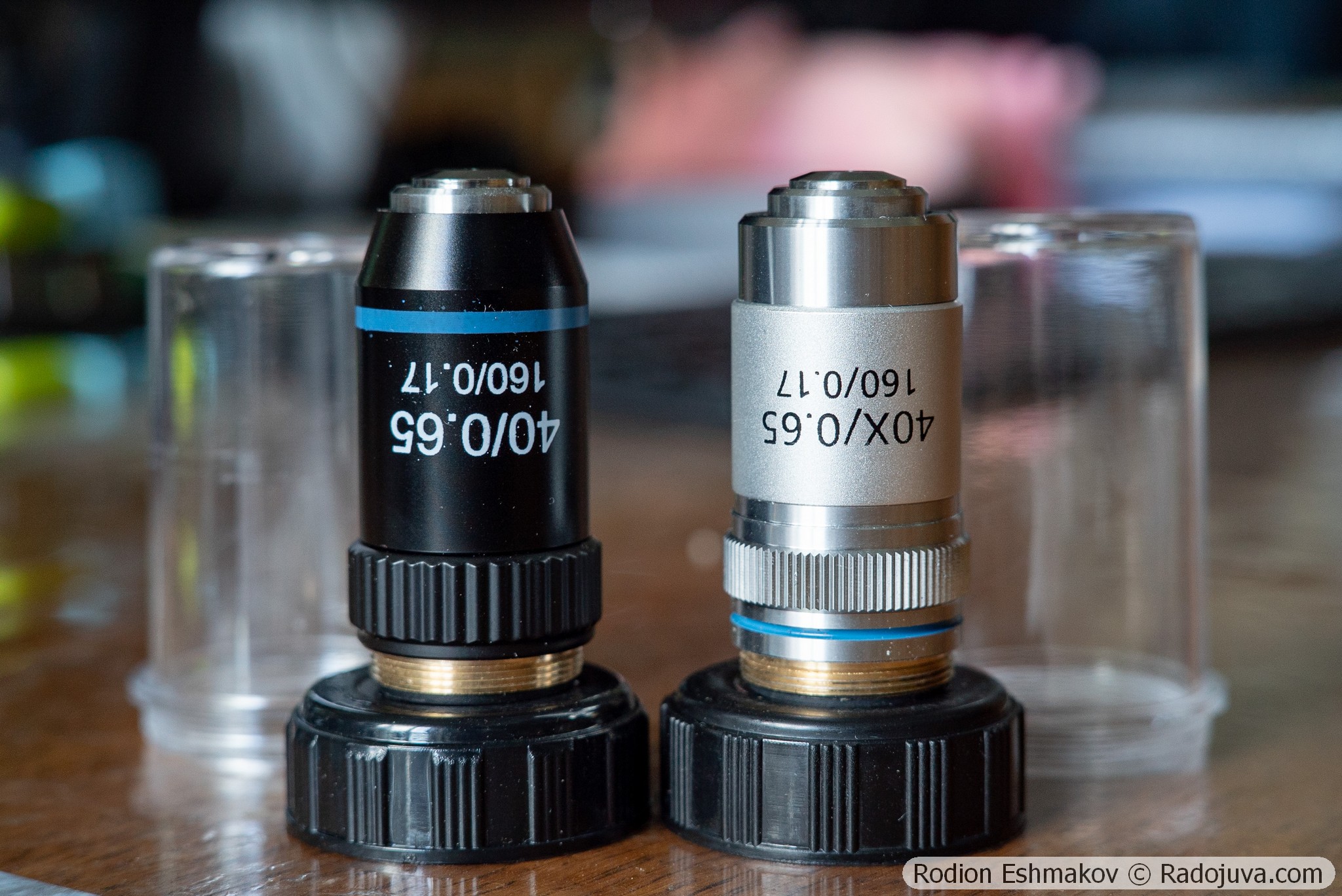
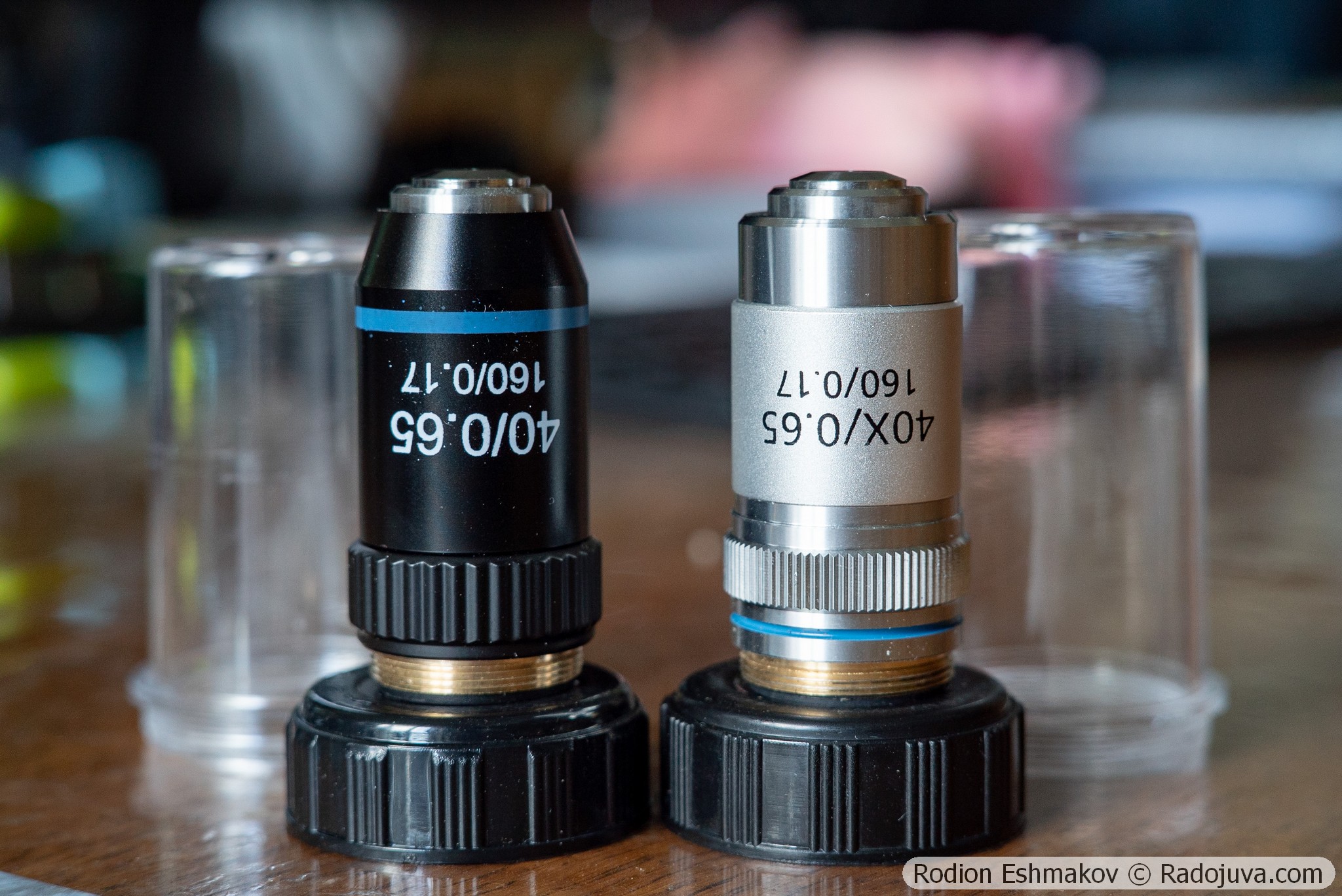
Chinese achromatic lenses 40/0.65 160/0.17 in two external design options.
This article is dedicated to the simplest and most affordable 40× achromatic objective lens for biological microscopes with a DIN-standard tube end distance (45 mm in length). This lens, in a wide variety of designs, under various brands and names, is installed as a standard lens on hundreds of thousands of modern, inexpensive educational and working microscopes. It can be purchased on AliExpress for approximately $5-10, making it the cheapest solution in its class. The website also offers reviews of other lenses in this series: 4/0.1 160/0.17 , 10/0.25 160/0.17 , 20/0.4 160/0.17 , and 100/1.25 160/0.17 Oil.
Technical specifications
Optical design – 5 lenses in 4 groups, high-aperture aplanat;
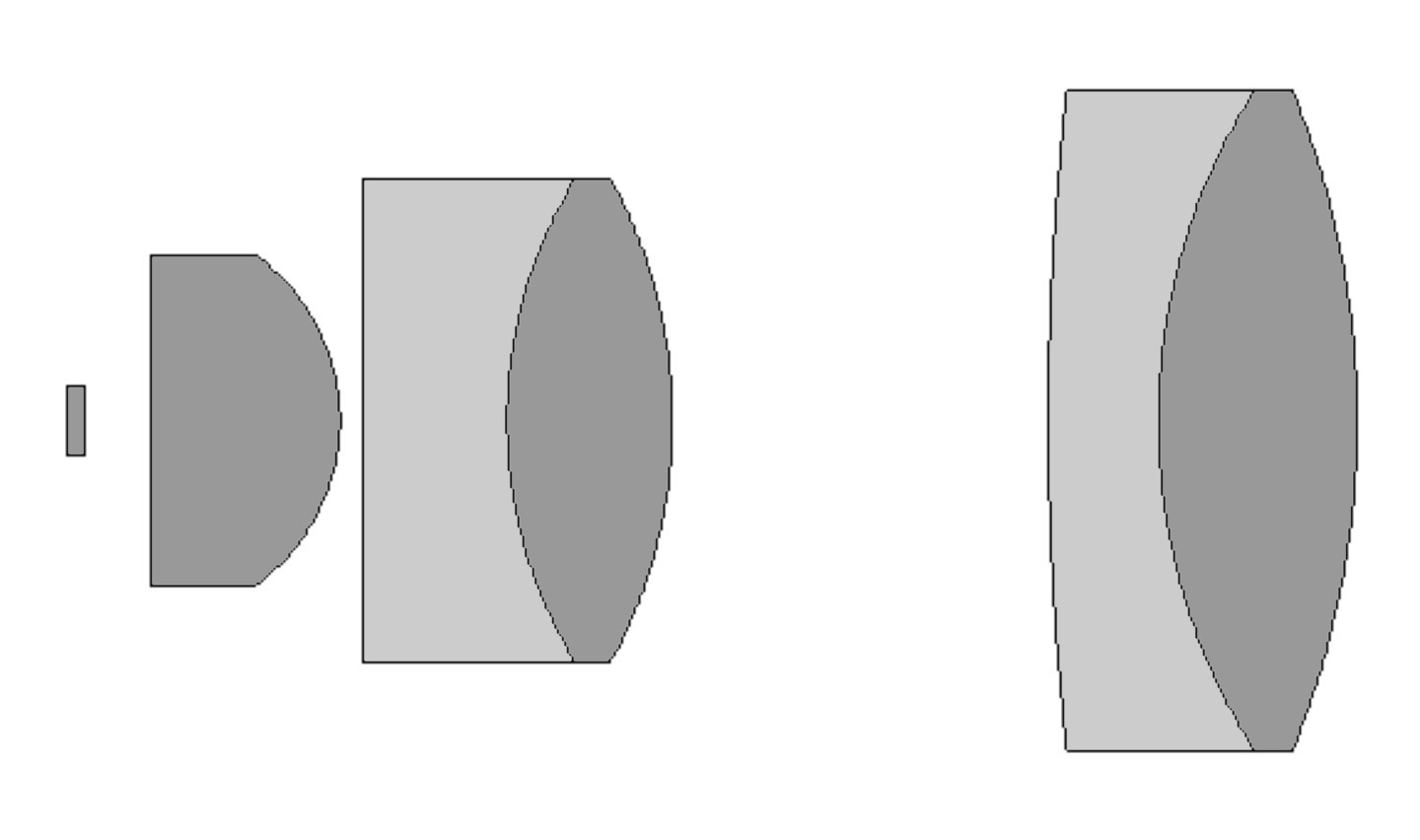
Drawing of the optical diagram of the achromatic objective 40/0.65 160/0.17.
Type of correction – achromat;
Tube distance – 160 mm;
Parfocal distance – 45 mm;
Magnification: 40×;
Numerical aperture – 0.65;
Working distance – 0.53 (to cover glass);
Cover glass thickness – 0.17 mm;
Lens block spring – yes;
Mounting type – RMS standard (4/5” × 1/36” thread);
Features - microscopic lens, does not have an iris diaphragm and a focusing mechanism.
Cost – ~$15 (can be purchased new) here, but not necessary).
Design and execution
This lens is mass-produced in China at numerous different factories in at least six different versions. A typical design uses a thin brass body with aluminum or even plastic decorative elements. The lens unit is spring-loaded to protect the specimen and the front lens element from collision during focusing—a very useful feature for a lens with such a short working distance (0.53 mm). One of the lens elements is centered during assembly through holes in the body—if the lens unit is disassembled for maintenance, centering must be performed manually.
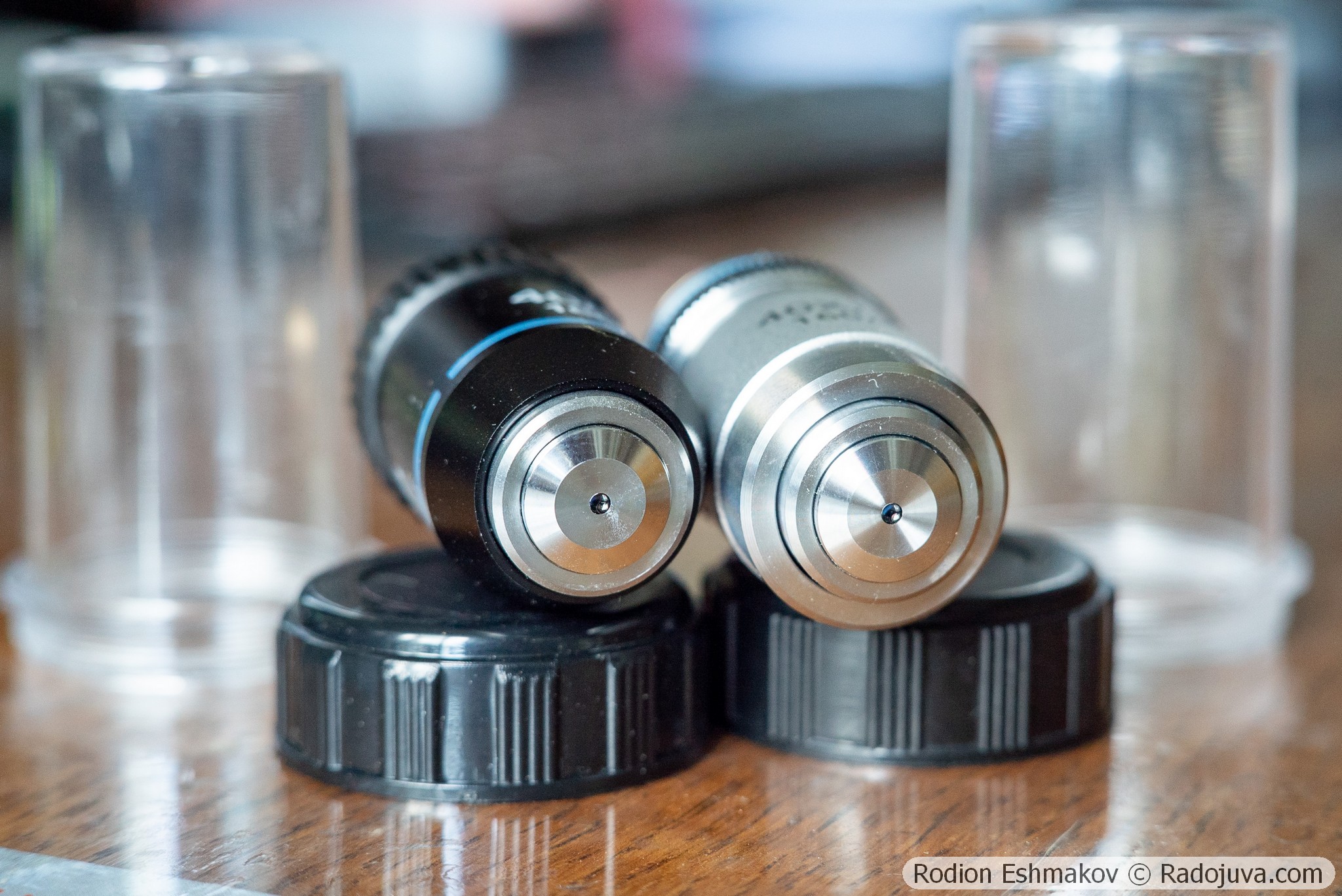
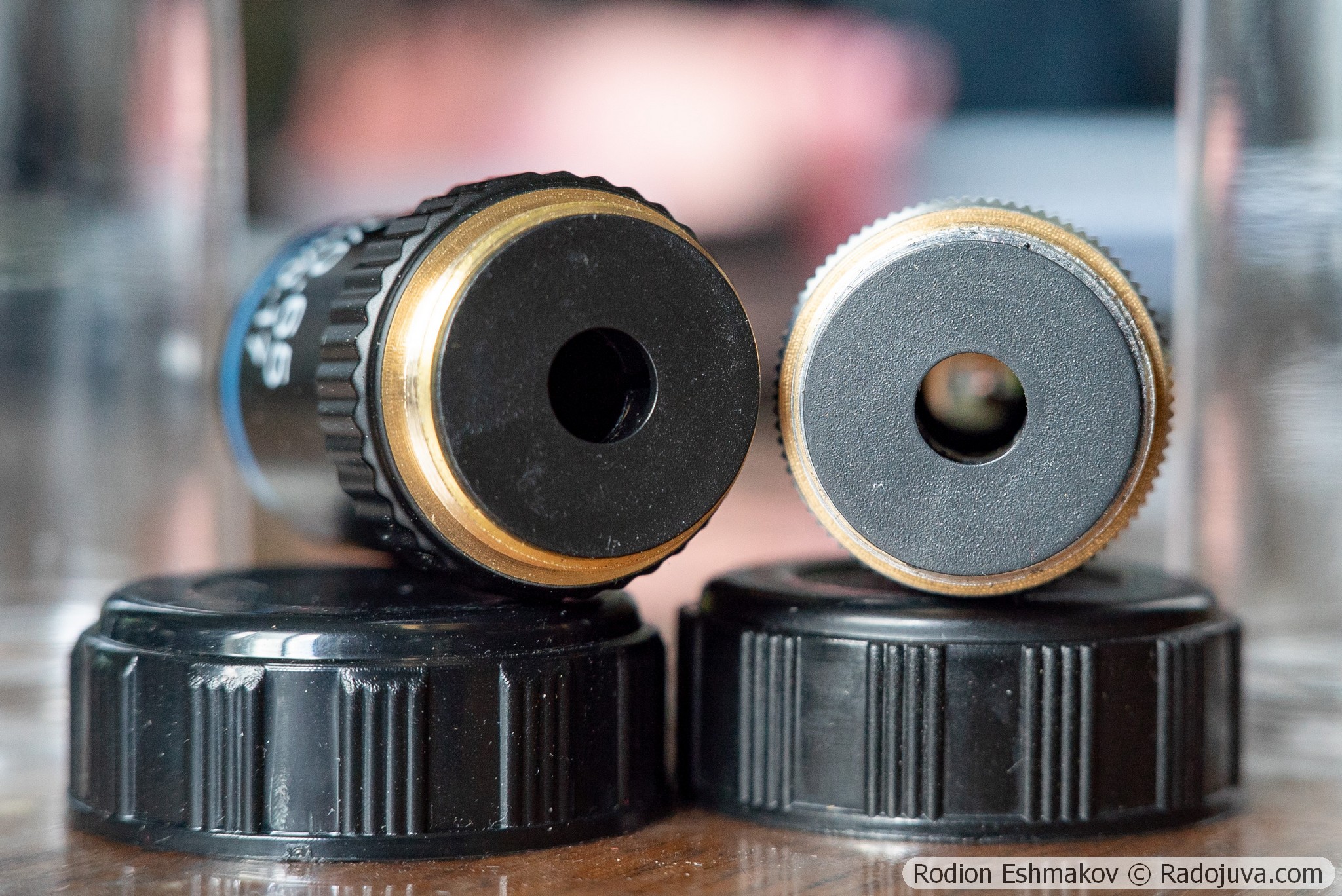
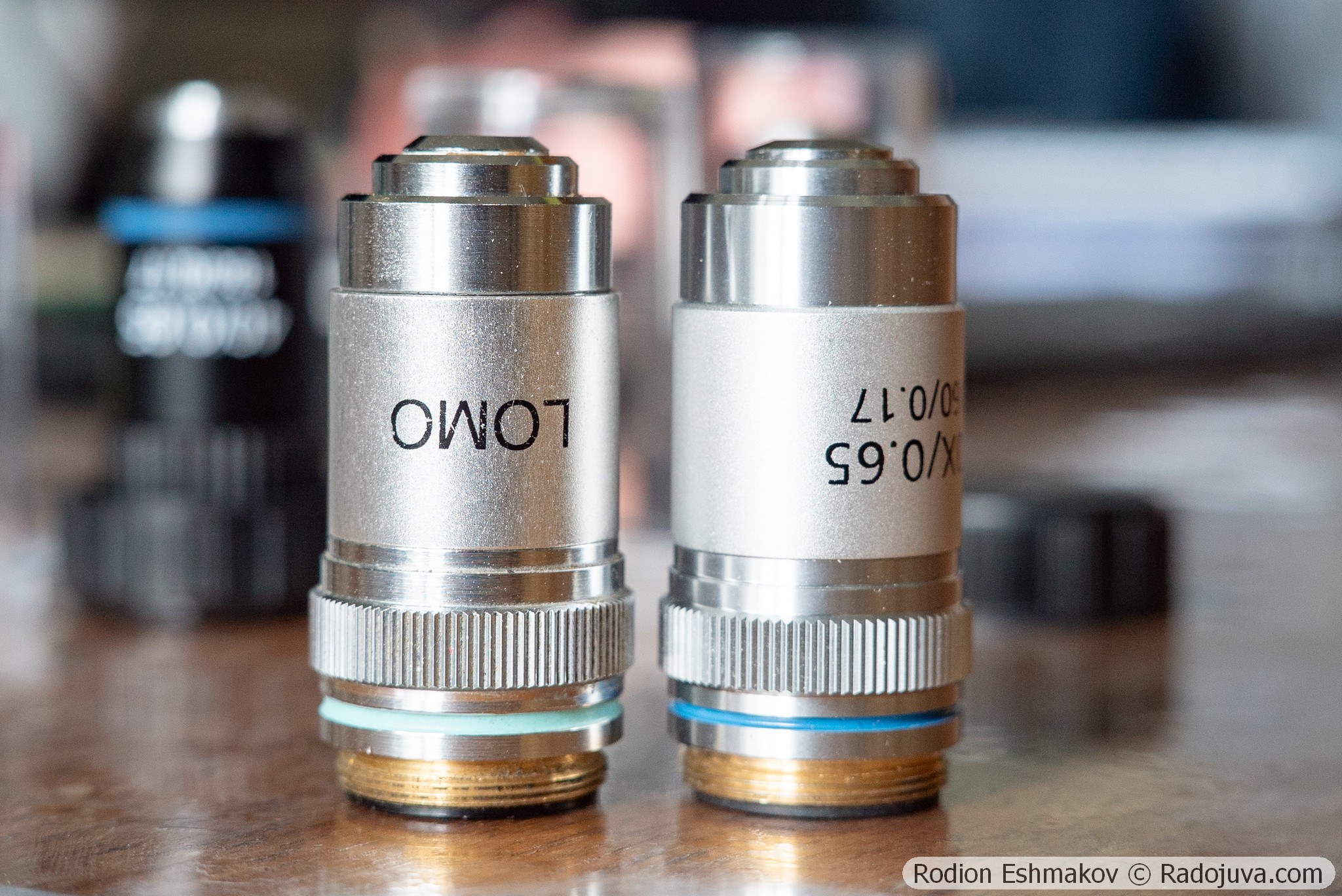
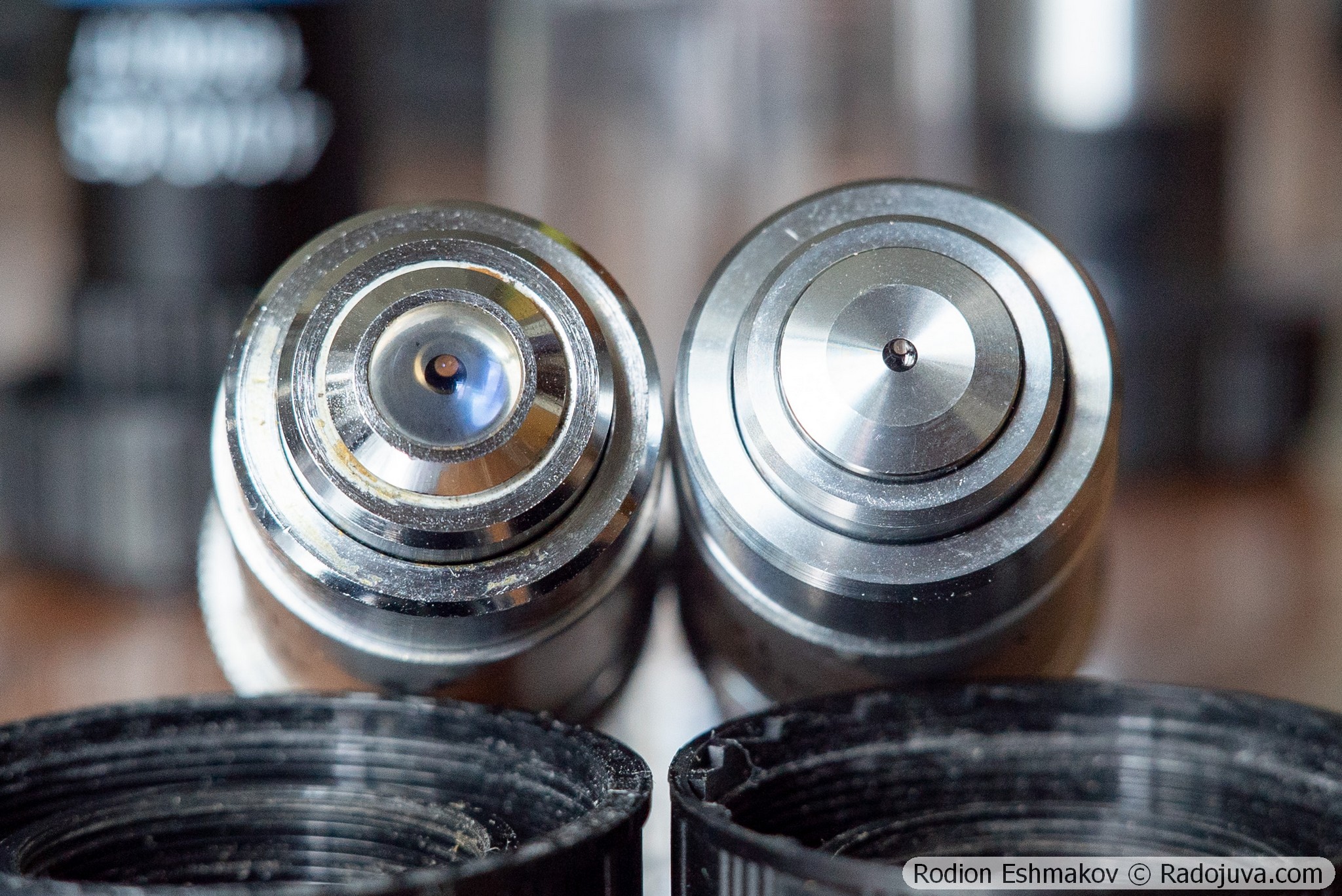
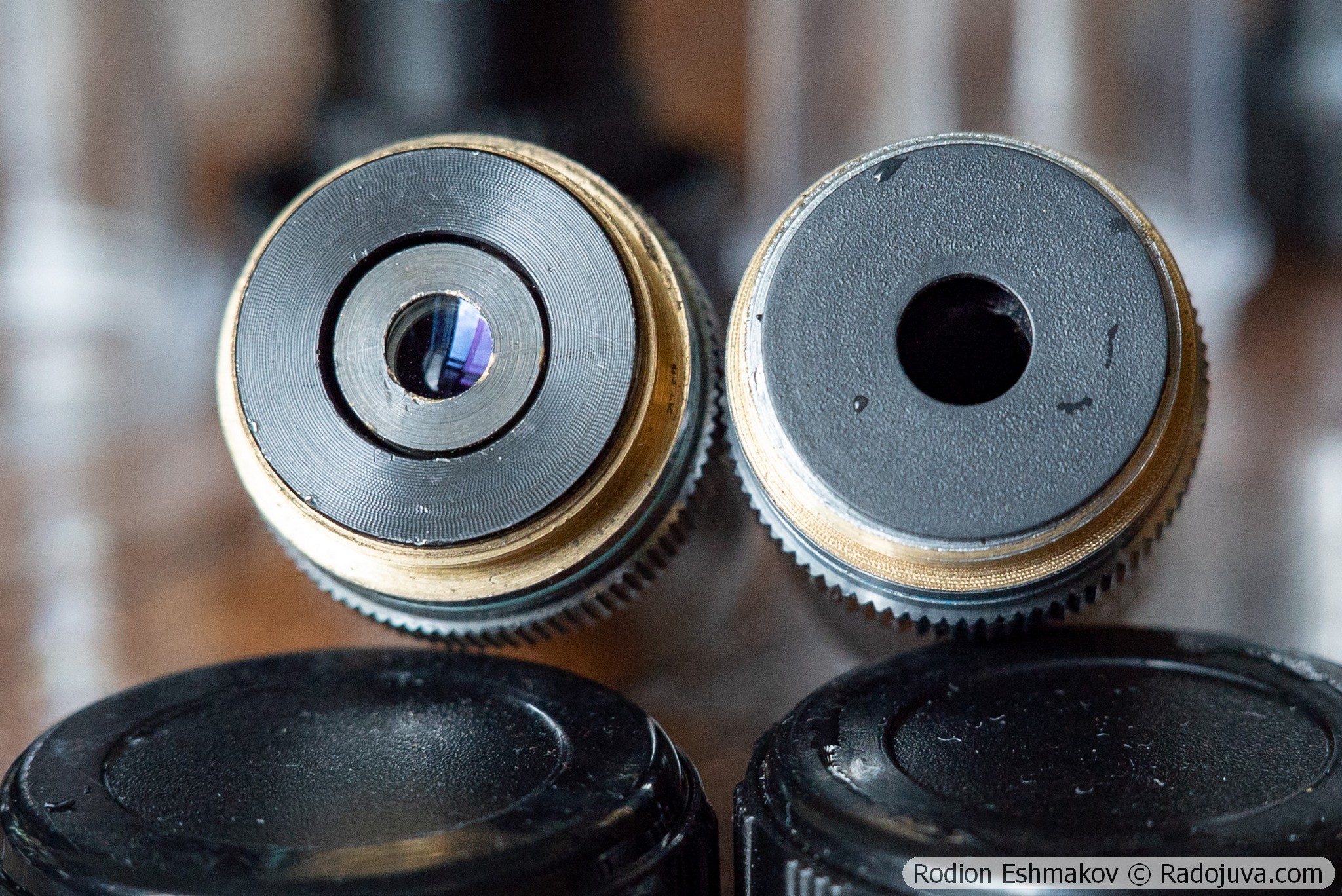
The objective lenses have a simple single-layer coating with a violet highlight. The blackening of the inner surfaces is very poor or absent. The lens is constructed using a very simple design, straight from Grandfather Abbe's design in the second half of the 19th century. The lens uses simple glass such as heavy crown and flint glass, including lead, which is being phased out everywhere these days due to environmental concerns.
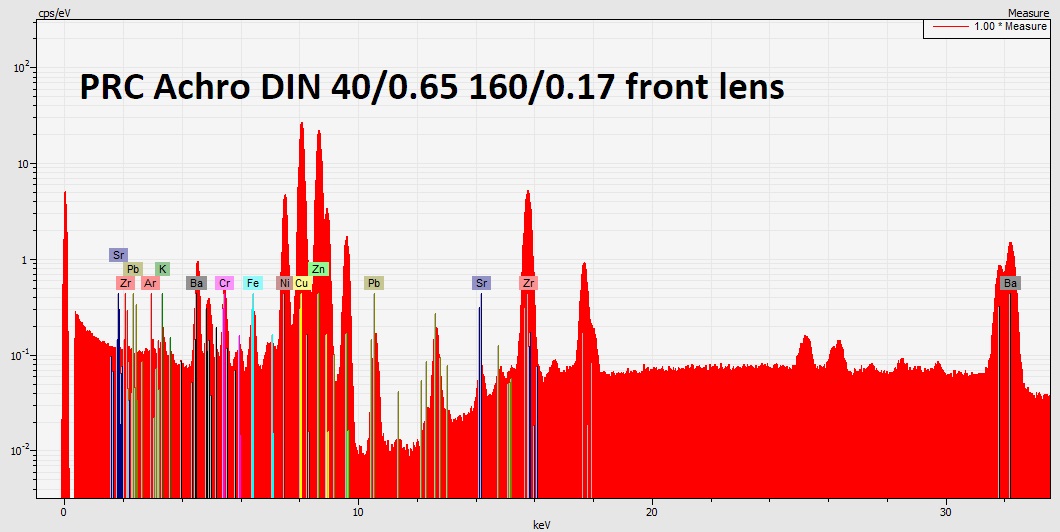
X-ray fluorescence spectrum of the front lenses of the objective.
The lens's rear-mounted diaphragm is particularly unusual. It has a diameter of approximately 4 mm, which is clearly insufficient to fill the pupil for off-axis beams. The LOMO 40/0.65 MS lens , which is very similar in design, has a much larger diaphragm and is located significantly closer to the lenses. Consequently, the Chinese 40/0.65 and 160/0.17 achromats have introduced very strong geometric vignetting for an unclear reason, which is completely uncharacteristic for micro-optics.
In general, these achromats are made extremely simply and even crudely, which is to be expected given their cost.
Optical properties. Comparative test
The lens presented in this review was previously compared with other 40× lenses in this article . An additional comparison was also conducted using a transmitted-light micrometer object and a Romanovsky-Giemsa-stained human blood sample. The test was performed using a KF-4M condenser (NA=0.8), a Ulanzi L2 illuminator , and a Sony NEX-6 (APS-C, 16 MP) camera in prime focus. The following lenses were selected for comparison:
1) LOMO MI 50×1.0 160/0 – a late LOMO achromat (Bimam/Mikmed-2 kit), a rare lens equipped with an iris diaphragm for use with darkfield condensers. It's impossible to confuse. Designated LOMO MI 50/1.0 160/0.
2) Plan 40/0.65 160/0.17 – a Chinese plan achromatic lens included with some microscopes shipped to Russia. It was not available on Aliexpress. It features a concave meniscus lens at the rear of the objective lens and is labeled as "PRC Plan 40/0.65 (meniscus rear)."
3) Plan 40/0.65 160/0.17 – an affordable Chinese plan achromat, sold on AliExpress. A distinctive feature is the precisely defined working distance of 0.68 mm, as stated by sellers. Like objective 2, it has a meniscus at the rear, but located directly in the plane of the rear end. It was also produced under the Nikon and LOMO brands as a standard achromat for entry-level microscopes (see below). It is designated as "PRC Plan 40/0.65 160/0.17 WD0.68."
4) LOMO 40/0.65 160/0.17 – an achromatic lens from the Mikmed-5 microscope kit. Its design and properties are identical to those of the objective described in point 3. It was manufactured in China and is labeled "LOMO 40/0.65 (Mikmed-5)." The objective itself is not exactly new and was manually cleaned and adjusted before testing.
5 and 6) Chinese achromats 40/0.65 160/0.17 DIN standard, presented in this review. Designated as "PRC Achr 40/0.65 160/0.17".
7) Carl Zeiss Jena 40/0.65 160/0.17 – East German achromat 40/0.65 DIN standard, designated as “CZJ 40/0.65 160/0.17 DIN”.
And a bonus:
8) Chinese achromat 60/0.85 160/0.17 DIN standard from the same line of optics as the 40/0.65 presented in this review. Designated as "PRC Achr 60/0.85 160/0.17".
9) A very old Soviet achromatic Progress 60/0.85 with the RMS standard code 02-60, designated as “Progress 02-60 60/0.85 (160/0.17)”.
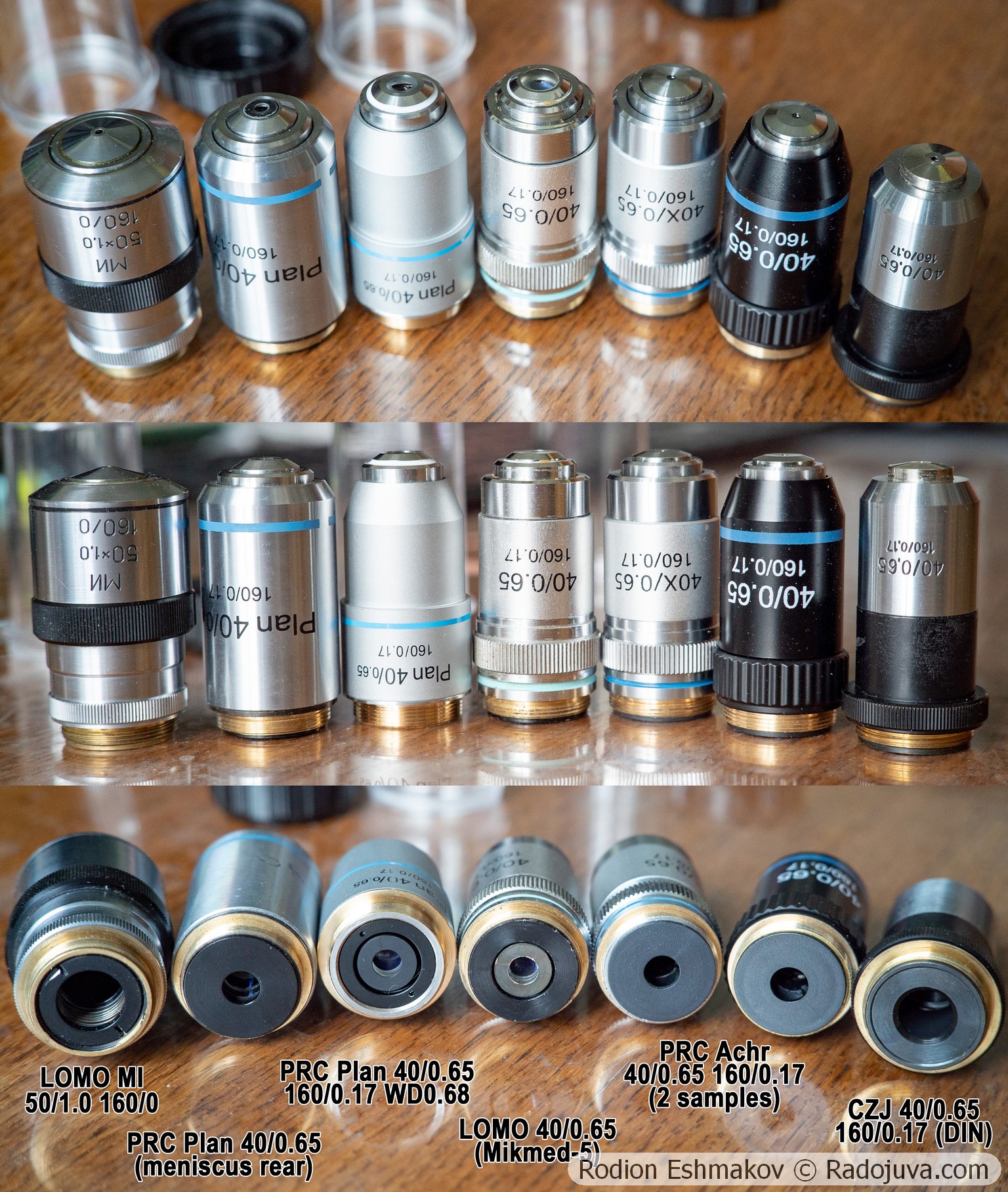
Tested 40-50× lenses and their conventional names.
Test shots on achromat 40/0.65 160/0.17 and image crops (at the same scale) are shown below.
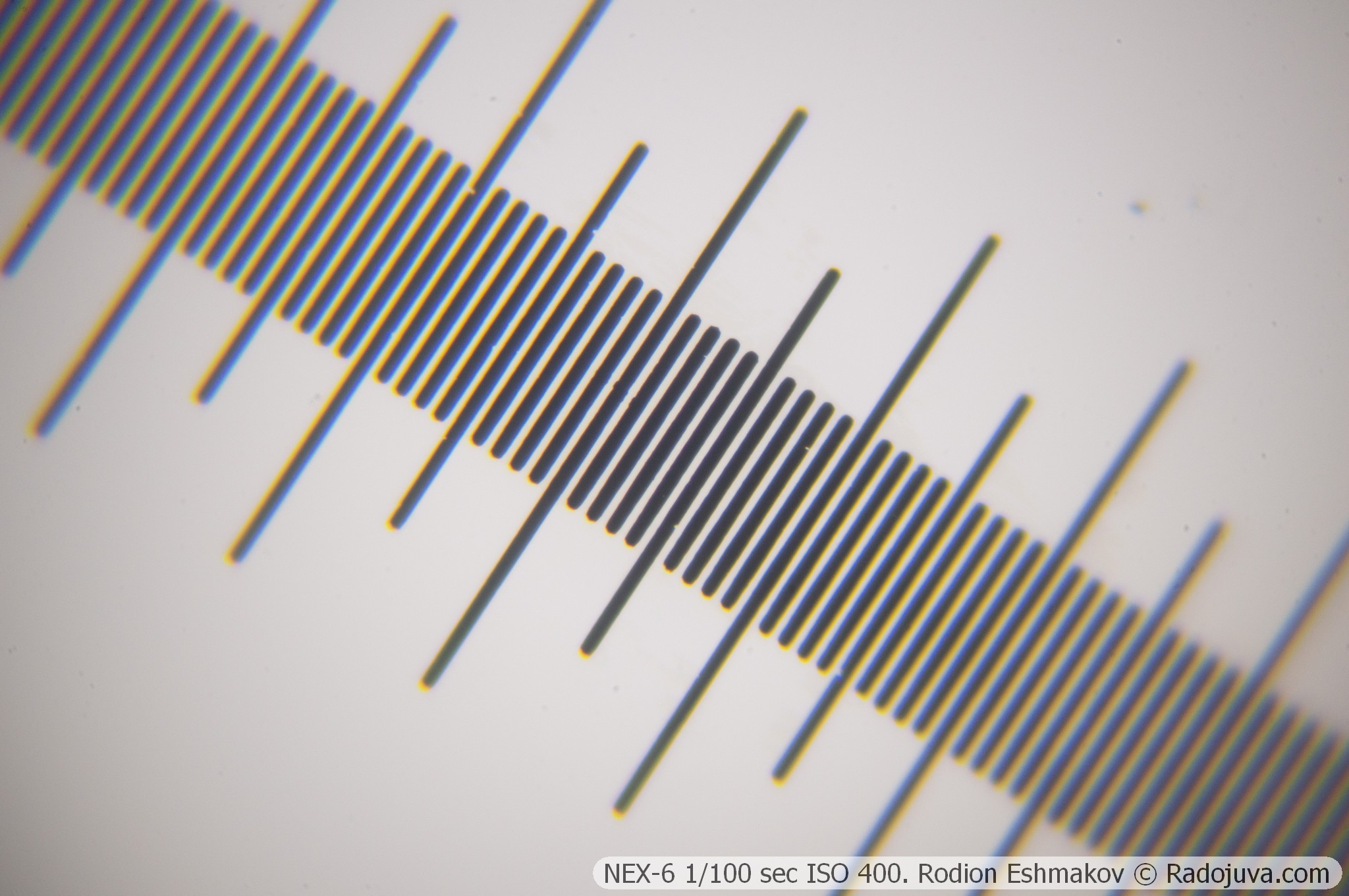
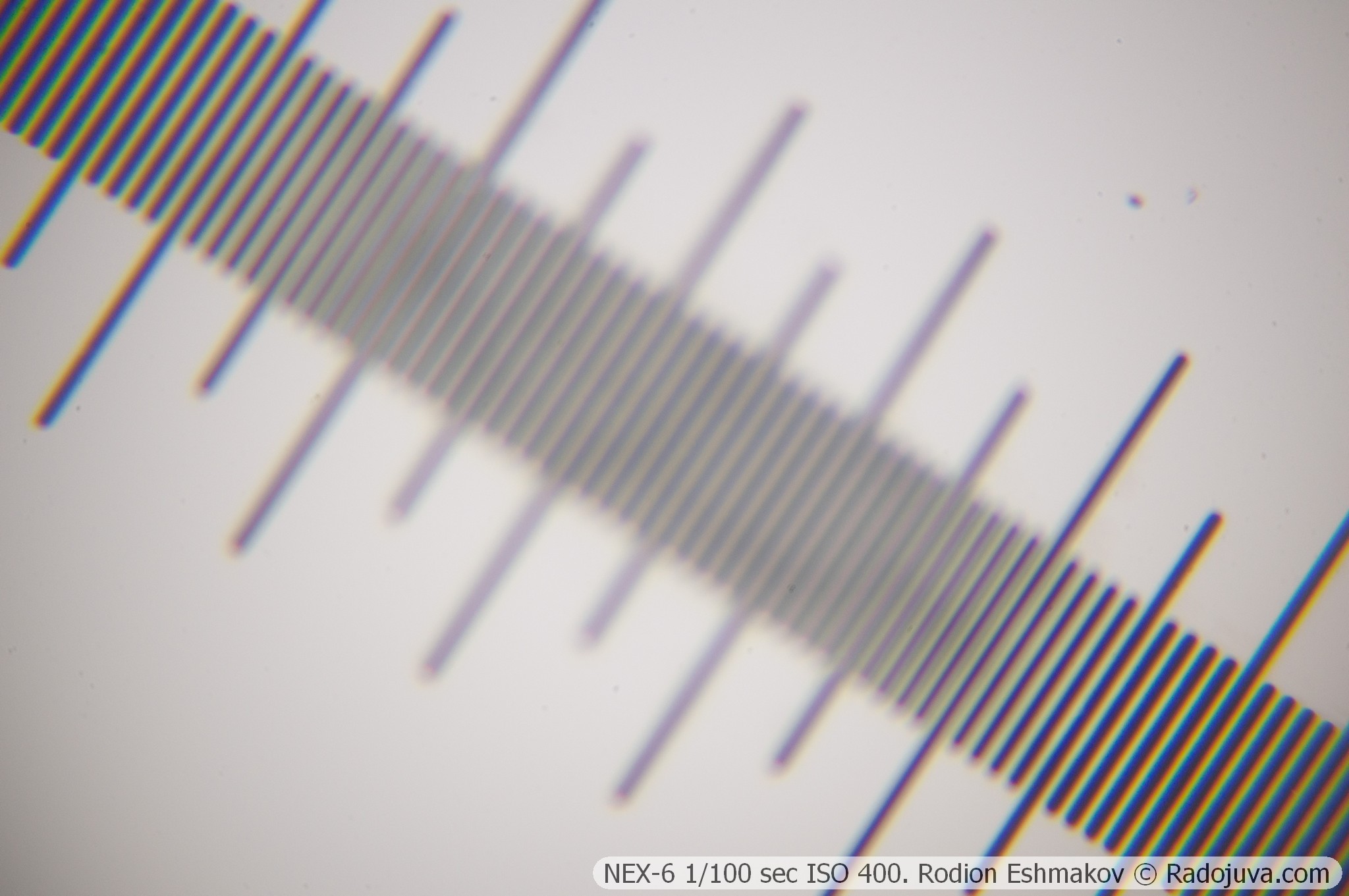
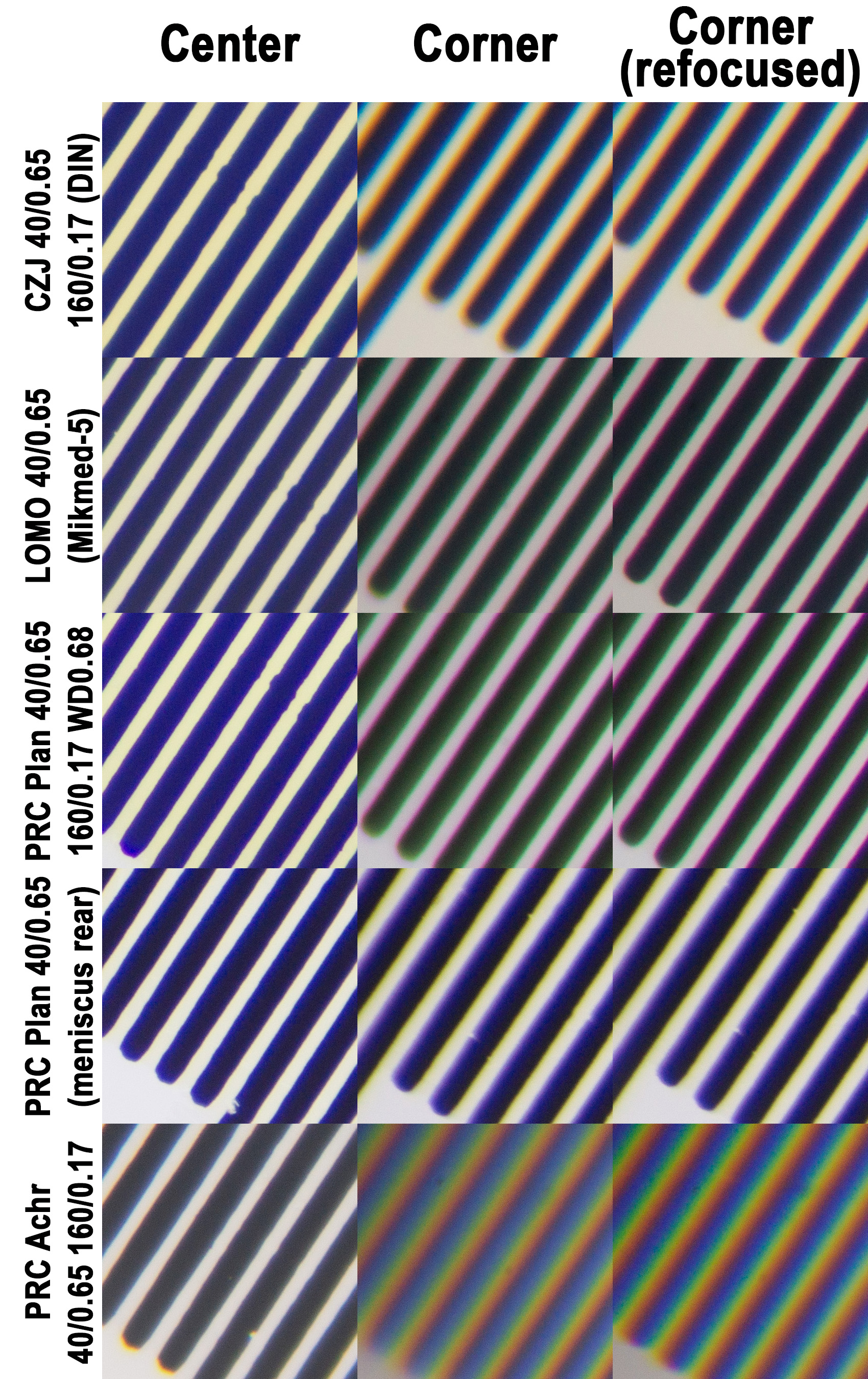
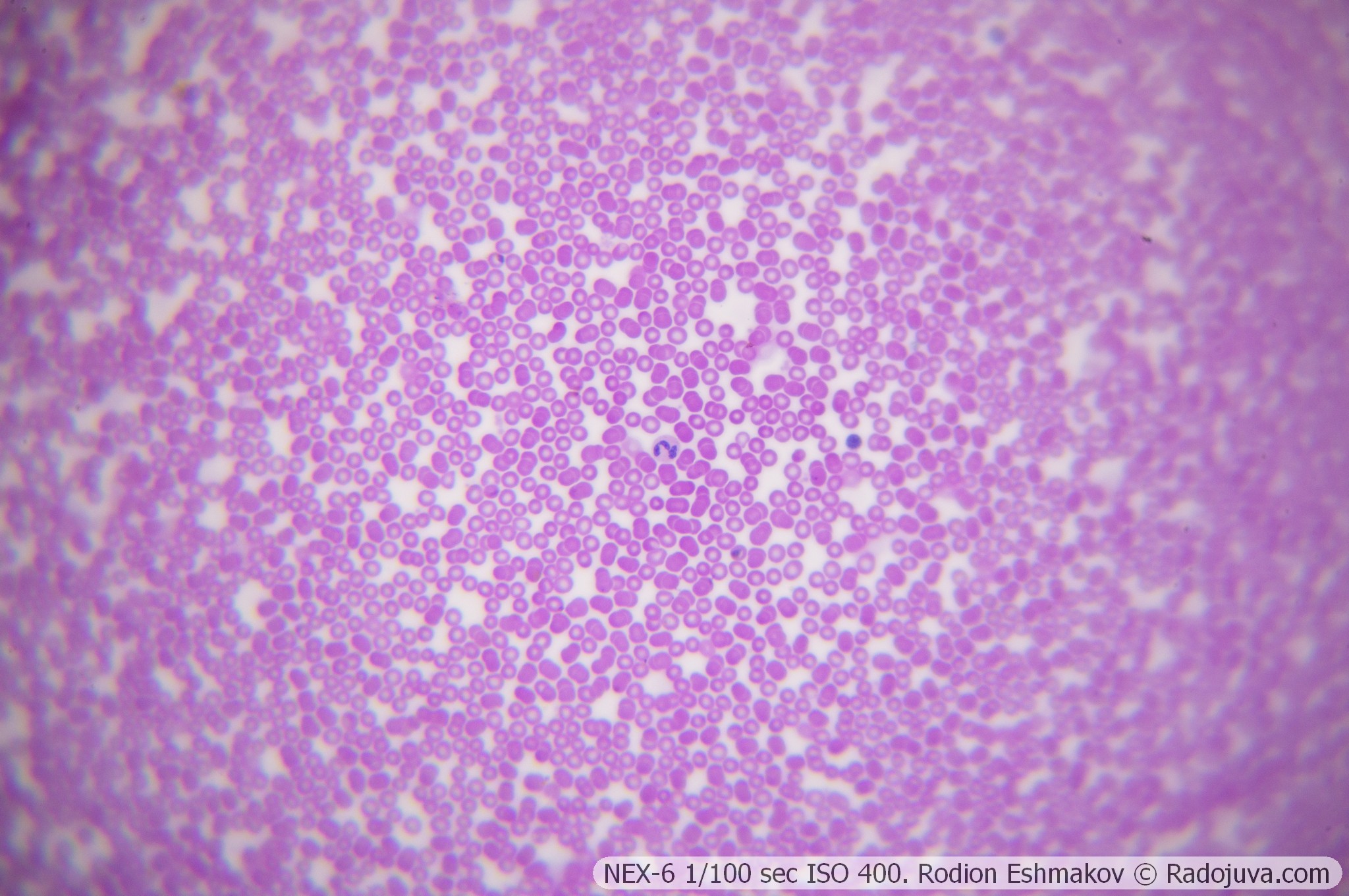
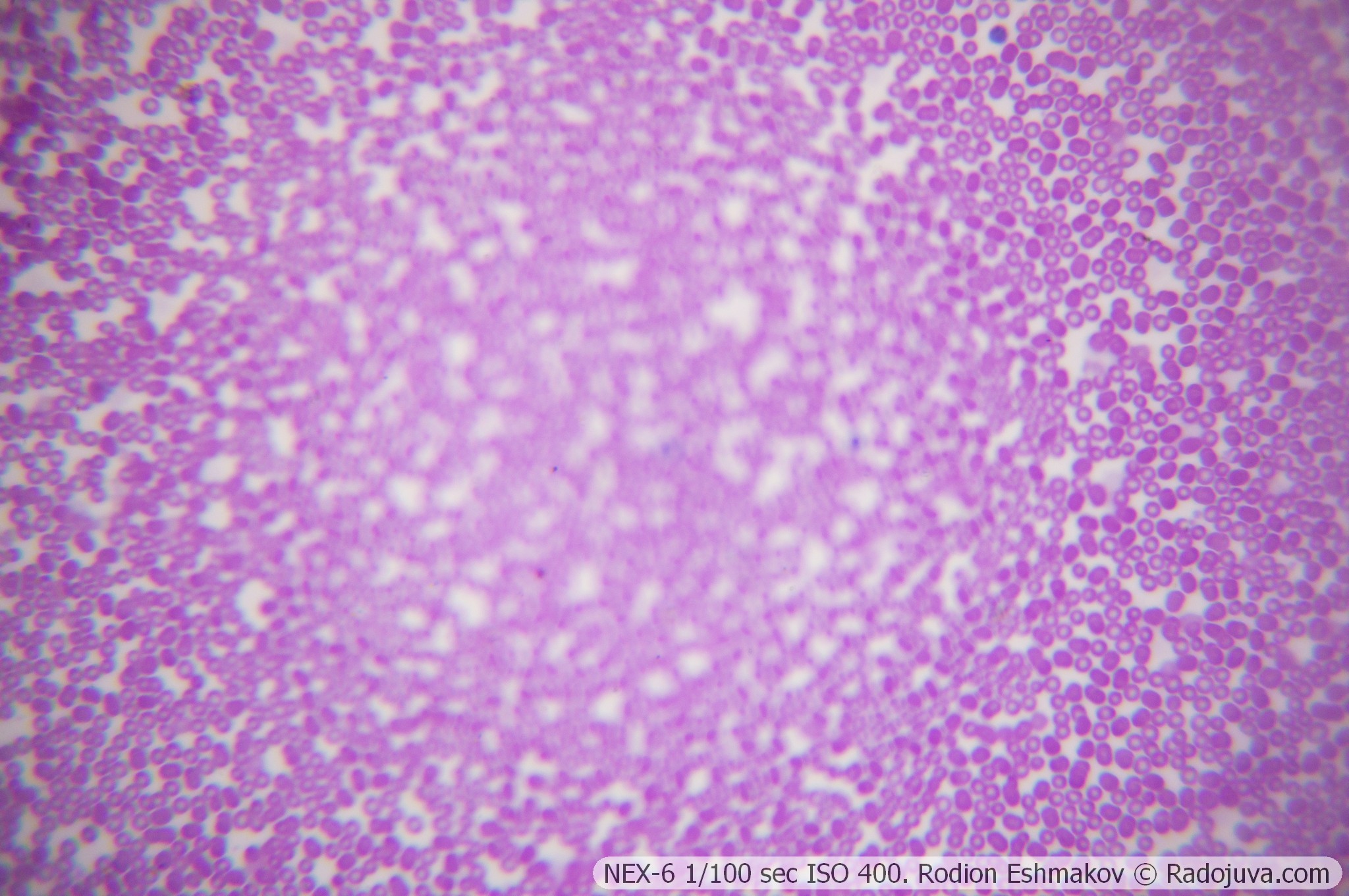
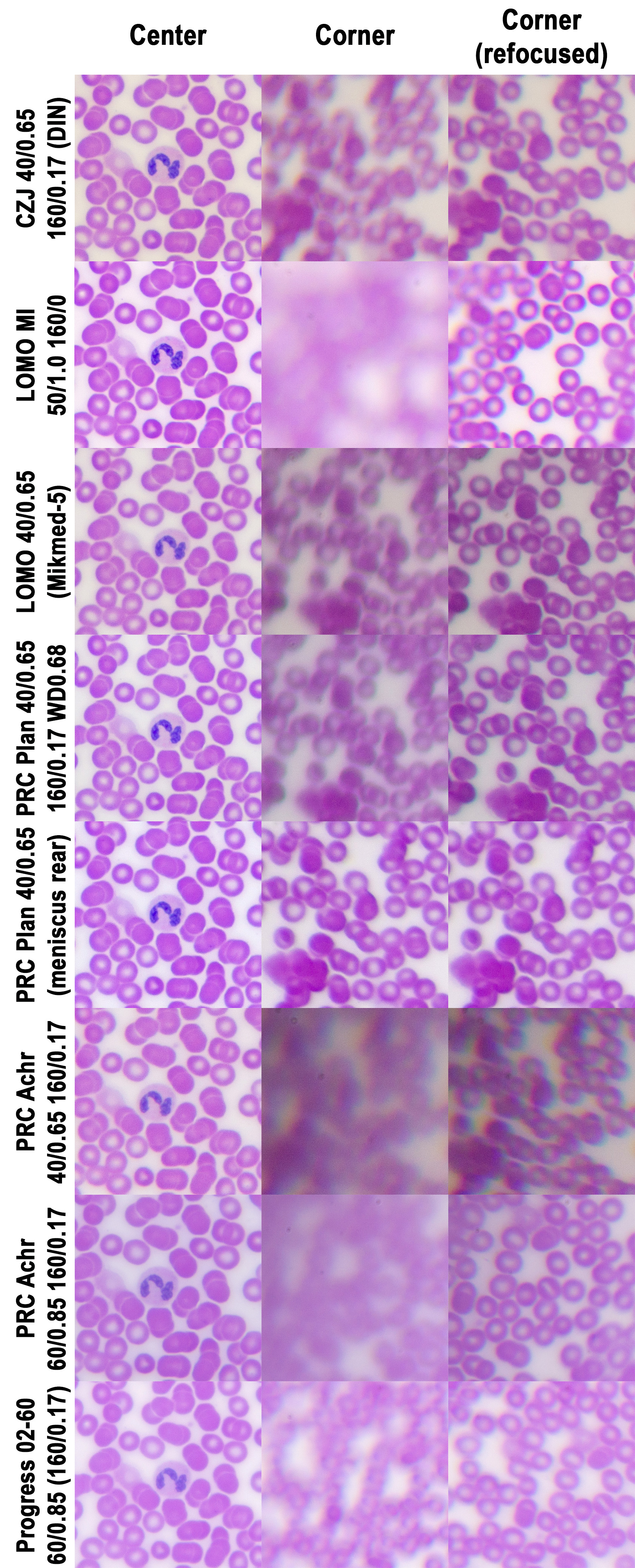
As you can see, the 40/0.65 160/0.17 achromat has the most mediocre image quality of all the lenses tested: very high levels of spherical aberrations and monstrous field distortions (astigmatism, field curvature, and lateral chromatic aberration). The Soviet LOMO 40/0.65 OX-1 (a "forty with a spring") RMS standard lens offers significantly higher image quality.
Both 60/0.85 achromatic lenses—both Soviet and Chinese—also performed quite poorly. Overall image quality is clearly better than the Chinese 40/0.65 160/0.17 achromatic lens, but they fail to reveal any new details despite their nominally higher magnification and aperture.
The Carl Zeiss Jena achromat, Plan 40/0.65 WD0.68, and LOMO 40/0.65 (Mikmed-5) twin lenses have similar characteristics. The older Zeiss lens is inferior in terms of lateral chromatic aberration correction. It and the 40/0.65 LOMO Mikmed-5 lens exhibit distorted color rendition with a distinct warm-toned bias. Both lenses exhibit noticeable vignetting. Overall, the Plan 40/0.65 WD0.68 is a decent budget solution, as previously confirmed by its selection as a kit lens by LOMO and Nikon. Even better is the Plan 40/0.65, which I couldn't find for sale on AliExpress – it does offer well-corrected field curvature and decent spherochromatic aberration correction.
My favorite lens in this test is the LOMO MI 50/1.0 160/0. Despite pronounced lateral chromatic aberrations and significant field curvature and astigmatism, this lens offers the best detail and sharpness in the central portion of the image. It has previously been shown to be on par with 100/1.25 oil immersion lenses in this regard.
As a result, the Chinese achromatic 40/0.65 160/0.17 DIN standard is a bottom-of-the-line optical device, inferior even to the mass-produced LOMO OX-1 objectives . The objective is frankly poor both in the center of the field and off-axis. Surprisingly, the objective can be used for recording Raman spectra, as it has relatively low light scattering due to its simple design and the presence of an anti-reflective coating on the lenses (especially after blackening the optical path).
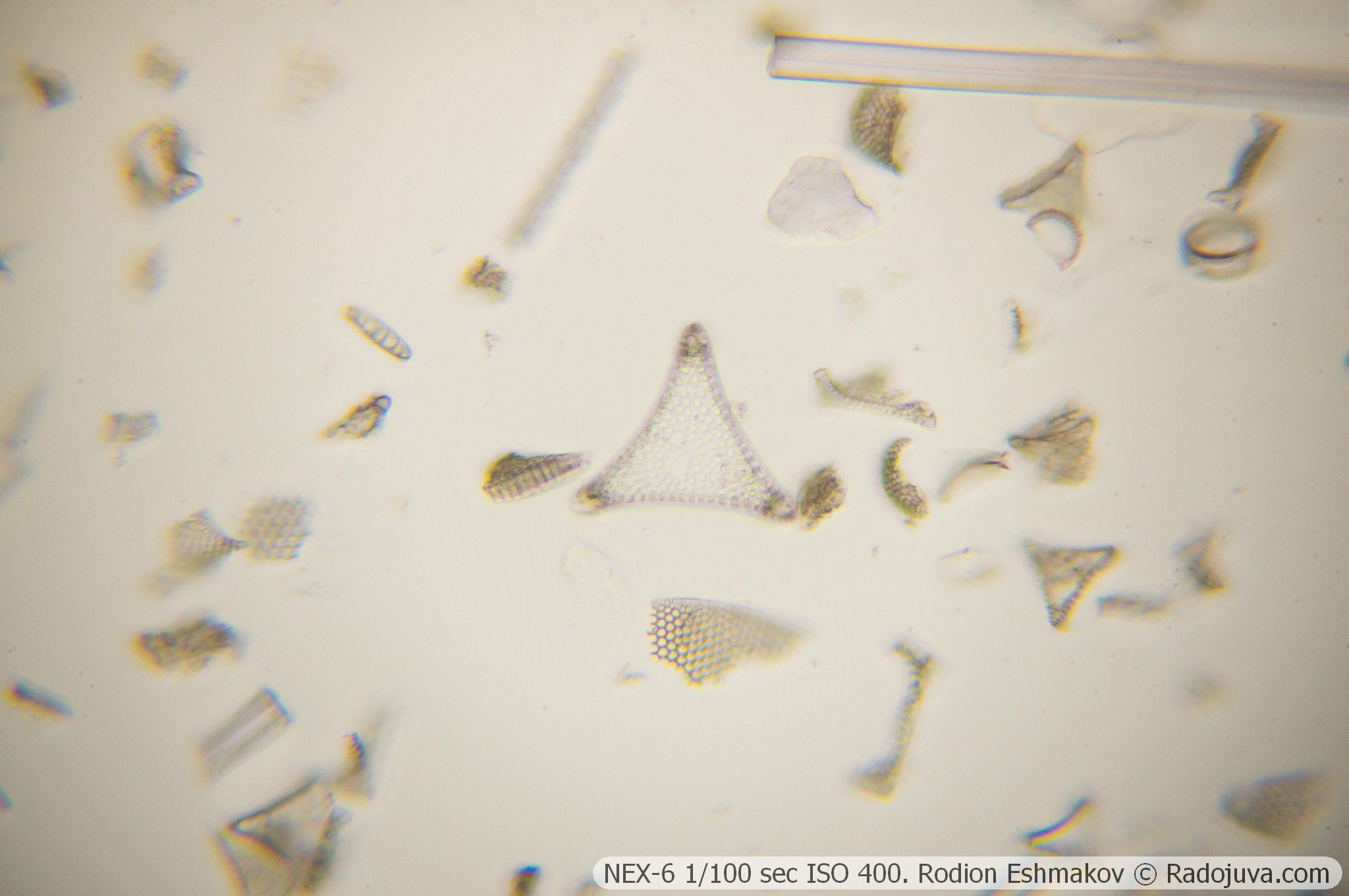
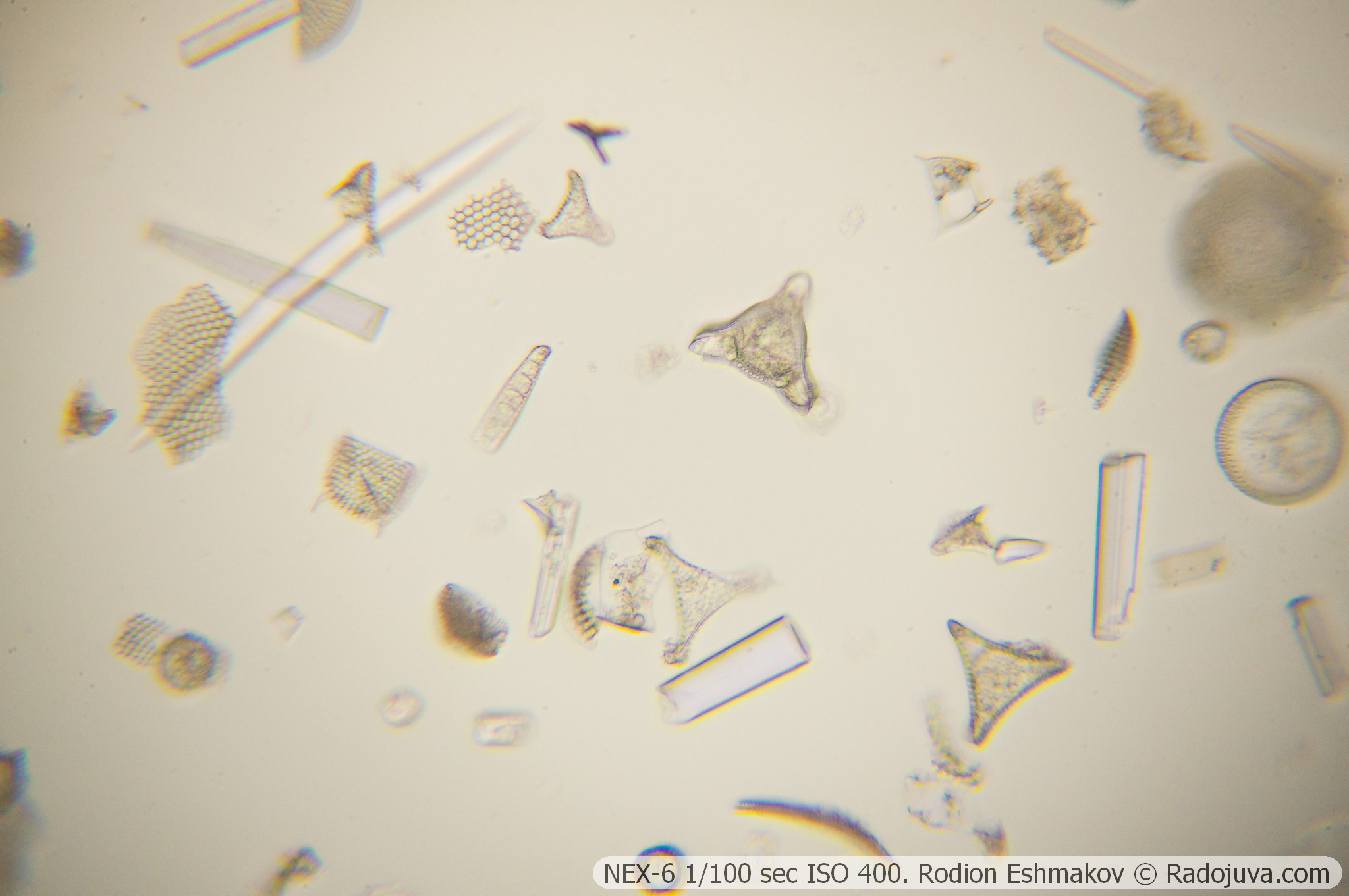
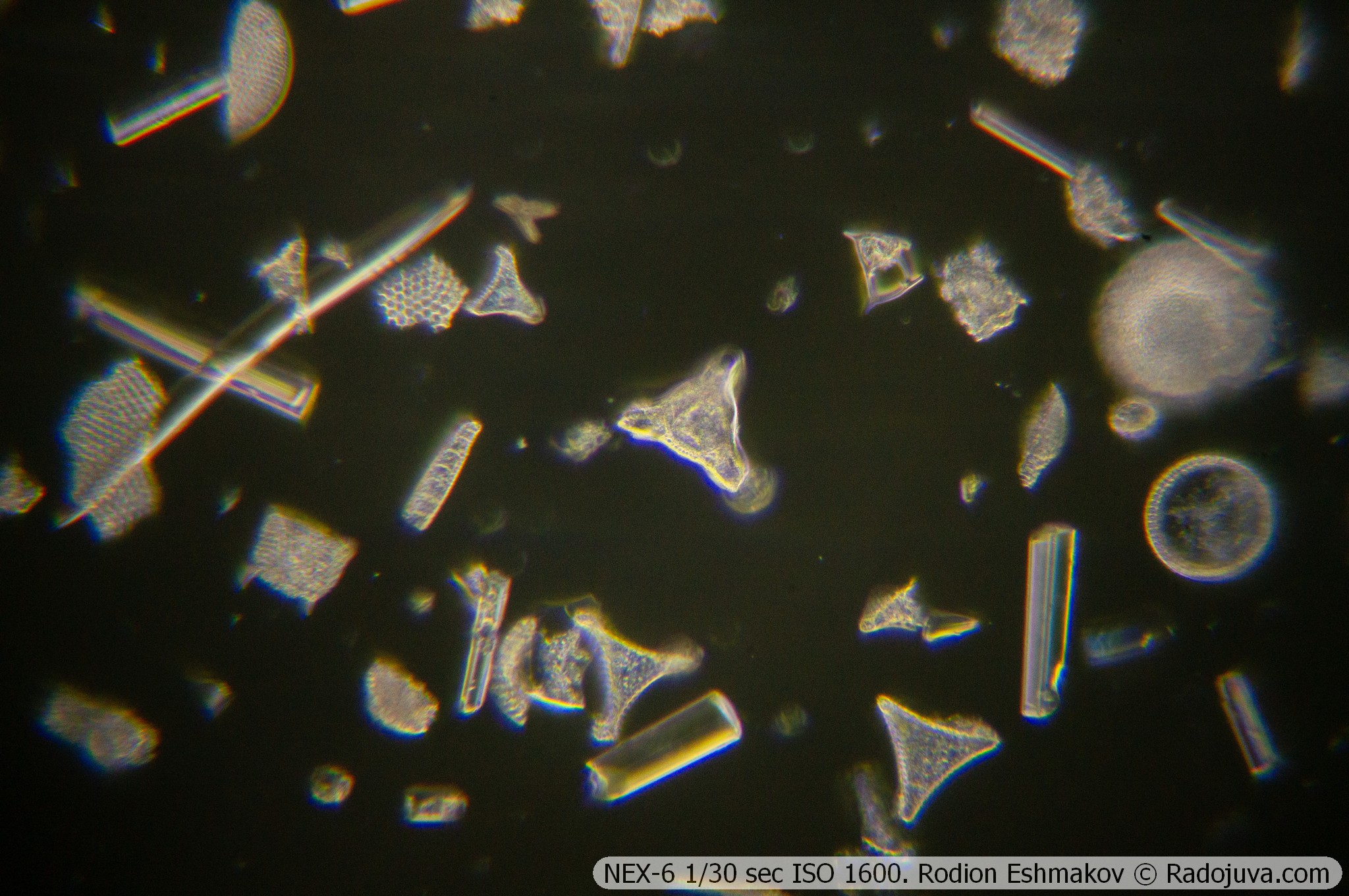
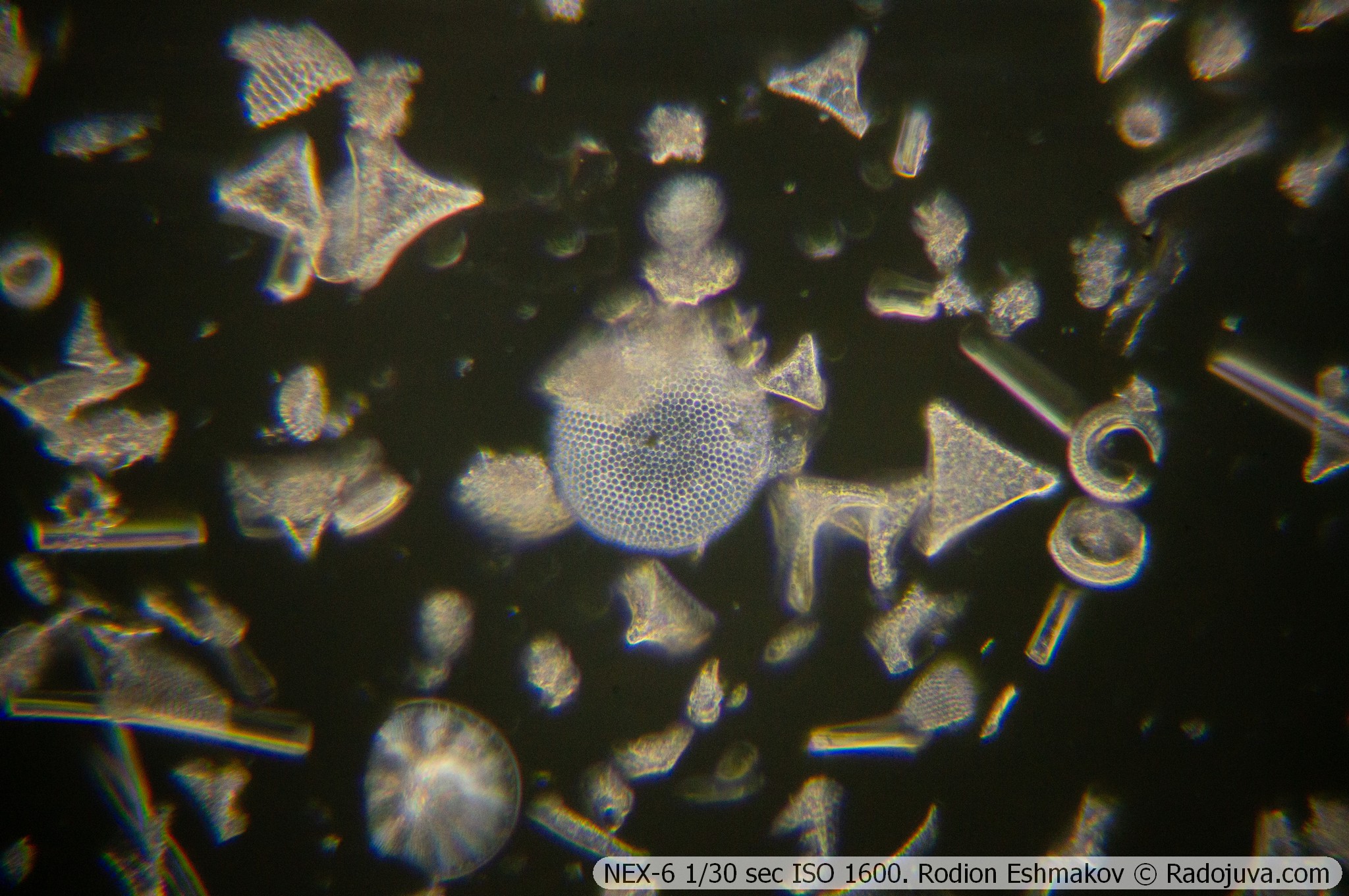
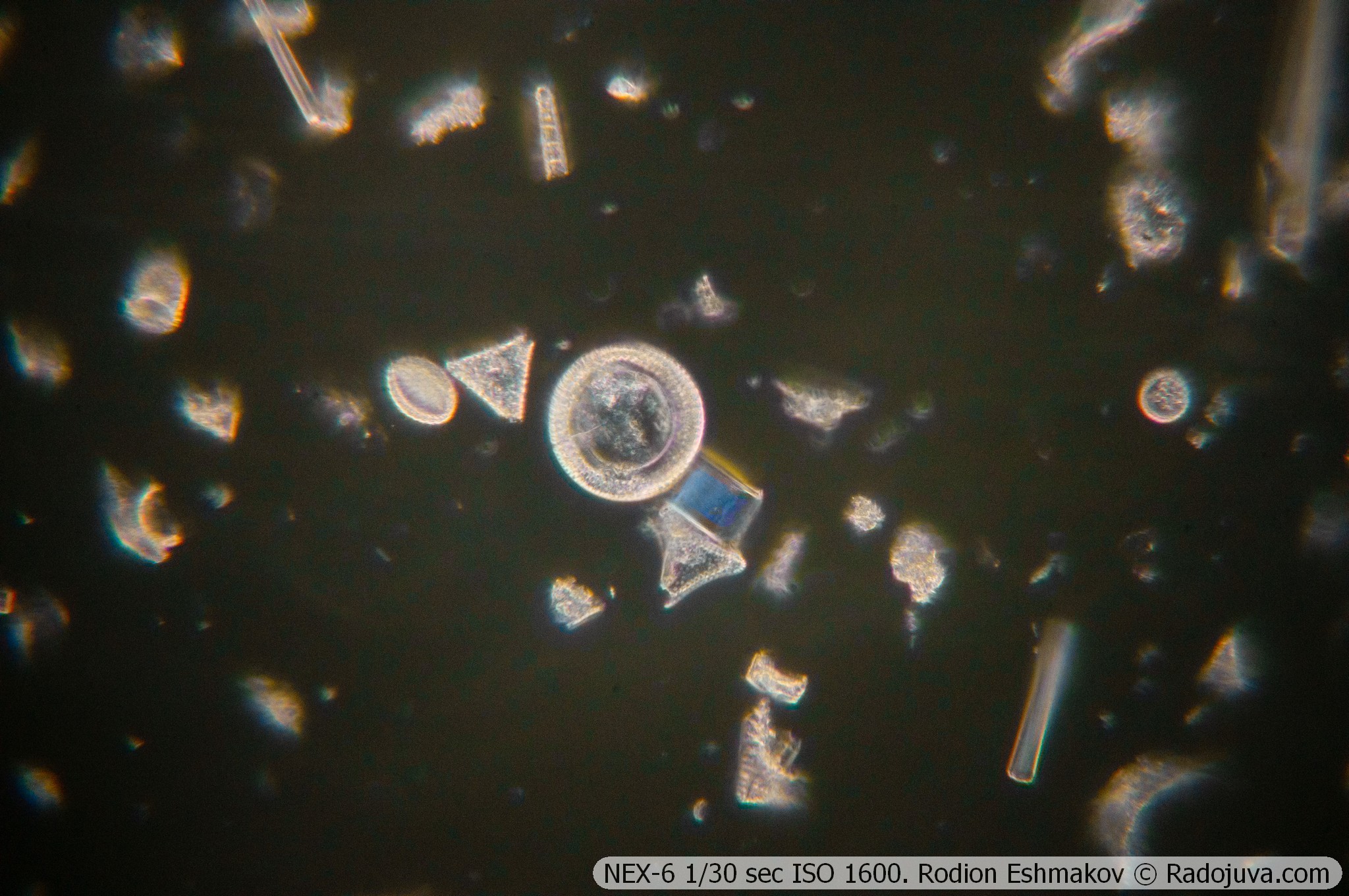
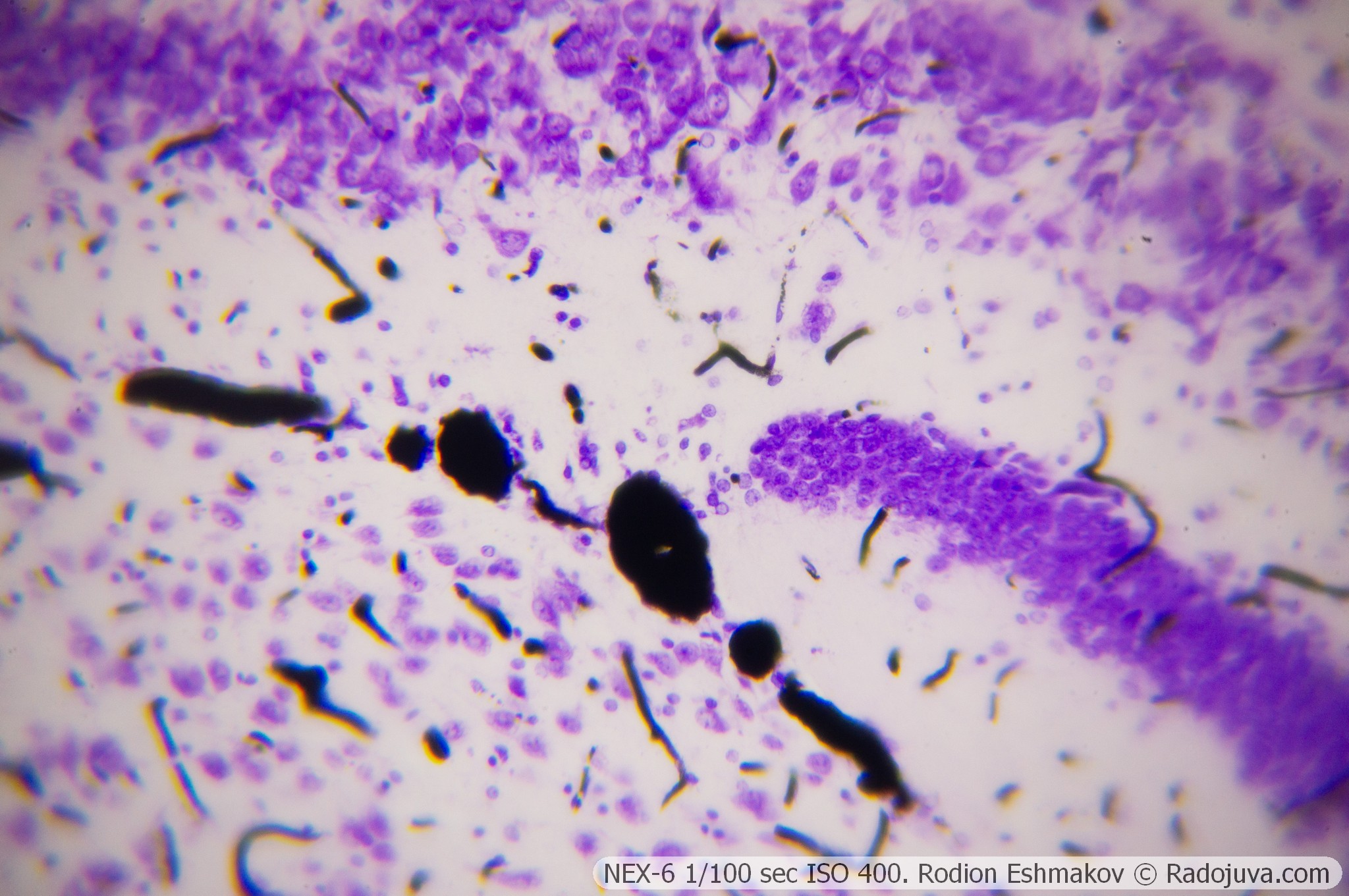
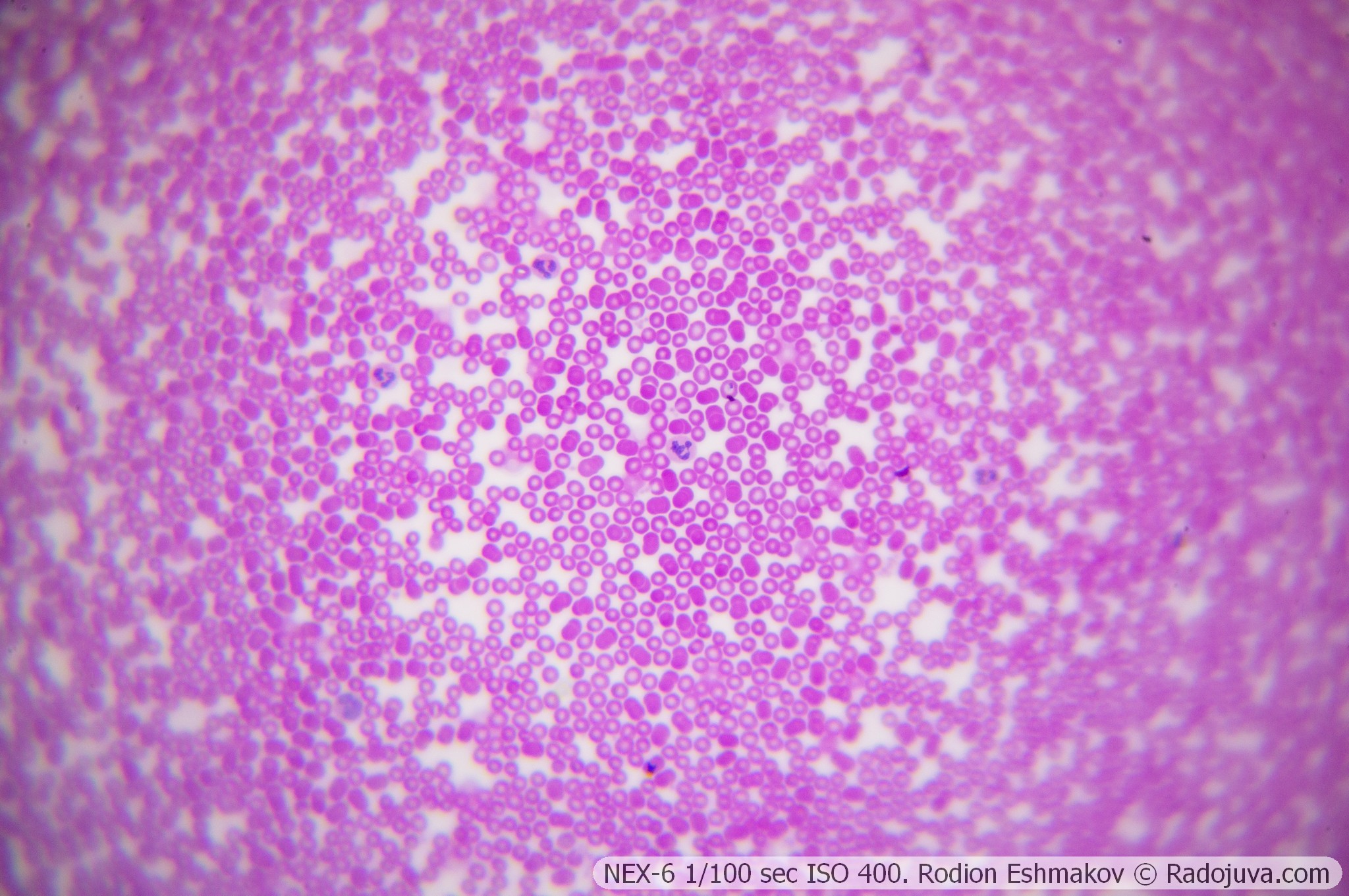
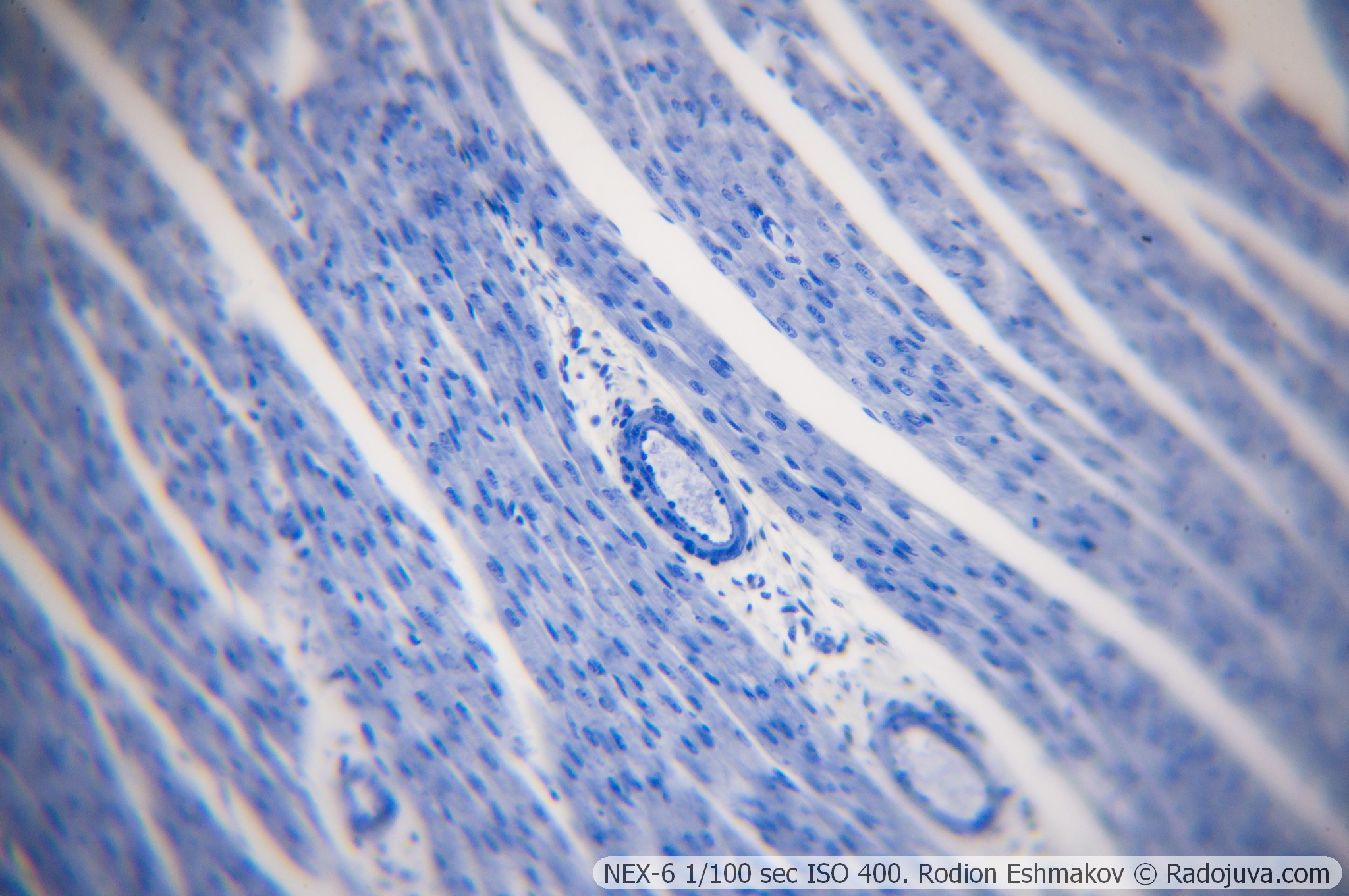
Below are some sample photos taken with a Sony NEX-6 and a Chinese achromatic 40/0.65 160/0.17 lens using stacking. In the photos: 1-3) Diatom shells in diatomite, finished slide (light and dark field); 4) Stained spinal cord slide; 5) Stained blood slide; 6) Stained cardiac muscle slide.
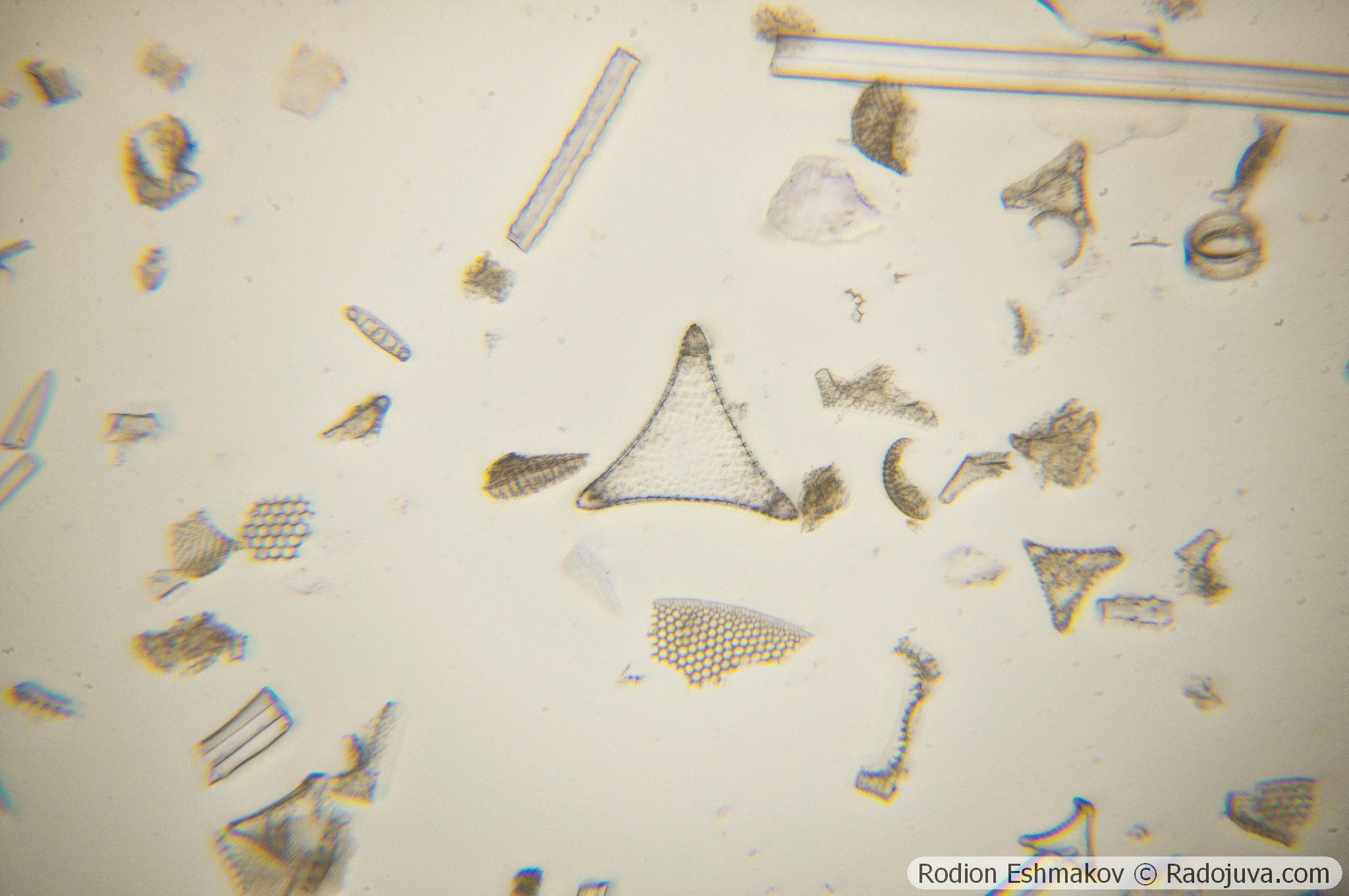
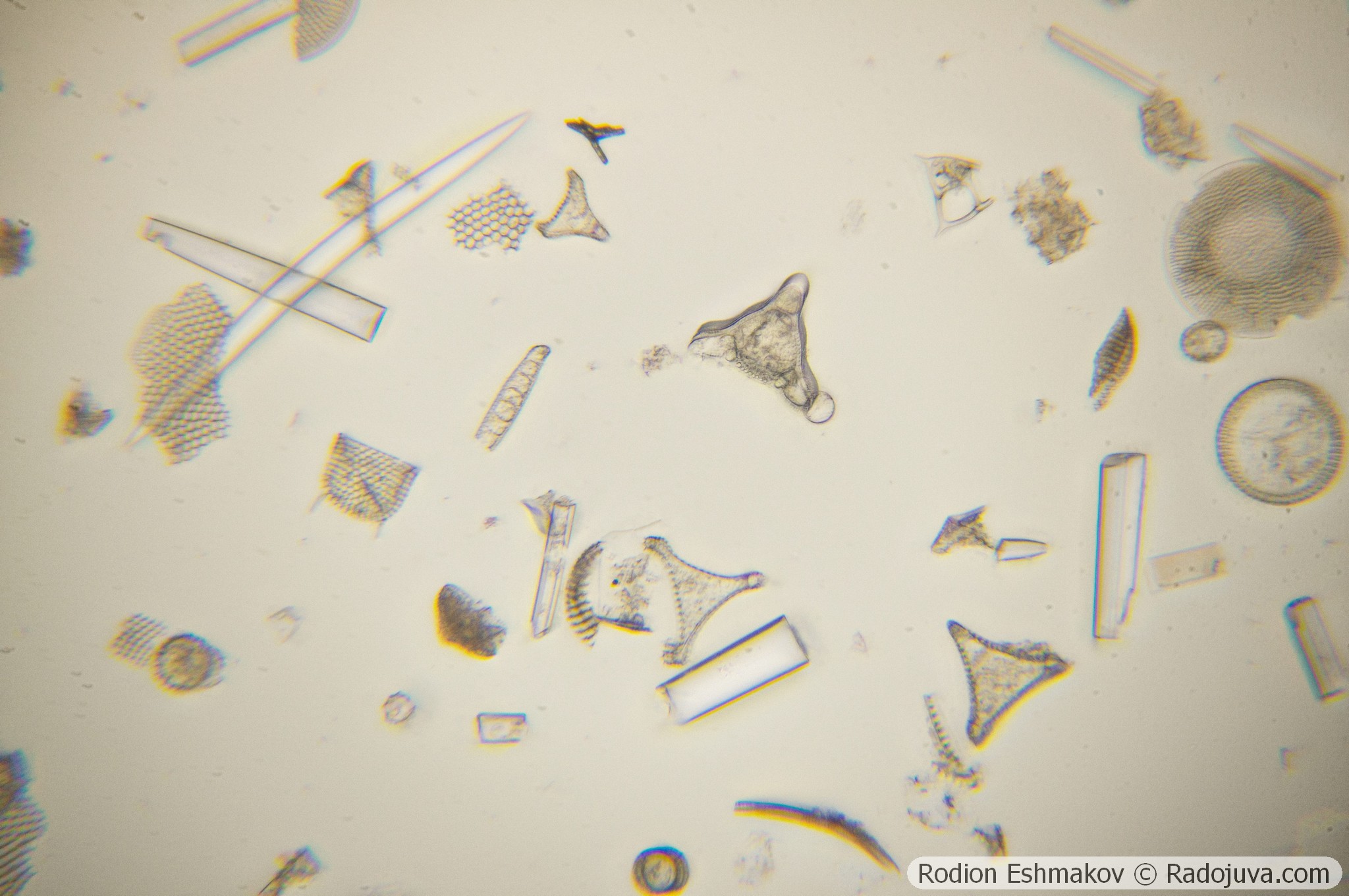
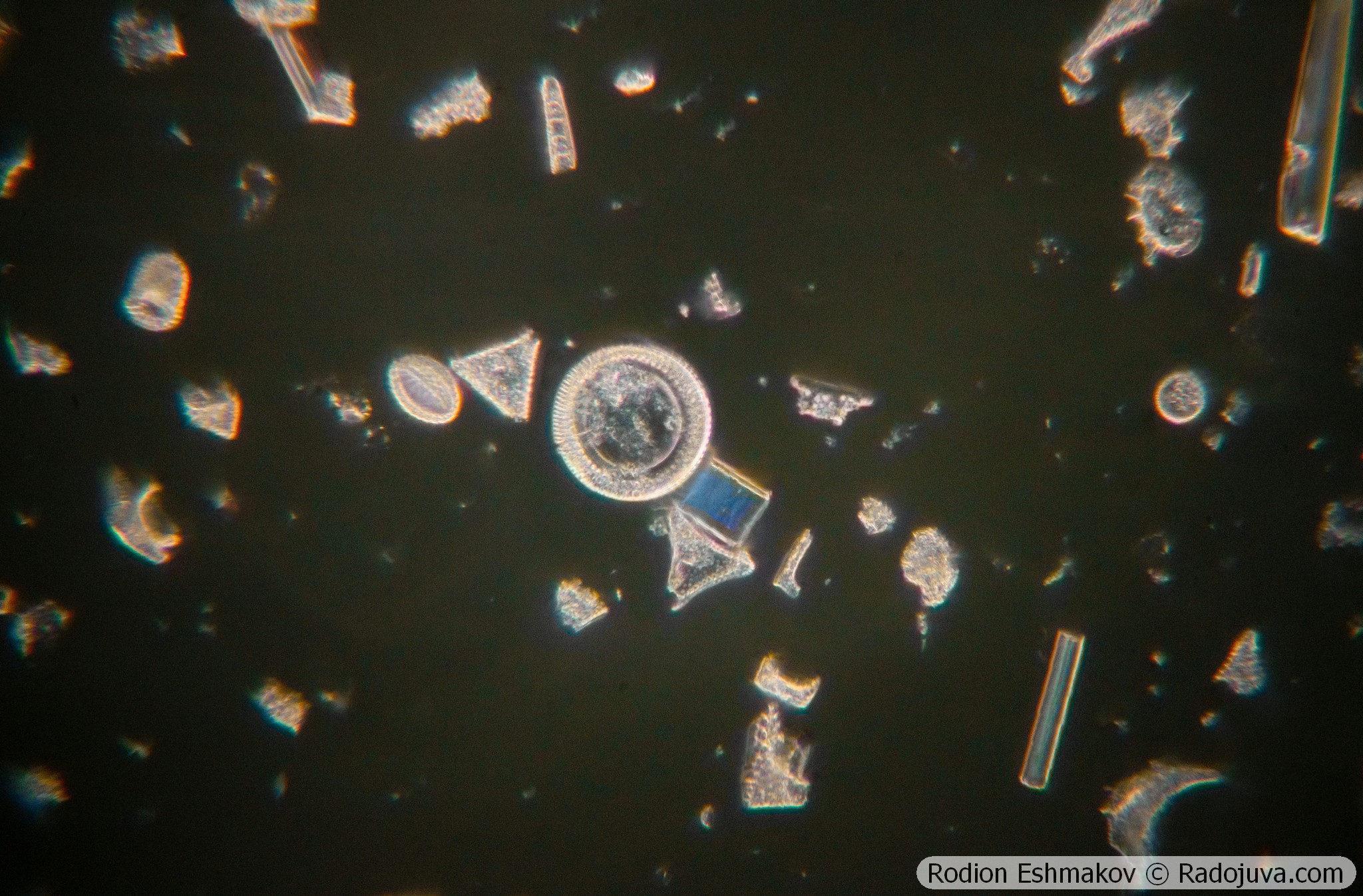
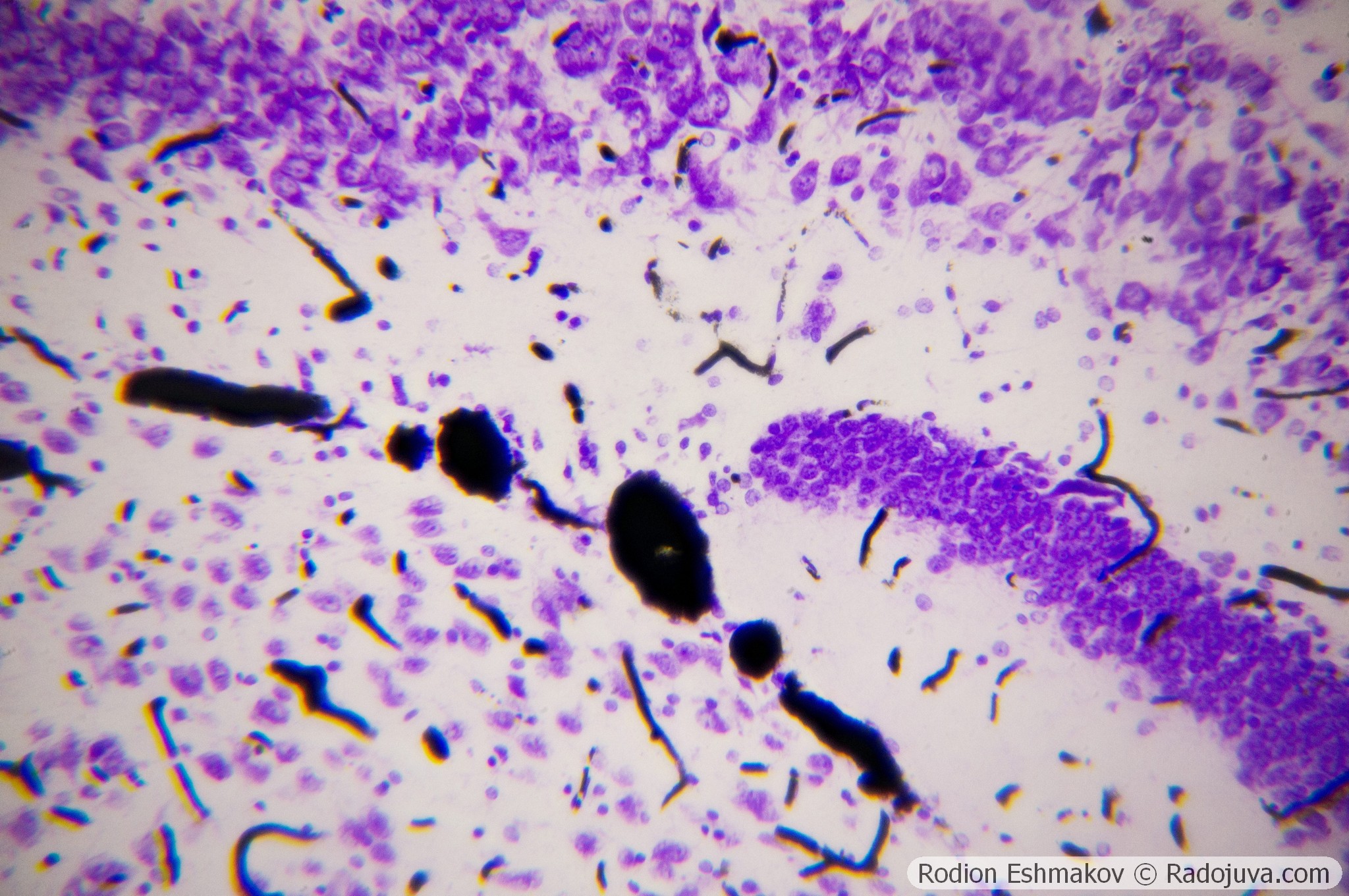
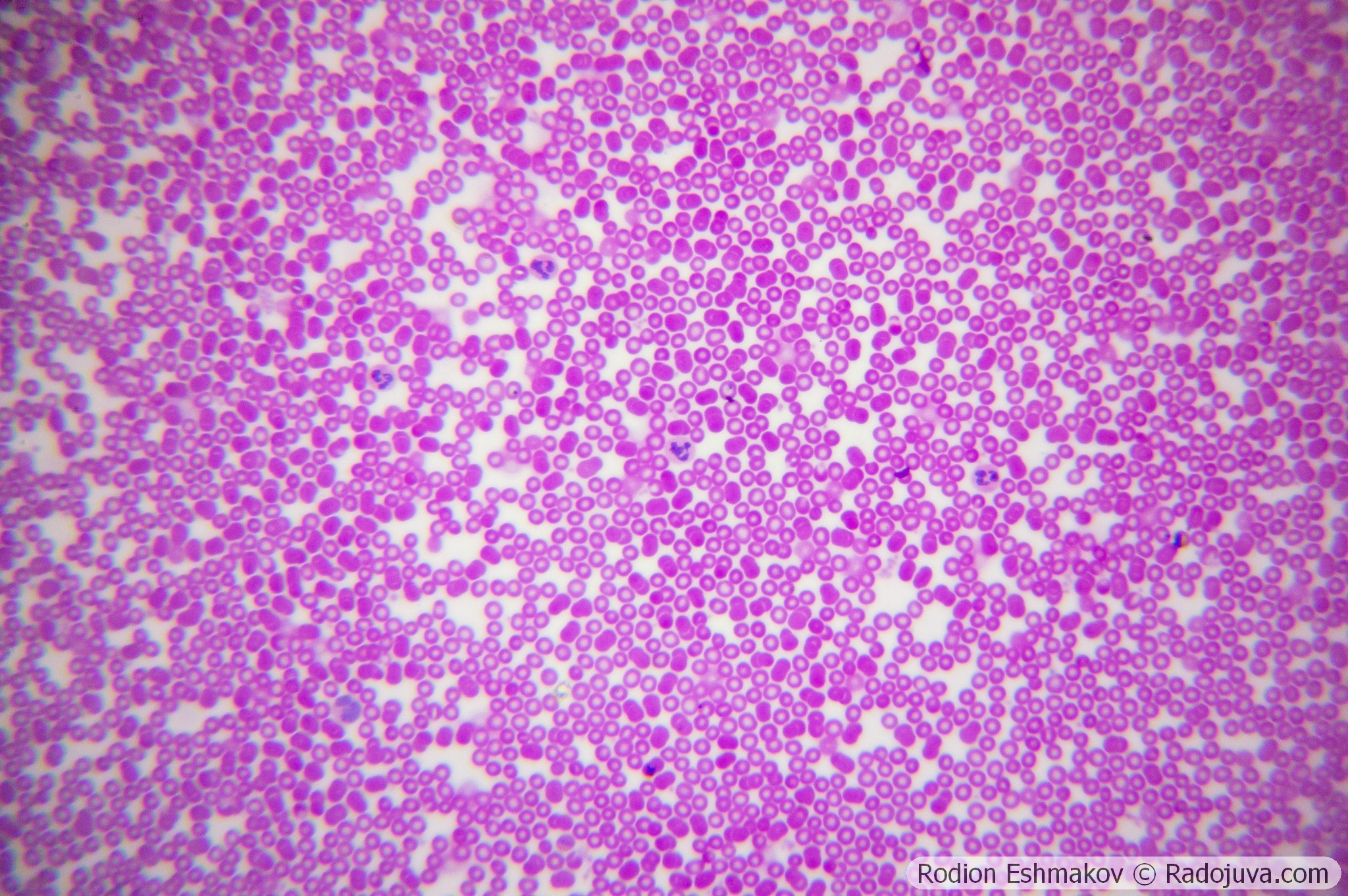
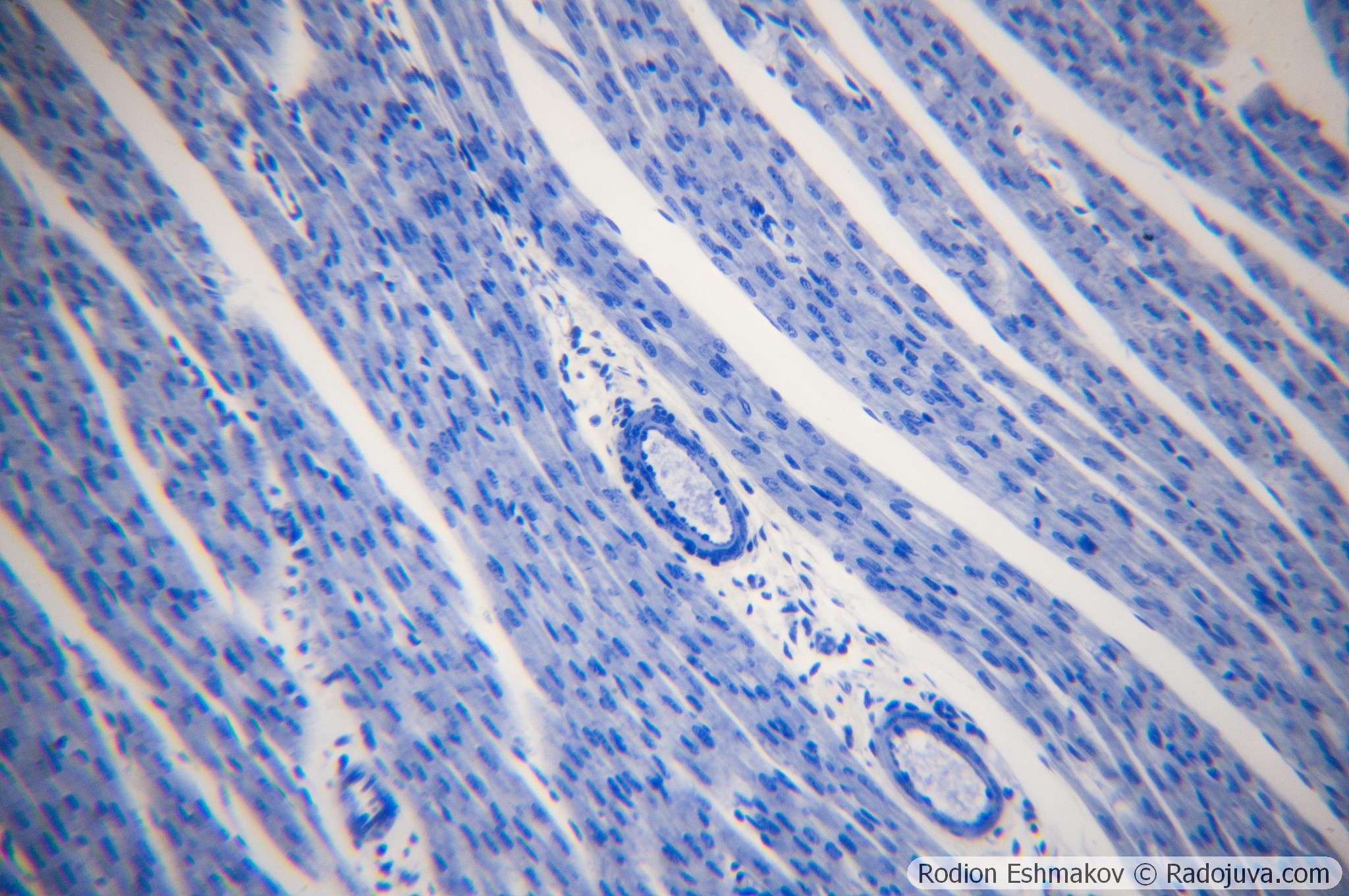
Below are photos taken without stacking. In the photos: 1-5) Diatom shells in diatomite, finished preparation (light and dark fields); 6) Stained spinal cord preparation; 7) Stained blood preparation; 8) Stained cardiac muscle preparation.
Conclusions
This Chinese achromatic 40/0.65 160/0.17 lens, like the 100/1.25 from the same kit, is a very poor objective, inferior even to the Soviet mass-produced LOMO 40/0.65 from Biolam microscopes. This objective is suitable for niche applications, such as teaching schoolchildren and students how to work with short-working-distance optics, and can be used for laser beam collimation (we successfully use this objective in our Raman spectrometer in the lab). However, it's best to avoid this objective in work – as a last resort, you can replace it with the 60/0.85 objective from the same kit, or, if you have the budget, with the Plan 40/0.65 160/0.17 WD0.68 objective.