
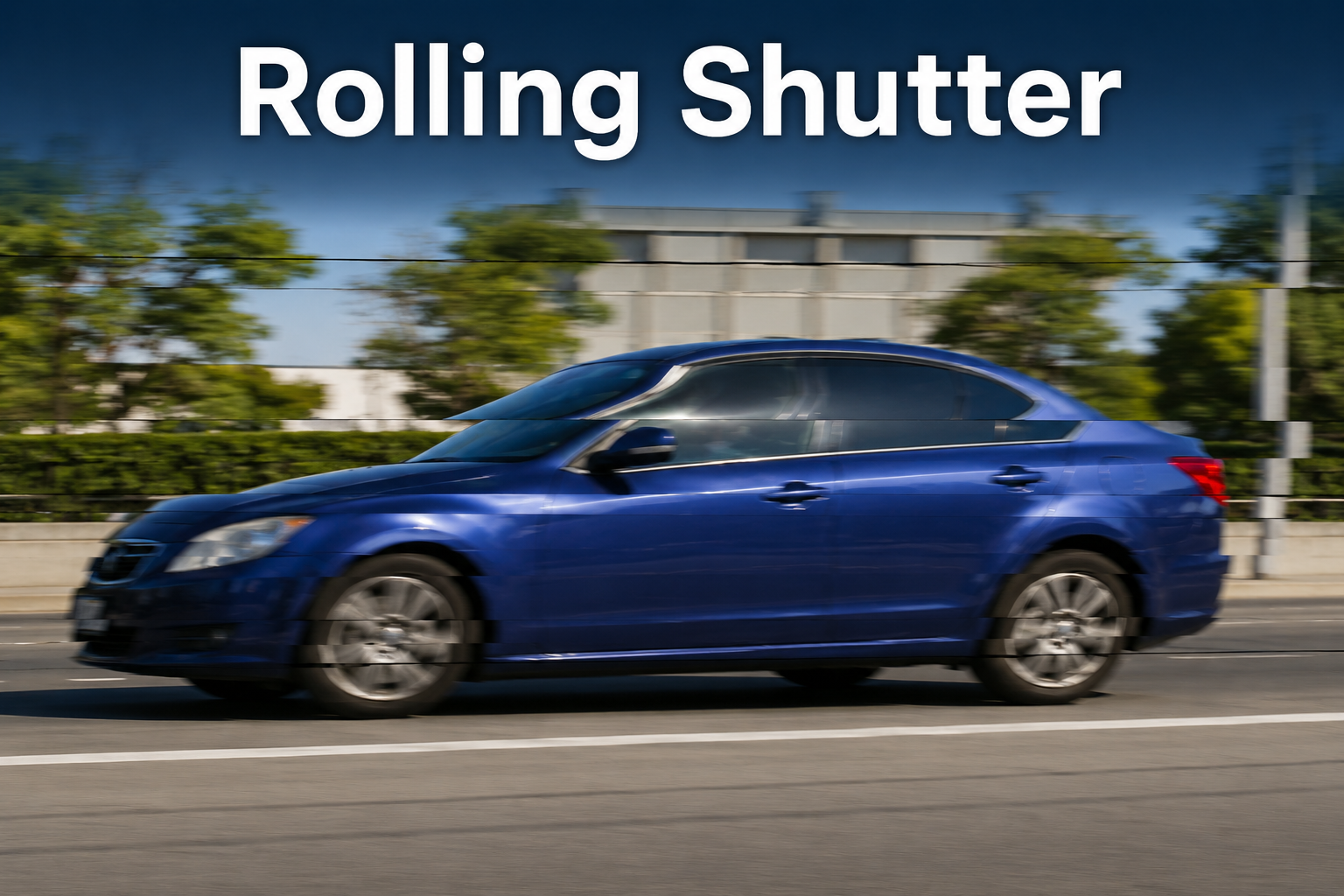
Rolling shutter
Only values for full-frame mirrorless cameras of Sony , Nikon , Canon , Leica , Panasonic , Sigma systems are shown here.
The time it takes to read one frame from the sensor/matrix with an electronic shutter in standard photo mode ( sensor readout time ) is the time it takes the camera to sequentially “read” the entire frame from the matrix/sensor with an electronic shutter.
The smaller it is, the:
- less rolling shutter (curvature of moving objects)
- The camera is better suited for sports, birds and fast movements.
- closer to the behavior of the “ideal” global shutter
Simply put, it's how quickly the camera "scans" the frame from top to bottom before saving it. Additional tricks are usually used for video mode.
Sony
| Camera | Sensor reading (electronic shutter) |
|---|---|
| sony a9 III | Global shutter (≈ 0 ms) |
| Sony a1II | 1/330–1/270 s (3–4 ms) |
| Sony a1 | 1/280–1/240 s (4–4.5 ms) |
| Sony a9 | 1/180–1/140 s (5.5–7 ms) |
| Sony a9II | 1/180–1/140 s (5.5–7 ms) |
| Sony a7R VI | 1/120–1/90 s (8–11 ms) |
| sony a7s III | 1/90–1/70 s (11–14 ms) |
| Sony ZV-E1 | 1/90–1/70 s (11–14 ms) |
| Sony a7 V | 1/90–1/70 s (11–14 ms) |
| sony a7s | 1/35–1/28 s (28–36 ms) |
| sony a7s II | 1/32–1/25 s (31–40 ms) |
| sony a7 III | 1/22–1/18 s (45–55 ms) |
| sony a7c | 1/22–1/18 s (45–55 ms) |
| Sony a7 IV | 1/17–1/14 s (58–71 ms) |
| Sony a7CII | 1/17–1/14 s (58–71 ms) |
| sony a7r II | 1/15–1/12 s (67–83 ms) |
| sony a7r III | 1/11–1/9 s (90–110 ms) |
| sony a7r IV | 1/8–1/6 s (125–167 ms) |
| Sony a7R V | 1/7–1/5 s (143–200 ms) |
| Sony a7CR | 1/7–1/5 s (143–200 ms) |
| Sony a7 | There is no electronic shutter |
| Sony a7II | There is no electronic shutter |
| Sony a7R | There is no electronic shutter |
Canon
| Camera | Sensor reading (electronic shutter) |
|---|---|
| Canon EOS-R1 | 1/300–1/250 s (3–4 ms) |
| Canon EOS-R3 | 1/220–1/180 s (4.5–5.5 ms) |
| Canon EOS R5 Mark II | 1/180–1/140 s (5.5–7 ms) |
| Canon EOS R6 Mark III | 1/120–1/90 s (8–11 ms) |
| Canon EOS R6 V | 1/120–1/90 s (8–11 ms) |
| Canon EOS R6 Mark II | 1/70–1/55 s (14–18 ms) |
| Canon EOS-R8 | 1/70–1/55 s (14–18 ms) |
| Canon EOS-R6 | 1/60–1/45 s (17–22 ms) |
| Canon EOS-R5 | 1/25–1/20 s (40–50 ms) |
| Canon EOS R5C | 1/25–1/20 s (40–50 ms) |
| Canon EOSRP | 1/18–1/15 s (55–65 ms) |
| Canon EOS | 1/15–1/12 s (65–80 ms) |
| Canon EOS Ra | 1/15–1/12 s (65–80 ms) |
Nikon
| Camera | Sensor reading (electronic shutter) |
|---|---|
| Nikon ZR | 1/300–1/250 s (3–4 ms) |
| Nikon z9 | 1/270–1/220 s (3.7–4.5 ms) |
| Nikon z8 | 1/270–1/220 s (3.7–4.5 ms) |
| Nikon Z6 III | 1/130–1/100 s (8–10 ms) |
| Nikon z5 II | 1/90–1/70 s (11–14 ms) |
| Nikon Zf | 1/70–1/55 s (14–18 ms) |
| Nikon z6 ii | 1/40–1/30 s (25–33 ms) |
| Nikon z6 | 1/35–1/28 s (28–36 ms) |
| Nikon z5 | 1/30–1/25 s (33–40 ms) |
| Nikon z7 ii | 1/18–1/15 s (55–65 ms) |
| Nikon z7 | 1/15–1/12 s (65–80 ms) |
Panasonic
| Camera | Sensor reading (electronic shutter) |
|---|---|
| Panasonic S1 II / S1 II E | 1/120–1/90 s (8–11 ms) |
| Panasonic S1R II | 1/110–1/85 s (9–12 ms) |
| Panasonic S5 II / S5 II X | 1/80–1/60 s (12–17 ms) |
| Panasonic S9 | 1/80–1/60 s (12–17 ms) |
| Panasonic BS1H | 1/60–1/45 s (17–22 ms) |
| Panasonic S1H | 1/60–1/45 s (17–22 ms) |
| Panasonic S5 / S5D | 1/55–1/40 s (18–25 ms) |
| Panasonic S1R | 1/25–1/20 s (40–50 ms) |
| Panasonic S1 | 1/25–1/20 s (40–50 ms) |
Leica
| Camera | Sensor reading (electronic shutter) |
|---|---|
| Leica SL3-S | 1/140–1/110 s (7–9 ms) |
| Leica SL3 | 1/100–1/80 s (10–12 ms) |
| Leica SL2-S | 1/70–1/55 s (14–18 ms) |
| Leica SL2 | 1/25–1/20 s (40–50 ms) |
| Leica SL | 1/25–1/20 s (40–50 ms) |
Sigma
| Camera | Sensor reading (electronic shutter) |
|---|---|
| Sigma BF | 1/120–1/90 s (8–11 ms) |
| sigma fp | 1/35–1/28 s (28–36 ms) |
| Sigma fp L | 1/20–1/15 s (50–65 ms) |
This material was prepared by Arkady Shapoval . The greatest support for the site is if you use links on this site, such as Amazon , when purchasing anything . It costs you nothing, but for this site, and therefore for my family, it's the main source of support.

Arkady, hello! Thanks for the information! It's very helpful and valuable!
Please don't take this as a know-it-all, but I would change the wording at the beginning of this article: The smaller it is, the... To: The faster the reading speed:... it will be more logical and understandable.
Fixed
"Sensor readout time is the time it takes for a camera to sequentially "read" the entire frame from the sensor using an electronic shutter." Fundamental error.
In English, the correct translation is "sensor readout time." Readout speed is the number of frames read per second. The higher the speed, the shorter the frame readout time. The lower the speed, the longer the readout time. All tables use time as a value. The speed of reading a sequence of frames may be lower than the frame readout time would indicate, as buffer write time, memory card write time, and other hardware and software delays are all factored in.
To put it simply, the difference between kilometers per hour (speed) and hours (time) is obvious; speed is definitely not time.
Fixed
But to think that the buffer affects rolling shutter is also a bit of a stretch.
Why not? If the processor gets distracted in the middle of a frame being read... It's not the buffer itself that's affected, but the work of the engineers and programmers. However, the impact won't be on the average performance, but rather on certain "unlucky" frames in a series, especially in long ones. If you use a cheap memory card, the likelihood of experiencing such "lag" increases. You can also crank up the temperature settings to the limit...
And then, I don't think so. I (literally) wrote that the frame read speed in a sequence can be lower (slower) than the read speed of a single frame, since there are other actions that occur between frames, which are added to the milliseconds spent reading the frame itself. In a sequence, this is taken into account, but in an individual frame, it is neglected... In other words, I was discussing the incorrectness of the term "speed" in this note, which was fixed. Now my comments can be deleted; the article is perfect.
Forgive me, but that's a completely different topic.
So, with the Nikon Z9, where the actual shutter speed is ~1/250th of a second, it's impossible to shoot a fast-moving subject, which requires a mirror-image shutter speed of 1/1000th of a second. What do shutter speeds shorter than the sensor's readout speed mean on a zoom lens?
This time is the difference between the start of the frame readout and the end of the frame readout. It's the readout, not the exposure time. Each pixel is exposed according to the shutter speed, for example, 1/8000 of a second (accumulating charge), but the last pixel (row) will only be read 1/250 of a second after the first pixel (row) is read. During this time, something in the frame can change (move, usually tilt). Anything shorter than 1/100 of a second is very, very good. And in this regard, the Z9 is indistinguishable from a regular mechanical shutter. I shoot a lot with the Sony a9, which is about 1/160, and I've never noticed a difference with a mechanical shutter. But on my Nikon Z5, the rolling shutter is enormous; even the slightest movement of the camera causes everything in the frame to tilt. The Sony A9M3 has a global shutter, meaning all pixels are read simultaneously, not line by line.
Hi,
Just out of curiosity, how did you do the testing? I noticed cameras having 8 – 10 milliseconds so does that mean that 8 milliseconds is with a specific settings in the camera?