
Huge thanks to Sergey Galusha for providing the 7Artisans 60mm 1:2.8 Macro II lens.
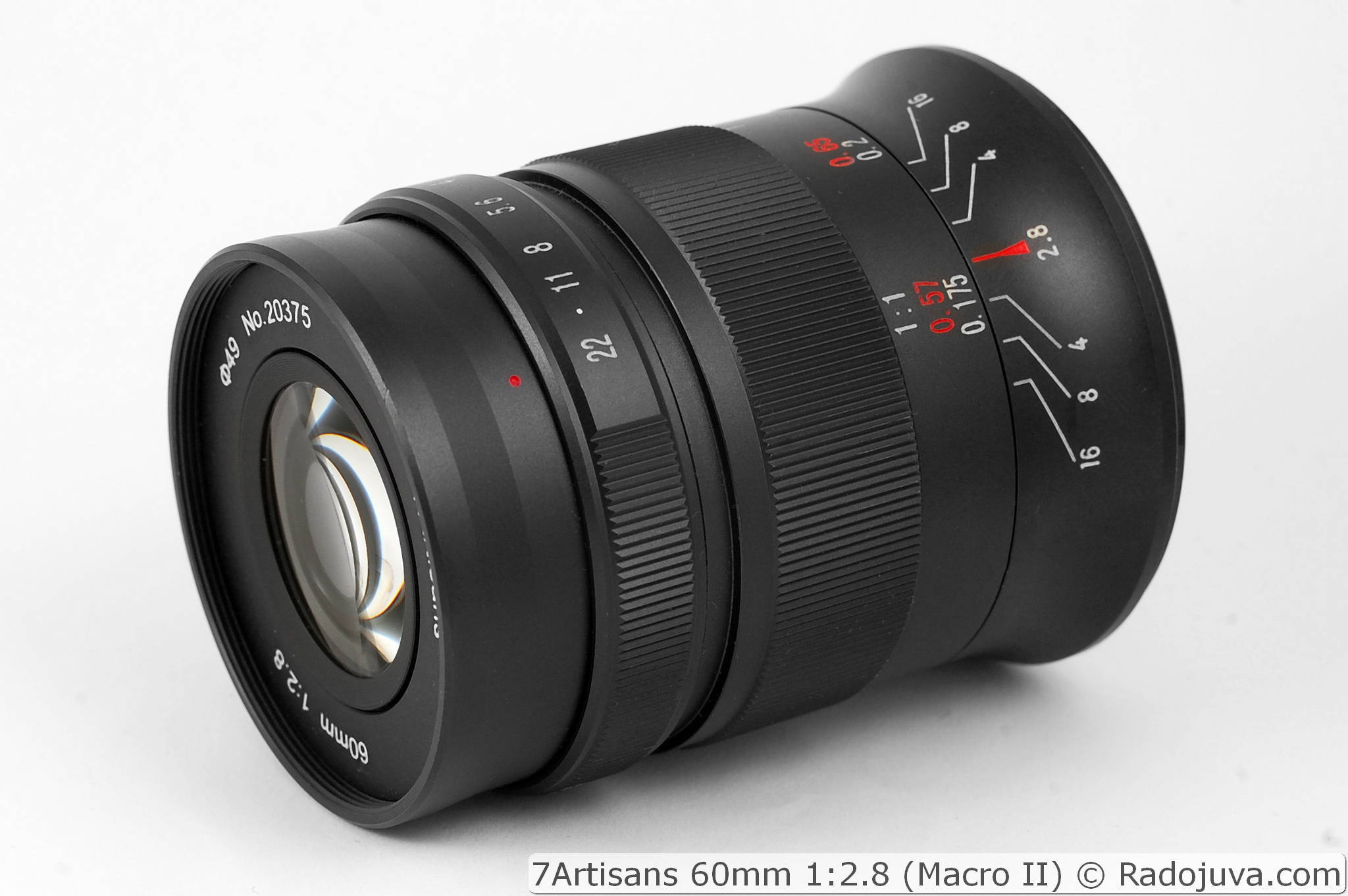
7Artisans 60mm 1:2.8 Macro II. Enlarge.
Navigation
- In short
- All 7Artisans lenses
- Main Specifications
- Assembly
- Focusing
- Image quality
- Sample Photos
- Price
- Conclusion
- User Comments
- Add your review or question on the lens
Please note that the 7Artisans 60mm 1:2.8 Macro II lens is available with various mounts. This review shows the 7Artisans 60mm 1:2.8 Macro II for Fujifilm X mirrorless cameras with APS-C sensors (for cropped cameras). However, the 7Artisans Macro 60mm F2.8 is also available with Sony E , Nikon Z , Leica L , Canon EF-M , Canon RFS , Fujifilm X , and Micro Four Thirds mounts . At the time of the lens's announcement , the list of available mounts was significantly smaller.
In this review, I will abbreviate the 7Artisans 60mm 1:2.8 Macro II lens as “7Artisans 60/2.8 II”.
7Artisans 60mm 1: 2.8 Macro II
In short
The 7Artisans 60/2.8 II is a modern macro lens for mirrorless cameras with an APS-C sensor (or smaller). It offers a maximum magnification of 1:1 and produces excellent image quality. This highly popular lens is one of 7Artisans ' best-selling lenses . It's sharp in the center of the frame even at f/2.8.
It is interesting due to its low price , all-metal body, 9 aperture blades and internal focusing.
The 7Artisans 60/2.8 Macro lens (the first version) was introduced on June 5, 2019. On May 20, 2021 , a follow-up model was announced – the 7Artisans 60mm 1:2.8 Macro II (from this review).
A list of all lenses from 7Artisans can be found on Radozhiv here.

7Artisans 60mm 1: 2.8 Macro II
Main technical characteristics of 7Artisans 60mm 1:2.8 Macro II:
| Review Instance Name | Near the front lens: 7Artisans 60mm 1:2.8 Ф49 No.20375
From the 'X-Mount' mount side |
| Basic properties |
|
| Front Filter Diameter | 49 mm |
| Focal length | 60 mm
|
| Zoom ratio | 1 X (this is a fixed lens, it does not have a zoom) |
| Designed by | Option from the review for cropped mirrorless cameras Fujifilm x.
This lens exists with mounts: |
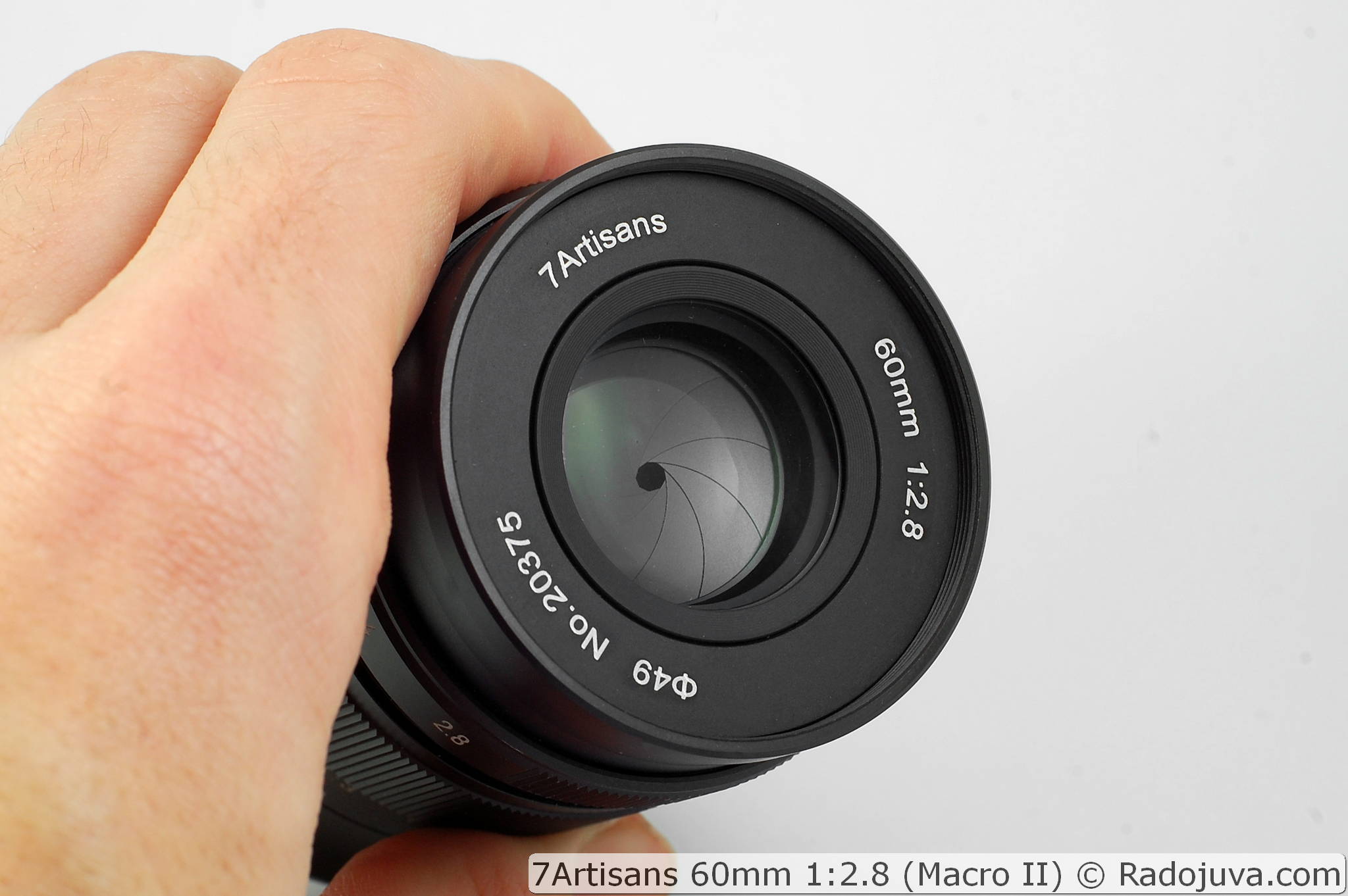
| Number of aperture blades | 9 rounded petals |
| Tags |
|
| Diaphragm | from F / 2.8 to F / 16, controlled using the aperture control ring. There are marks for F / 2.8, 4, 5.6, 8, 11, 16 (dot only), 22. The ring rotates without clicks, smoothly. You can set any intermediate value. |
| MDF | 0.175 meters, maximum magnification ratio 1:1
working distance about 10 centimeters |
| The weight |
|
| Optical design | 11 elements in 8 groups
It is stated that ultra-low dispersion and conventional spherical elements from Hoya are used. |
| Lens hood | It must be screwed into the thread of the front filter, is supplied |
| Manufacturer country | Made in China (there is no data on the country of manufacture on the lens itself) |
| Period | Announced May 20, 2021 |
| Price |

These lenses are very popular. All major lens manufacturers have 60/2.8 MACRO class models in their arsenal. Often these lenses are used not only for macro photography, but also for a variety of creative photography.

7Artisans 60mm 1: 2.8 Macro II
Assembly
Overall the lens is well built.
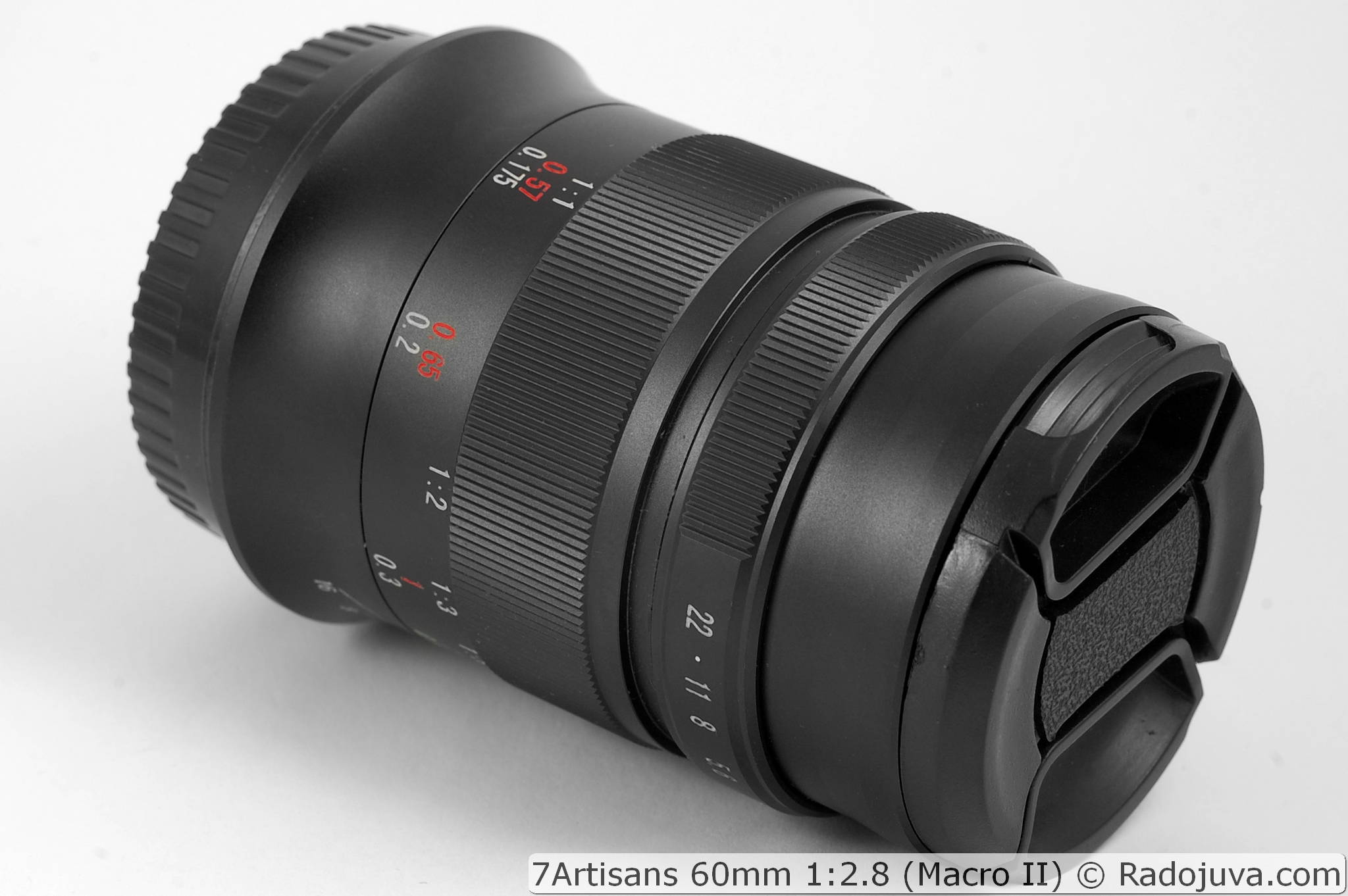
The 7Artisans 60/2.8 II uses a metal bayonet mount, and the lens barrel itself is made entirely of metal (aluminum). The bayonet mount is painted black (dark brown).
The front lens cap is metal and has no latches ; it simply fits snugly against the frame. There's a special fabric seal on the inside of the cap. It fits snugly and is easy to install and remove.
The weight of the 7Artisans 60/2.8 II itself is more than 300 grams. In your hands, the lens feels like a solid thing.
The nine- bladed aperture produces a circular opening at all aperture settings, resulting in fairly round discs of blur in out-of-focus areas of photos. The aperture can only be controlled manually using a dedicated aperture ring. The aperture ring rotates smoothly, without clicks or fixed values, allowing you to set any intermediate value between f/2.8 and f/22, which is very useful when shooting video. The aperture ring is located on the front side of the lens , behind the focus ring. This placement of the aperture ring is quite convenient.

7Artisans 60mm 1: 2.8 Macro II
Focusing
The 7Artisans 60/2.8 II can only use manual focus.
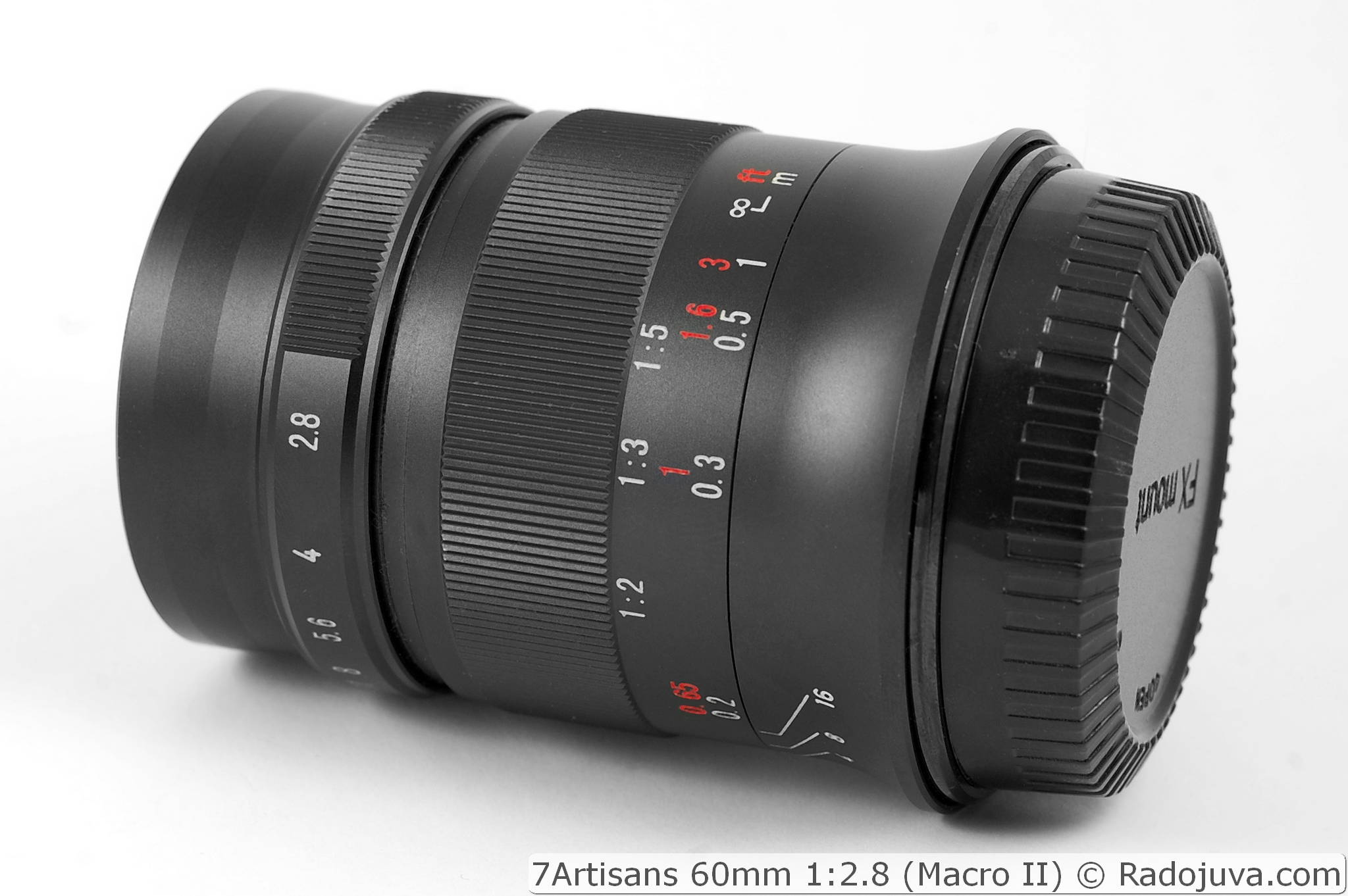
The focusing ring is not very wide, made of metal with fine serrations. It rotates 135 degrees (3/8 of a full turn). Focusing is smooth and pleasant.
The focusing ring is poorly 'stretched' in the range from half a meter to infinity, which is why it is extremely inconvenient to focus in this range of distances. The slightest touch of the focusing ring in this range will noticeably change the focusing accuracy.
The lens uses internal focusing - while rotating the focusing ring, the front and rear lenses remain motionless.
On the ring there is a scale with a focusing distance in meters and feet, a depth of field scale and a scale with a magnification factor.
The minimum focusing distance is 17.5 cm and the maximum magnification ratio is 1: 1. The working distance when shooting at 1: 1 magnification is about 10 cm (distance from the front of the lens to the subject).
There is a very strong 'Focus Breathing' effect (changing the viewing angle during focusing), which is characteristic of almost all macro lenses. When focusing towards the MDF, the viewing angle decreases.
7Artisans 60mm 1: 2.8 Macro II
Image quality
7Artisans 60/2.8 II is optically good.
Sharpness
- in the center of the frame at F/2.8 the lens behaves well. Sharpness at F/2.8 is present both when focusing at infinity and when focusing at about 1-2 meters
- good / excellent resolution in the center of the frame on covered apertures after F / 4
- there is a significant drop in sharpness in the corners of the frame at F/2.8
- the far corners of the image do not receive high resolution even at very closed apertures
Distortion
- the overall level of distortion is at a level typical for such lenses
- weak pincushion distortion
- difficult to notice distortion
Vignetting
- slight vignetting at F/2.8 and focusing at infinity
- easy to fix
- almost completely disappears after F/4
- when used on full-frame cameras, during focusing there will be absolutely dark edges and corners of the image, but when focusing on MDF you can get rid of vignetting
Aberration
- low chromatic aberration, including low fringing
- freezing almost completely disappears after F/4
Rest
- You can get significant artifacts from bright light sources; in backlight the lens behaves mediocrely
- The lens tolerates side light well, maintaining high contrast
Important: At the time of writing this review, a 7Artisans 60/2.8 Macro profile for popular RAW converters was not available. You can create one yourself or wait for its release.
7Artisans 60mm 1: 2.8 Macro II
Sample Photos
Sergey Galusha shared some sample photos from the 7Artisans 60/2.8 II.



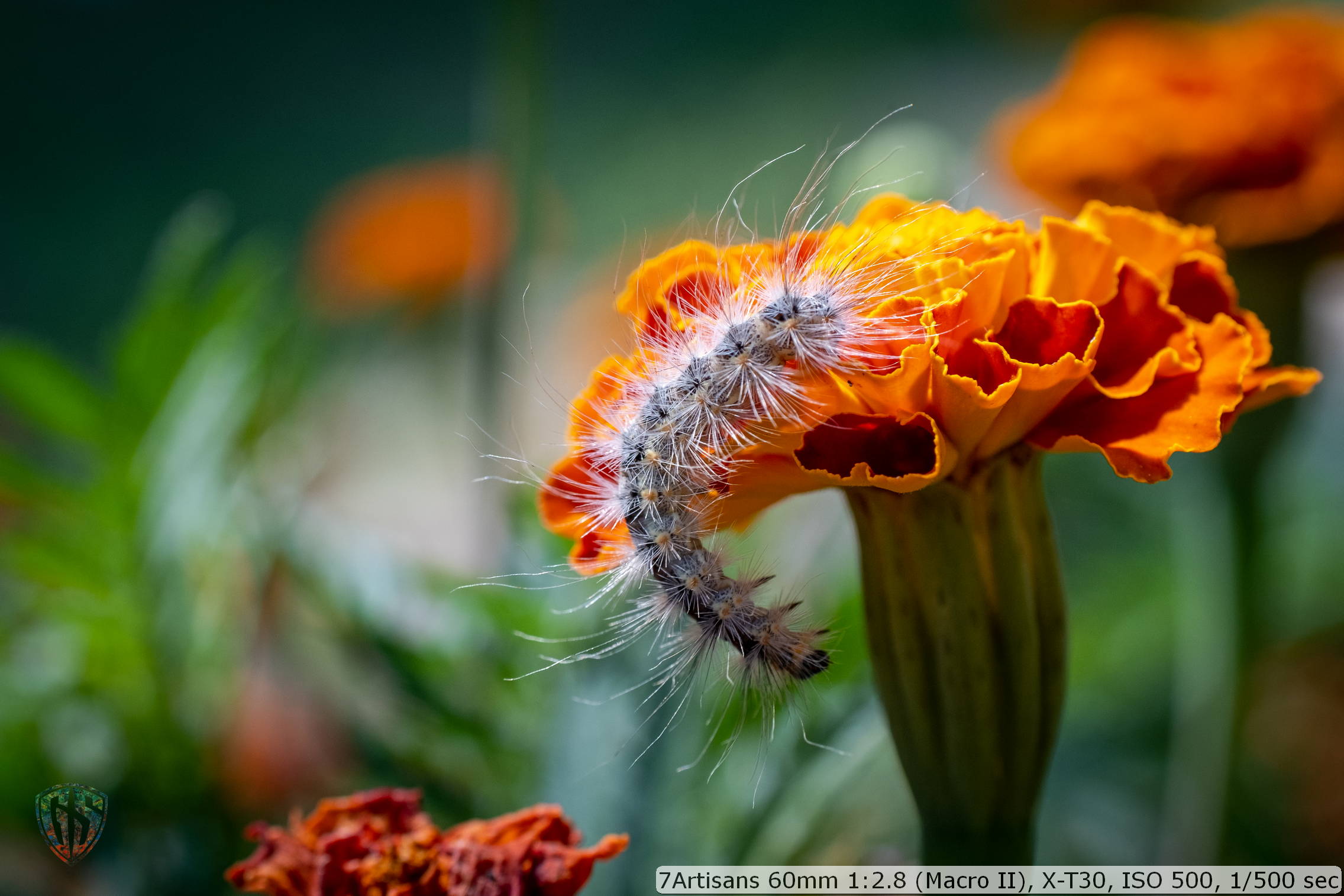





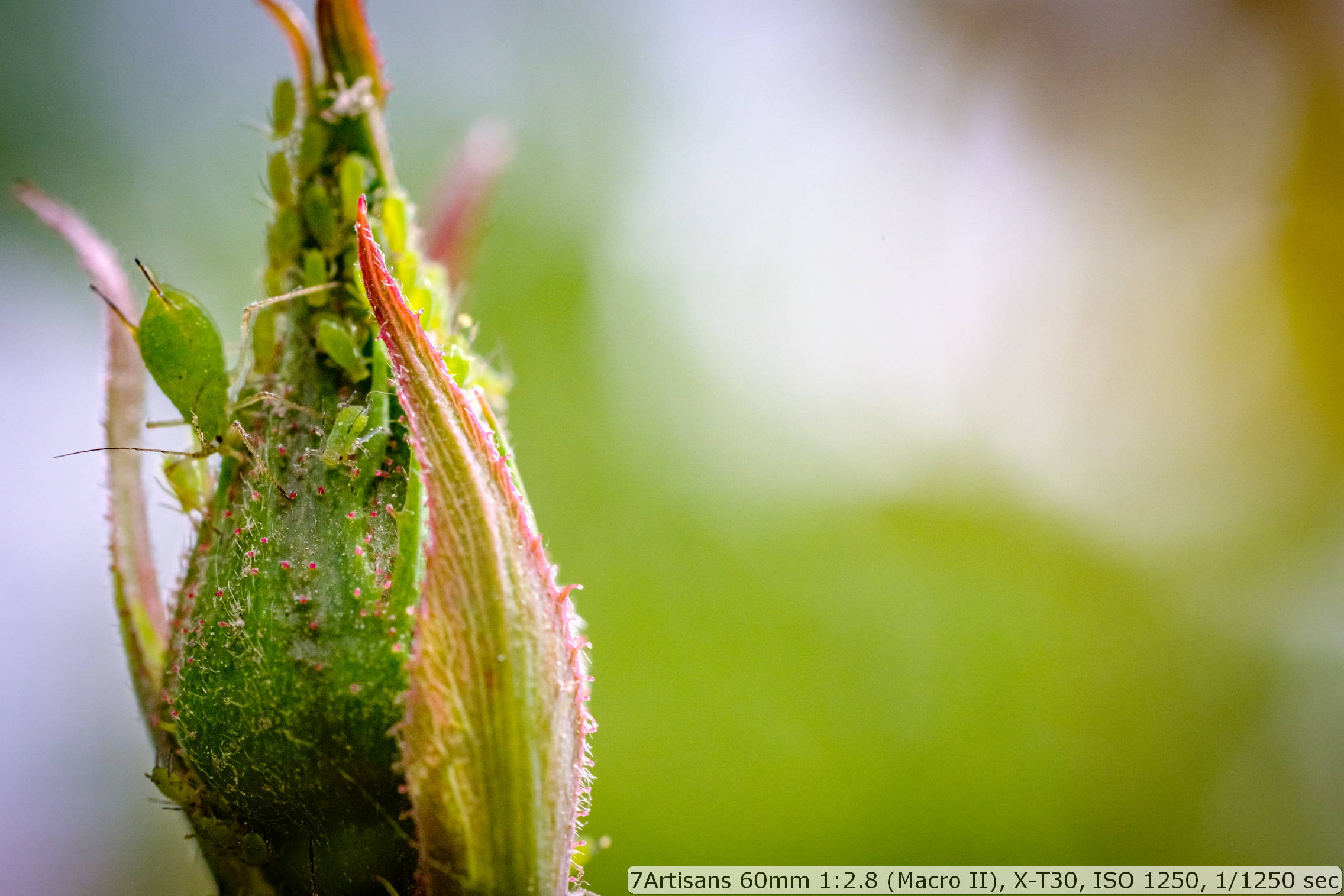
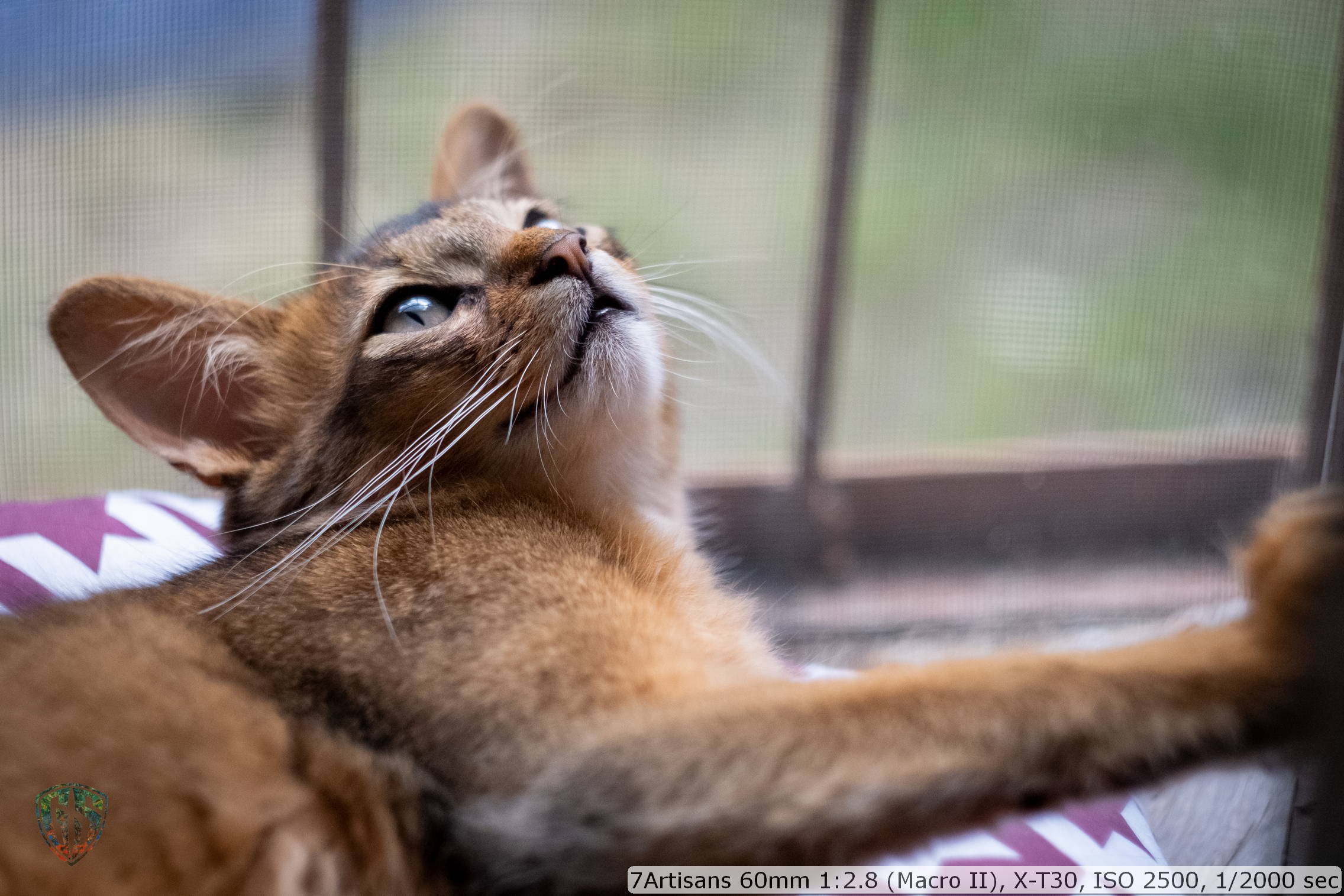



And some sample photos from my legendary Nikon D40 can be seen here , and several original RAW ('.NEF') files can be seen here.

7Artisans 60mm 1: 2.8 Macro II
Price
View on the Pergear website with free shipping.

7Artisans 60mm 1: 2.8 Macro II
Conclusion
7Artisans 60/2.8 II is an inexpensive macro lens for cropped mirrorless cameras of popular systems. Optically and mechanically balanced. I recommend.
10 main advantages
- low cost (about 170 dollars)
- internal focus
- ability to shoot with 1:1 magnification
- special optical elements in the optical design (previous version 7Artisans Macro 60mm F2.8 didn't have them)
- compact sizes
- the lens barrel is completely made of metal, including a metal mount
- there is a scale of depth of field, focusing distance and magnification
- the aperture ring rotates smoothly, without intermediate values (useful for video)
- good sharpness in the center of the frame already at F / 2.8
- well fixed chromatic aberration
10 main disadvantages
- small focus ring pitch
- difficult to focus at long and medium focusing distances
- previous version 7Artisans Macro 60mm F2.8 had 10 aperture blades (versus 9 blades in the second version)
- previous version 7Artisans Macro 60mm F2.8 had a significantly larger (better) working distance to the shooting lens at a scale of 1:1
- previous version 7Artisans Macro 60mm F2.8 had a hood included in the package, which could be immersed in water and perform macro photography underwater
- ordinary Chinese 'no-name' back cover, which does not inspire much confidence in the brand
- no CPU pins to form the correct EXIF
- a threaded (non-bayonet) hood should be used
- there is no lens profile for popular RAW converters, the lens is not 'hardwired' into modern cameras
- significant deterioration in resolution at F/2.8 in the corners of the image
This material was prepared by Arkady Shapoval . The greatest support for the site is if you use links on this site, such as Amazon , when purchasing anything . It costs you nothing, but for this site, and therefore for my family, it's the main source of support.

I’ve been using it for a year now, for my money the lens is just fire, but focusing beyond a meter is really almost impossible.
Thank you for looking around, Arkadia.
The Chinese have begun releasing a large number of macro-objectives. Soon to surpass the Japanese and European pickers, taken as a number of names of makrushniks, which have never happened before)
In another iteration of this lens, a lot has changed, starting with the optical design and ending with the new appearance. The melodious and mechanical part has changed to a better one. If you look at the bayonet mount, you’ll be disappointed that you just need to screw the bayonet adapters together.
A friend had the first version for the EOS-M mount of such a lens. Beside the doors, through which the insides were visible, there was a pile of thick silicone oil and shavings on helicoids, through which the lens had to be sorted and cleaned in order to remove everything.
The new version, I bet, no longer has this.
Ale marvel at the price and it’s easy to come to your senses: for the price a hat is sewn for Vanya)
Yes, in the review of the first version I described in detail that the mechanics there are disgusting. This is a completely different matter. I would even say it is very good here.
The Chinese have already surpassed everyone in terms of macro, laowa has long been the best on the market.
A revolution for advertisers and videographers
Often they got around. Prote makrushnikov with a focal length and not 150, not 180, not 200 have not yet overcome the stench. And from the excess, 2-5 times they got it in their teeth. It is not yet known what the durability of these macroscopic lenses is. They have a lot of plastic lenses, and as far as durability is concerned, the power supply will not last. Chinese-made eyepiece lenses are not ice. of the same hardness, and after 3-4 cycles, their light transmittance drops significantly . Korean lenses are on the front.
It is possible that the Chinese will soon remove the lens from an increase of x5-10. I want, I think, in which there will be technical, or more precisely, optical changes. Ale bulo bazhannya da mozhlivosti.І pennies) The hour will tell.
I have this version for Nikon Z. Another disadvantage I would add is this stupid front cover without a latch. It can easily fall off when carried.
But there really are no complaints about the optics (at this price). The lens also provides a very pleasant, neutral blur, without clearly noticeable artifacts in the blur circle.
Look at my lens. And, as you say, the cover is not suitable for anyone. Meal price is $1. Before that, I bought a vikory blend, and with such a layout, the real glass went straight into the box.
I used it for several months, mainly for macro photography of small animals. I rarely used F2.8-4, as the depth of focus and aperture aren't critical with flash. I occasionally used the macro extension tubes for magnification beyond 1:1. The center sharpness is quite adequate for a 32MP APS-C sensor, even with extensive cropping.
Focusing at close range is quite convenient. However, I personally didn't like the placement of the aperture ring—since it's closer to the far end of the lens, I kept accidentally bumping it and moving it. And since it's click-less, it's fairly easy to move.
The body is well made (at least on my sample).
Overall, it's a great lens for the price. The key is to avoid buying from local resellers, where I've seen prices as high as $600, which is completely absurd. I bought it from the manufacturer's official website – they shipped it to Ukraine quickly, and I received it via Meest within a week and a half.
I recommend it for macro, but if you use it for other purposes, then, of course, there will be problems with both focusing and quality at an open aperture.
In the end, I changed it to the Laowa 90mm, since it has a 2:1 magnification and better optics (but also different dimensions and a higher price).