
A huge thank you to ProFotoSale for providing the Nikon N AF-S Nikkor 300mm 1:4E PF ED VR (SWM IF Nano Crystal Coat) lens. ProFotoSale sells a wide range of new and used lenses for various systems, including similar Nikon lenses.

Nikon N AF-S Nikkor 300mm 1:4E PF ED VR SWM IF Nano Crystal Coat. Increase.
Navigation:
- In short
- History
- Main Specifications
- Assembly
- Enlightenment 'N' (Nano Crystal Coat)
- Stabilizer
- Focusing
- Rare switch 'A / M - M / A - M'
- Diaphragm
- Image quality
- Sample photos (FX, DX)
- My experience
- Lens prices
- Conclusion
- User Comments
- Add your review or question on the lens
In the Nikon N AF-S Nikkor 300mm 1: 4E PF ED VR (SWM IF Nano Crystal Coat) review, I will abbreviate it as Nikon 300 / 4E VR.
The Nikon 300/4E VR's appearance was taken from bhphotovideo.com . You can see the specific model I reviewed here (profotosale.com.ua) , here (club-foto.ru) , here (facebook.com) , here (instagram.com) , or here (vk.com).
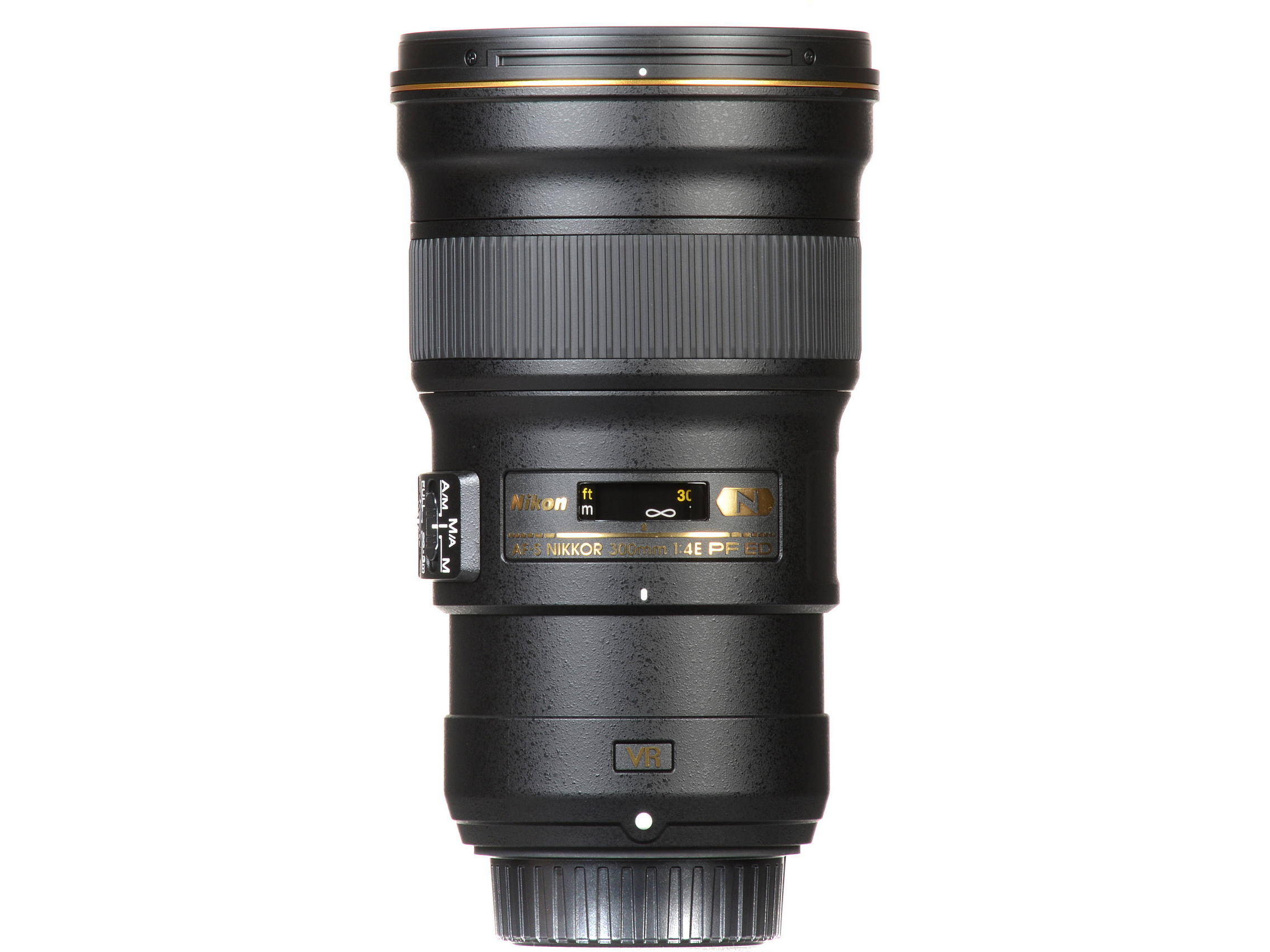
Nikon N AF-S Nikkor 300mm 1: 4E PF ED VR SWM IF Nano Crystal Coat
In short
The Nikon 300/4E VR is a high-quality telephoto prime lens with image stabilization. It's a significant upgrade from the previous Nikon ED AF-S Nikkor 300mm 1:4D IF Silent Wave Motor lens , announced back in 2000. Overall, it's a solid lens for the professional lineup. It's the latest (and newest) and best in its lineup.
Among its features, the lens's record-low weight and compact size are particularly noteworthy . It is the most compact and lightweight lens in its class . This small size was achieved through the use of a phase Fresnel lens (represented by the 'PF' designation in the lens name).
The 300mm focal length is the focal length transition from telephoto to super telephoto. But due to its maximum aperture of f / 4, this lens can be easily paired with teleconverters.

Nikon N AF-S Nikkor 300mm 1: 4E PF ED VR SWM IF Nano Crystal Coat
History
Nikon has been manufacturing 300/4 (4.5) class lenses since 1964.
There are 3 autofocus versions of full-frame lenses for 300/4 class SLR cameras in total:
- Nikon ED AF Nikkor 300mm 1: 4, from June 1987 to August 2000
- Nikon ED AF-S Nikkor 300mm 1: 4D IF Silent Wave Motor (there are two sub-versions: with a black or a white case), from August 2000 to the present day (in 2021 it is still considered the current model)
- Nikon ED AF-S Nikkor 300mm 1: 4 E PF N VR SWM IF Nano Crystal Coat, January 2015 to present. Lens shown in this review
It 's worth noting that the Nikon 300/4E VR was the first Nikon Nikkor lens to use PF (Phase Fresnel) optical elements . Canon had been producing lenses with similar Diffractive Optics technology since December 2001, including the Canon EF 400mm 1:4 DO (Diffractive Optics) IS USM (2001) and the Canon Zoom Lens EF 70-300mm 1:4.5-5.6 DO (Diffractive Optics) IS USM (2004).
In June 2018, another lens was released – Nikon N AF-S Nikkor 500mm 1:4E ED PF VR , which takes advantage of PF elements and has a record-breaking light weight.

Nikon N AF-S Nikkor 300mm 1: 4E PF ED VR SWM IF Nano Crystal Coat
Main technical characteristics of Nikon N AF-S Nikkor 300mm 1: 4E PF ED VR (SWM IF Nano Crystal Coat):
| Review Instance Name | Gold letters: Nikon N AF-S Nikkor 300mm 1: 4E PF ED VR
On the body in white letters: Nikon SWM VR PF ED IF Ø77 Nano Crystal Coat Made in CHINA |
| Basic properties |
|
| Front Filter Diameter | 77 mm, metal thread for filters |
| Focal length | 300 mm, EGF for Nikon DX cameras is 450 mm, EGF for Nikon CX cameras is 810 mm |
| Zoom ratio | 1 X (this is a fixed lens, without the ability to change the focal length) |
| Designed by | primarily for Nikon FX digital full-frame cameras |
| Number of aperture blades | 9 rounded petals |
| Tags |
|
| Diaphragm | from f / 4 to f / 32. The lens does not have an aperture ring (G - lens type) |
| MDF (minimum focusing distance) | 1.4 meters, maximum magnification ratio 1:4.17 |
| The weight |
|
| Optical design | 16 elements in 10 groups, 1 element is low dispersion (ED element is shown in yellow in the optical diagram). 1 element is a phase Fresnel lens (such an element is shown in green in the optical scheme)
Clickable Image |
| Lens hood | Usually comes in the box, Nikon marking HB-73 |
| Transportation | Using the Nikon CL-M3 Case |
| Period | since January 2015 |
| Manufacturer country | Made in CHINA (made in China) |
| Instructions | See |
| Cost | See |

Compared to lenses in the 300/2.8 class , the 300/4 series is more basic. However, all 300/4 versions are professional Nikon Nikkor lenses and are included in the Nikon Professional Service list. Incidentally, the 300mm is exactly the middle of the 200-400mm range, which is used by more expensive lenses: the Nikon 200-400/4G VR , Nikon N 200-400/4GII VR , and Nikon N 180-400/4E VR . Therefore, many tasks can be solved with a relatively inexpensive Nikon 300/4E VR instead of very expensive f/4 zooms.

Nikon N AF-S Nikkor 300mm 1: 4E PF ED VR SWM IF Nano Crystal Coat
Assembly
Nikon 300 / 4E VR is well built. The build quality matches the professional focus of the lens. The lens barrel has the characteristic slightly 'wrinkled' coating found in many professional Nikkor lenses. The lens body is made of plastic, but with a metal mount and thread for light filters.
The lens weighs approximately 750 grams (without a tripod foot). This is very light. Furthermore, the Nikon 300/4E VR is very compact. It weighs almost as much as a standard Nikon 70-300/ 4.5-5.6G VR and is comparable in size to a Nikon 24-70/2.8E VR . The length of the Nikon 300/4E VR is only 14.7 centimeters. I found it very comfortable to use the Nikon 300/4E VR on the Nikon D700 and Nikon D40 cameras.
The Nikon 300 / 4E VR 'is equipped with' a special feature - a gold ring near the front lens, which means it can be classified as a professional lens in the NIKON NIKKOR line.
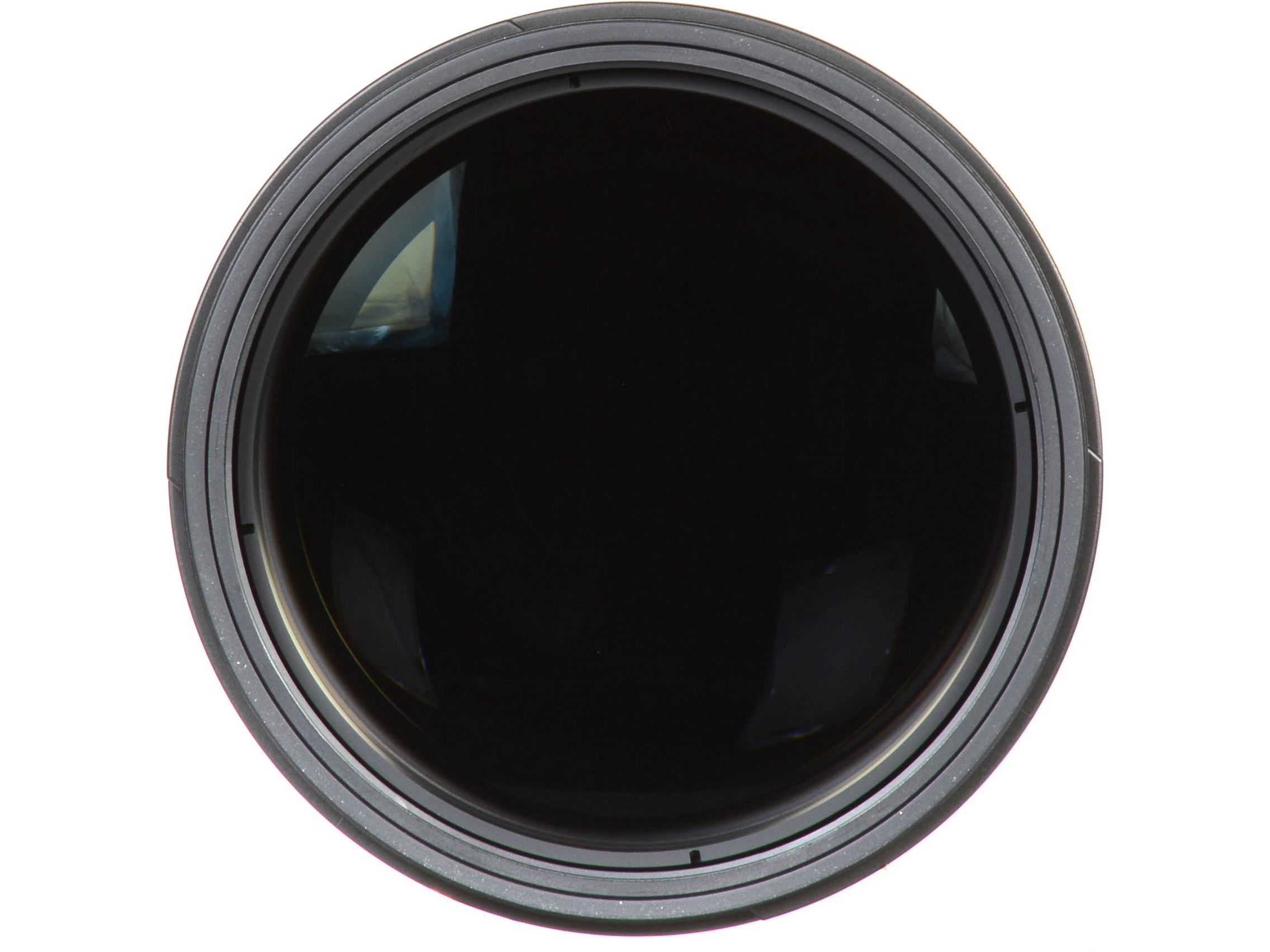
The front of the lens has a protective rubber bumper . There is also a rubber seal for the bayonet mount . The front lens has a special protective fluorine coating.
The Nikon 300/4E VR can use the detachable RT-1 tripod foot. Unfortunately, the foot is not included . This same foot also fits the Nikon N 70-200/4G ED VR . The average price of the original foot is around $160, but a Chinese-made one costs only about $10.
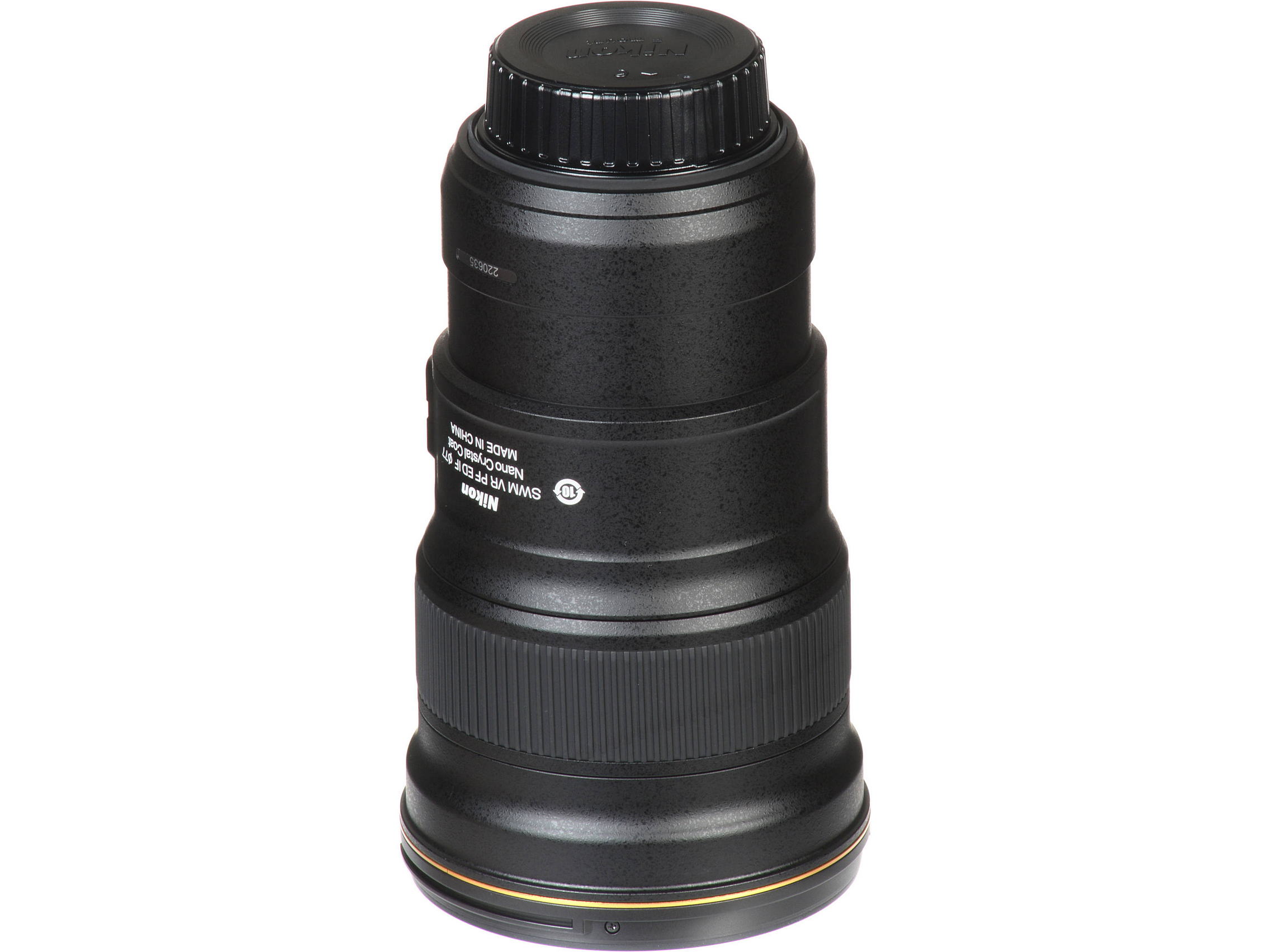
It's a bit of a pity that such a lens has the inscription 'MADE IN CHINA' (made in China).
Nikon N AF-S Nikkor 300mm 1: 4E PF ED VR SWM IF Nano Crystal Coat
Enlightenment 'N' (Nano Crystal Coat)
The Nikon 300/4E VR boasts the letter 'N' on its barrel. 'N' stands for 'Nano Crystal Coat', a nanocrystalline coating applied to the lens's optics. This coating effectively controls flare and ghosting, and also produces excellent color rendition. It's likely that only a few of the lenses in this lens feature this coating. The rest feature classic SIC ( Nikon Super Integrated Coating ) coating.
It is a pity that Nikon does not indicate the number of lenses in the optical scheme, which have 'N'-coating.

Nikon N AF-S Nikkor 300mm 1: 4E PF ED VR SWM IF Nano Crystal Coat
Stabilizer
The Nikon 300/4E VR features Nikon VR ( Vibration Reduction ) image stabilization , which , according to the manual, can compensate for 4.5 shutter speed stops . This translates to shutter speeds up to 23 times slower than what a lens without VR would require. The Nikon 300/4E VR does its job very well. It's one of the most powerful stabilization systems I've seen in a Nikon Nikkor lens.
The 4.5-stop ratio is the highest among all other Nikon Nikkor lenses and is only found in the Nikon 800/5.6E VR and Nikon 70-300/4.5-5.6E VR models.
To turn the stabilizer on/off, there is a switch on the lens called 'VR OFF/NORMAL/SPORT'.
There is a 'Normal / Sport' switch to select the mode. The gimbal can operate in two modes: 'Normal' and 'Sport'.
- 'Normal' mode Suitable for most static scenes and avoids camera shake.
- 'Sport' mode best suited for shooting dynamic scenes. In this mode, the image in the viewfinder is the most stable. This mode is great for use on a sedentary monopod. Usually such lenses have a Normal / Active switch, where in the Active position the stabilizer also works when the camera is moving, for example, while driving a car.
Both modes can track the movement of the camera to create panoramas. Both modes 'understand' when the lens or camera is mounted on a tripod and adapt their work to the current conditions.
I was able to take blur-free shots of still objects even with extreme effort at 1/20th of a second. And if you really try, you can get a sharp shot even at 1 /10th of a second ( example ). In real-world shooting, the stabilizer works very well.
It is recommended to turn off the stabilizer when shooting with a tripod at very slow shutter speeds.
Important : There is information that the first lenses had a problem with the stabilizer.

Nikon N AF-S Nikkor 300mm 1: 4E PF ED VR SWM IF Nano Crystal Coat
Focusing
The Nikon 300/4E VR focuses quite quietly thanks to the ' SWM ' motor ( Silent Wave Motor ) and is an ' AF-S ' type lens (with a built - in focusing motor ), and therefore will automatically focus on almost any Nikon DSLR camera.
The minimum focusing distance is just 1.4 meters, which is quite short for a 300mm focal length. However, you can shoot at a maximum magnification of 1:4.17 (a very good ratio).
Nikon 300 / 4E VR has a window with distance scale in meters and feet. There are no marks for working in the infrared spectrum, and there is no depth of field scale either.
The Nikon 300 / 4E VR has an optional 'Full ∞-3m' switch that acts as a focusing distance limiter. The ∞ sign means infinity.
- In the 'Full' position, automatic focusing is available over the entire range of distances - from ∞ to MDF
- In the '∞-3m' position, auto focus is available in the range from 3 meters to ∞.
Please note that the focus limiter is disabled during manual focusing . The previous-generation Nikon ED AF Nikkor 300mm 1:4 lens used a more sophisticated focus limiter with manual focus range selection.
The focusing ring is very wide and comfortable, rotates 225 degrees (5/8 of a full turn). During autofocus, the focus ring does not rotate and can be used to support the lens.
Autofocus speed is fast (close to average). While the lens doesn't focus lightning fast, refocusing on nearby objects is fairly quick. However, the lens produces a distinctly audible hum during autofocus. When rapidly and frequently changing autofocus direction (when the lens 'jerks'), there is a slight crackling sound from the motor stopping and starting. Compared to the previous Nikon AF-S Nikkor 300/4D, the focusing speed of the Nikon 300/4E VR hasn't improved significantly.
I must note that, in general, the autofocus performance is a little worse than, for example, the more advanced Nikon 300/2.8G II model.
Very important : focusing speed depends significantly on the lighting and the complexity of the scene being photographed. In low light, for example, when the lens is covered by the front cap, focusing speed is slow, and the lens travel time from MFD to infinity and back is very long.
During focusing, the front and rear elements remain stationary, as the lens uses internal focusing , indicated on the barrel by the letters ' IF ' — ' Internal Focus '. Any filters, such as polarizing or graduated filters, can be used without any problem.
When using automatic focusing through the OVI, the lens demonstrated excellent focusing tenacity on Nikon D700 and Nikon D40 cameras (with the most primitive three-point focusing module ).
Focus Features:
- Important: The quality of focusing Nikon 300 / 4E VR in Live View mode is highly dependent on the camera used.
- Nikon 300 / 4E VR has a very pronounced 'Focus Breathing' effect (changes in the angle of view during focusing). When focusing towards the MDF, the angle of view decreases significantly.
- Focus Shift (shift focus, change of focusing distance due to aperture) no
- Nikon 300 / 4E VR does not have a hard stop (hard infinity mechanical stop), which allows you to accurately and quickly focus the lens to infinity under any external temperature conditions. For precise aiming at infinity, you cannot just bring the focusing ring to its extreme position.
- The lens transmits the distance to the subject in the camera and is D lens.
- Lens compatible with Nikon TC-E converters that support auto focus
- Well compatible with Nikon FTZ / Nikon FTZ II and Nikon FT1 Mirrorless Camera Adapters Nikon Z и Nikon 1.

Nikon N AF-S Nikkor 300mm 1: 4E PF ED VR SWM IF Nano Crystal Coat
Rare switch 'A / M - M / A - M'
The lens has a rather rare focus mode switch ' A/M - M/A - M '. Typically, similar lenses have a more common switch ' M/A - M '.
In fact, the 'A/M' position enables automatic focusing with full manual focus adjustment/correction, but with automatic focus priority. This means that the 'A/M' mode prevents autofocus from being overridden by accidental rotation of the focus ring.
To cancel autofocus and switch to manual focusing during autofocus, you need to turn the focus ring a certain distance . The exact length of this distance is only learned through practice.
The ' M/A ' mode disables autofocus immediately after you start rotating the focus ring, while the 'A/M' mode disables autofocus only after you continue rotating the focus ring for some time.
Nikon has made the distinction between 'A/M' and ' M/A ' modes very subtle. To summarize the difference between these modes, it all comes down to how sensitive the focus ring is to disabling autofocus and switching to manual focus. I recommend leaving 'A/M' mode enabled and forgetting about this switch forever.
A focus mode switch 'A / M - M / A - M' is mainly found on Nikon's 'longest' telephoto lenses:
- Nikon N AF-S Nikkor 200mm 1: 2G II ED VR
- Nikon N AF-S Nikkor 300mm 1: 4E PF ED VR [overview]
- Nikon N AF-S Nikkor 300mm 1: 2.8G II ED VR [overview]
- Nikon N AF-S Nikkor 400mm 1: 2.8G ED VR
- Nikon N AF-S Nikkor 400mm 1: 2.8E ED FL VR
- Nikon N AF-S Nikkor 500mm 1: 4G ED VR
- Nikon N AF-S Nikkor 500mm 1: 4E ED FL VR
- Nikon N AF-S Nikkor 500mm 1: 4E ED PF VR
- Nikon N AF-S Nikkor 600mm 1: 4G ED VR
- Nikon N AF-S Nikkor 600mm 1: 4E ED FL VR
- Nikon N AF-S Nikkor 800mm 1: 5.6E ED FL VR
- Nikon N AF-S Nikkor 70-200mm 1: 2.8G II ED VR [overview]
- Nikon N AF-S Nikkor 70-200mm 1: 2.8E FL ED VR
- Nikon AF-P Nikkor 70-300mm 1:4.5-5.6E ED VR
- Nikon N AF-S Nikkor 80-400mm 1: 4.5-5.6G ED VR [overview]
- Nikon N AF-S Nikkor 120-300mm 1: 2.8E FL ED SR VR [announcement]
- Nikon N AF-S Nikkor 180-400mm 1: 4E FL ED VR TC 1.4
- Nikon N AF-S Nikkor 200-400mm 1: 4G II ED VR
You can see the various types of switches used by Nikon autofocus lenses here . Generally, Nikon likes to confuse users with various obscure autofocus modes.
On the lens that I reviewed, the focus ring, as it rotates, creates the sound / hum of two rubbing plastic parts. It was not possible to achieve the oil stroke of the focusing ring.

Nikon N AF-S Nikkor 300mm 1: 4E PF ED VR SWM IF Nano Crystal Coat
Diaphragm
The lens diaphragm consists of nine rounded blades that form a smooth opening. The aperture closes to f/32.
One of the subtle advantages of telephoto lenses with a maximum aperture of 1:4 is the ability to easily use them with teleconverters.
When using a 1.4x teleconverter, the lens becomes a '420/5.6' lens, allowing autofocus on all Nikon DSLR cameras.
Even with a 2X teleconverter, when the lens becomes a 600/8 ′ focal length, it can autofocus on some DSLR cameras. A list of cameras whose focus sensors are designed to work with a maximum aperture of f/8 can be found here.
Using a 2X teleconverter with the Nikon AF-S 300/4D lens on Nikon D7100 , D7200 , D7500 , D500 (and possibly some others) and enabling 1.3x crop mode also allows for an equivalent focal length of 1170 mm (300 x 2 x 1.5 x 1.3) and a maximum aperture of F/8.0. On Nikon 1 series cameras, paired with a 2x teleconverter, you can achieve an equivalent focal length of 1620 mm (300 x 2 x 2.7). However, the greatest equivalent focal length can be achieved on Nikon D2x and D2xs cameras , where you can enable 2x crop mode and achieve an equivalent focal length of 1800 mm (300 x 2 x 1.5 x 2).
Important : The Nikon 300/4E VR uses electromagnetic aperture control . Only certain Nikon digital cameras will work correctly with this lens.
The exact list of digital cameras that support working with 'E'-type lenses:
Nikon D3, D3s, D3x, D4, D4s, D5, D6, Df, D600, D610, D700, D750, D780, D800, D800E, D810, D810a, D850, D300, D300s, D500, D7000, D7100, D7200, D7500, D5000, D5100, D5200, D5300, D5500, D5600, D3100, D3200, D3300, D3400, D3500
+ Nikon Z FX , Nikon Z DX with Nikon FTZ / Nikon FTZ II adapter.
+ Nikon 1 CX with Nikon FT-1 adapter
The exact list of cameras that do not support working with 'E'-type lenses:
Nikon D1, D1h, D1x, D2x, D2h, D2xs, D2hs, D40, D40x, D50, D60, D70, D70s, D80, D90, D100, D200, D3000
+ Fujifilm FinePix S1 Pro , S2 Pro , S3 Pro , S3 Pro UVIR, S5 Pro , IS Pro
'E' type lenses on the cameras in this list will always shoot at full aperture. Other features of the work are possible.
Electromagnetic aperture control has several advantages over the older method of controlling aperture using mechanical levers on the camera and lens:
- increases aperture value accuracy
- increased response speed, which is important for high-speed shooting
- As far as I know, the old aperture lever mechanism (Non-G, G lenses) was designed for a maximum speed of 10 frames per second. The electromagnetic diaphragm can easily operate at higher speeds
- simplifies iris operation during movie shooting
- the mechanism is quieter (at least there is no noise from the aperture control mechanisms built into the camera)
- simplifies the design of the camera itself, as well as macro rings, teleconverters and other adapters. This is very critical for telephoto lenses with a focal length greater than 500 mm.
- third-party lens design is simplified for Nikon / Canon and many other systems, especially mirrorless ones. The manufacturer does not need to globally change the design of the lens for different aperture control mechanisms on different cameras. For all, an electromagnetic diaphragm is used without additional mechanical parts. Let me remind you that, for example, all lenses for cameras Canon EOS equipped with an electromagnetic diaphragm since 1987
- most likely there are other positive features, less obvious, such as improved power consumption or the possibility of having a huge number of aperture blades
The only downside to electromagnetic diaphragm technology is its incompatibility with older cameras. For example, with older cameras like the Nikon D90 , Nikon D3000 , and Nikon D2xs, aperture control on the Nikon 300/4E VR will no longer be possible.
An accurate list of all Nikon Nikkor electromagnetic diaphragm lenses:
- E:
- Nikon N AF-S Nikkor 28mm 1: 1.4E ED
- Nikon N AF-S Nikkor 105mm 1: 1.4E ED
- Nikon N AF-S Nikkor 300mm 1: 4E PF ED VR
- Nikon N AF-S Nikkor 400mm 1: 2.8E ED FL VR
- Nikon N AF-S Nikkor 500mm 1: 5.6E ED PF VR
- Nikon N AF-S Nikkor 500mm 1: 4E ED FL VR
- Nikon N AF-S Nikkor 600mm 1: 4E ED FL VR
- Nikon N AF-S Nikkor 800mm 1: 5.6E ED FL VR
- Nikon N AF-S Nikkor 8-15mm 1: 3.5-4.5E ED Fisheye
- Nikon N AF-S Nikkor 16-80mm 1: 2.8-4E ED VR DX
- Nikon N AF-S Nikkor 24-70mm 1: 2.8E ED VR
- Nikon N AF-S Nikkor 70-200mm 1: 2.8E FL ED VR
- Nikon AF-P Nikkor 70-300mm 1:4.5-5.6E ED VR
- Nikon N AF-S Nikkor 120-300mm 1: 2.8E FL ED SR VR
- Nikon N AF-S Nikkor 180-400mm 1: 4E FL ED VR TC 1.4
- Nikon AF-S Nikkor 200-500mm 1: 5.6E ED VR
- PC-E:
- Nikon N PC-E Nikkor 24mm 1: 3.5D ED
- Nikon N PC-E Nikkor 45mm 1: 2.8D ED Microphone
- Nikon N PC-E Nikkor 85mm 1: 2.8D Microphone
- PC, E:
- Nikon N PC Nikkor 19mm 1: 4E ED
- Z, E:
- All lenses Nikon Nikkor Z FX + Nikon Nikkor Z DX
- 1, E.
- All lenses Nikon Nikkor 1
The first such lens (not counting the PC-E) was the Nikon 800/5.6 E , announced in 2013.

Nikon N AF-S Nikkor 300mm 1: 4E PF ED VR SWM IF Nano Crystal Coat
Image quality
The Nikon 300/4E VR has no particular issues with image quality. It's good to excellent. The lens was introduced at a time when full-frame cameras with 36MP sensors ( the D810 , 2014) and cropped-sensor cameras with 24MP sensors ( the D7100 , 2013) already existed. It shouldn't have any particular issues with modern cameras with high-density sensors (like the Nikon D850). Compared to the Nikon AF-S 300/4D , the Nikon 300/4E VR has noticeably increased resolution at wide-open apertures, but at smaller apertures, it's extremely difficult to discern the difference.
Sharpness
- in the center of the frame at F / 4 the lens has good / excellent resolution
- there is a drop in sharpness to the far edges and corners of the frame
- the stock of sharpness should be sufficient at least for teleconverters with a magnification of 1.4x
- only on very closed apertures, detail can drop due to diffraction
Distortion
- the lens has a low level of distortion
Vignetting
- the overall level of vignetting is at a level typical for such lenses
- noticeable vignetting is only observed at f / 4
- vignetting almost completely disappears at F / 8
- on Nikon DX cameras the vignette disappears at F / 5.6
- vignetting decreases with focus towards MDF
- vignetting is easily fixable in the editor
Aberration
- low chromatic aberration
- spherical aberration rate is low
- the level of refrigeration (aberrations coloring contrast elements in the blur zone) is low
Rest
- nice, good color rendering
- aperture at f / 4.5-f / 32 is well rounded
- in many scenes, the lens can create nice bokeh
- the lens may produce a small amount of specific flare. This is a feature of using PF lenses. This flaw should be partially corrected by post-processing with original Capture NX-D software or similar. During my entire work with the lens, I was unable to get these specific “jagged” flares. Maximum here such a glare
- it is difficult to get a star effect due to the rounded aperture.
There is a lens profile for the lens in popular RAW converters.
Modern Nikon cameras can recognize this lens, which automatically corrects vignetting, distortion and some chromatic aberration. Paired with the enhancement algorithms Nikon 300 / 4E VR is just wonderful. Modern digital photography is not only an objective lens and a camera sensor, but also post-processing of the obtained result.

Nikon N AF-S Nikkor 300mm 1: 4E PF ED VR SWM IF Nano Crystal Coat
Sample photos on D500 (DX), D7200 (DX), D2x (DX), D800E (FX), 1 V2 (CX)
Photographer Daniil Komov shared photos taken with the Nikon 300/4E VR and the Nikon D500 , D7200 , D2x , D800E, and even the Nikon 1 V2 . Be sure to visit his website https://www.dkomov.ru/ , where you'll find numerous photos taken with the Nikon 300/4E VR (including those with the TC-14E II teleconverter). You can also find Daniil on social media: Facebook , Instagram , VK , YouTube , and Flickr . Some of the photos in the gallery were also taken with the TC-14E II teleconverter.





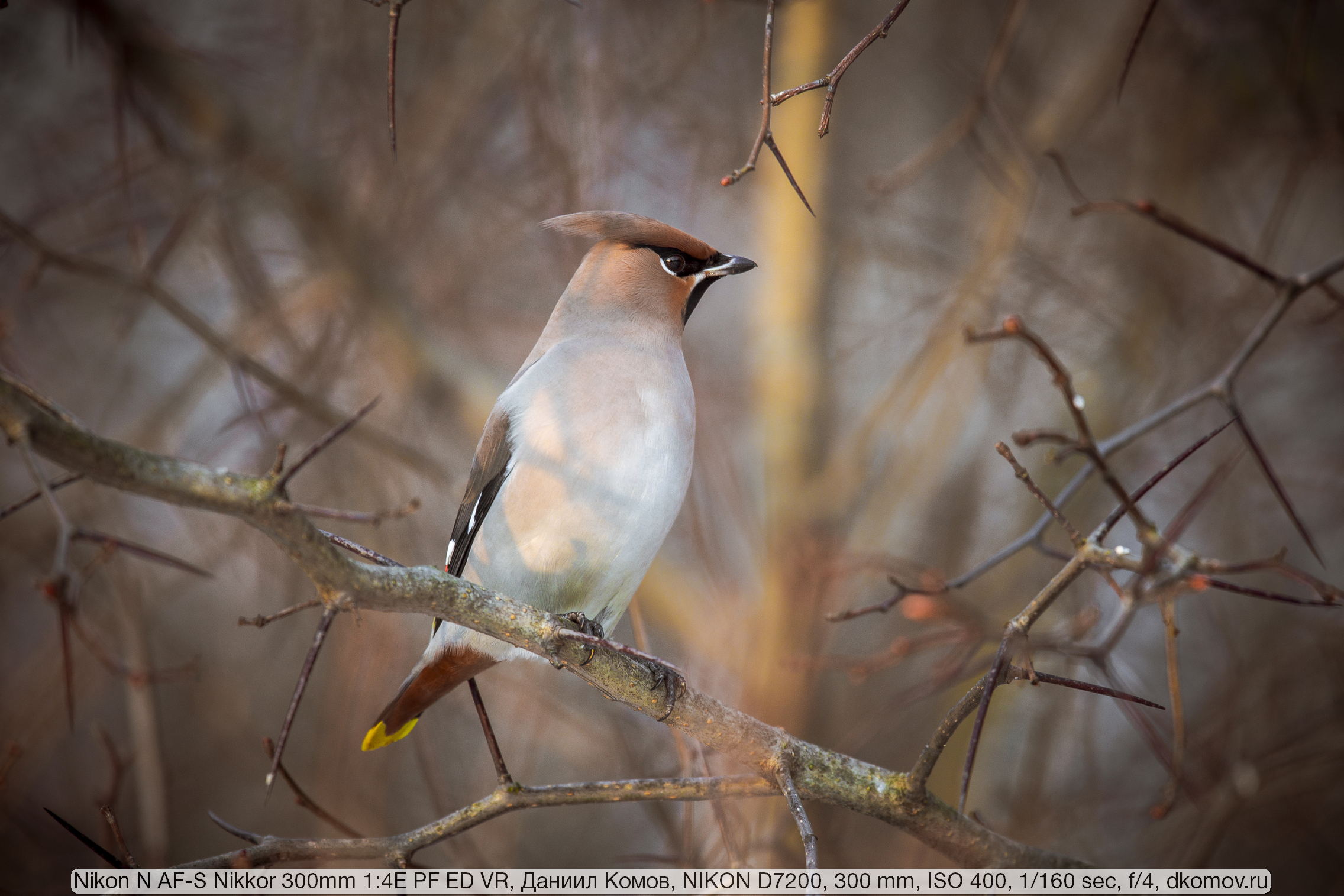






Full-size JPEG files can be downloaded from Daniil Komov's personal website (look for the download button in the upper right corner of the site).
Sample photos on Nikon D40 (DX), D700 (FX)
My examples on the Nikon D40 (APS-C, Nikon DX, 6 MP CCD ). JPEGs straight from the camera, unprocessed . The shooting was done using a lightweight monopod and also handheld. After 1600 shots (about an hour and a half of shooting), I only wanted one thing – the same lens, but much lighter.
Don't worry, I also tested this Nikon 300/4E VR on a Nikon D700 (a full-frame digital SLR). Several original RAW files (14-bit, lossless compression, benchmarked against my favorite ghetto neighborhood charts) are available on the cloud here.
But I find shooting with the old Nikon D40 much more fun and interesting. It's much easier to get good results with the Nikon D700 than with the Nikon D40 , which is Nikon's most basic digital zoom. And that makes it interesting. The Nikon 300/4E VR on the Nikon D40 has a very good weight balance. It's a shame the Nikon D40 doesn't have aperture control (you can only shoot at f/4).





The original photos in JPEG ('.JPG') format can be viewed/downloaded from this link (Google Drive, 100+ photos).

Nikon N AF-S Nikkor 300mm 1: 4E PF ED VR SWM IF Nano Crystal Coat
My experience
Almost always, such lenses are bought for some specific task. Usually this is shooting animals, sports, portrait photography.
With the Nikon 300 / 4E VR, you simply enjoy handheld shooting.
A 300mm focal length isn't that long. Shooting wildlife at 300mm, even on a Nikon DX series camera, is quite challenging. This lens really does make sense when paired with teleconverters. For example, to get a close-up shot of this duck , I needed a shooting distance of just 3.4 meters. People on Instagram asked me about this and assumed that a focal length like this would allow for similar shots from 20-25 meters away, but that's not true.
Nikon N AF-S Nikkor 300mm 1: 4E PF ED VR SWM IF Nano Crystal Coat
Prices
Prices for the lens can be found on the E-Katalog here , or in the price block below:
Conclusion
Nikon 300 / 4E VR is a unique lens due to its lightness and compactness. There are no other analogues with such weight and dimensions yet. The image quality is high.
10 main advantages :
- very light weight and very compact size (as for a 300/4 class full frame autofocus lens with Image Stabilizer for SLR cameras)
- good / excellent optical performance
- high-quality assembly, front protective bumper, rubber mount for the mount, protective coating of the front lens
- detachable tripod foot support
- classic 77 mm filter diameter
- the ability to use a large number of autofocus teleconverters, users note that the lens works very well with TK
- fast and fairly quiet focusing motor
- internal focusing with excellent MDF, focusing distance limiter, advanced focusing modes A / MM / A
- ED lenses and PF lenses in optical design
- XNUMX-blade electromagnetically controlled diaphragm
10 main disadvantages :
- high cost, the price of the lens is in the region of $ 2000 (for the same money you can purchase Sigma 70-200 / 2.8 DG OS Sport + Sigma TC-1401 1.4x)
- the tripod foot is not included in the delivery set and separately costs around $ 160 (suitable for Nikon 70-200 / 4G VR), truth, the Chinese counterpart costs only about $ 10
- strong 'Focus Breathing' effect (changes in viewing angle during focusing)
- Nikon camera owners had to wait 15 years from the date of release Nikon AF-S 300 / 4Dto get a 300/4 class lens with stabilizer
- the focusing distance limiter is not adjustable (the older version has this feature Nikon AF 300/4)
- there is a network Get in touchthat the first batch of lenses had problems with the stabilizer (the stabilizer was ineffective)
- the inscription 'MADE IN CHINA' is not as pleasant for many users as the 'MADE IN JAPAN' in previous versions
- there may be specific glare in the backlight (a feature of optics with PF elements, it is possible to partially cure it using the original Capture NX-D utility)
- there is a network Get in touchthat some specimens suffer from a centering problem, which has a bad effect on detail at the edges and corners of the frame
- perceptible vignetting at F / 4, drop in sharpness in the corners and edges of the frame at F / 4
A huge thank you to ProFotoSale for providing the Nikon N AF-S Nikkor 300mm 1:4E PF ED VR (SWM IF Nano Crystal Coat) lens. ProFotoSale sells a wide range of new and used lenses for various systems, including similar Nikon lenses.
Comments on this post do not require registration. Anyone can leave a comment.This material was prepared by Arkady Shapoval . The greatest support for the site is if you use links on this site, such as Amazon , when purchasing anything . It costs you nothing, but for this site, and therefore for my family, it's the main source of support.



Oh, and the sumny cat is still on D40, like I wrote to the FB))
Great photographs are a statement that glass is still the dominant link in the lens-camera chain ...
I think it will be interesting to say a few words about the prices, I will not talk about the new ones, but a BU in excellent condition costs at least $ 1200.
The variant from the review costs exactly $ 1000, in excellent condition
So we found a lens that costs more in China than outside of China. Indirectly, this indicates that there is a greater demand for it.
This is not a topic, but I would like to ask you for help - on my D3s a mirror began to stick a few days ago, I tried different batteries, different lenses, manual, autofocus, everything is the same. That is, the mirror sticks (not always, but often) in the upper position, if you unscrew the lens and press the shutter, then it goes down and is ready to work, and after a certain number of shutter operations it again sticks in the upper position and Err appears on the camera display ... What could be the matter here, and do you need to change the shutter right now? I also noticed that the camera mount itself needs to be cleaned, a lot of dirt has already got there within 3 years, but I don't think that's the case.
Well, then bring yogo into a literate service. To clean it, to perezmazhut, or even more. Here gadatism is dumb.
Thank you!
The blue-eyed cat was filmed nva d40! It's just kapets! Arkady again multiplied all the "experts" on cameras !!
Well, not all, but about half
I guessed that this provocation was not just like that =)))
Your D40 will have an anniversary soon, Arkady. A little more and there will be 200 thousand frames)
Respect to Daniil Komov, beautiful portraits of wildlife.
Regarding d40, the colors are of course as always :)
There is such a lens. I shoot together with a 1,4 converter, in the end 420mm f5,6. I can say one thing, the lens is excellent. Sharpness is high, the picture is nice, focusing is pretty fast. The only drawback is the high cost.
It seems that the fluorine coating (fluorine-containing coating) is afraid of isopropyl alcohol, I ruined the front lens of such a lens that way. Alcohol literally erases it from the lens, leaving a rough surface of damaged coating, while some very strong efforts to press on the lens are not required. I shoot as is, it did not affect the picture, I shoot with a Nikon TC-17eII converter. Sharpness of course drops, but it is still normal, but the autofocus speed drops significantly
Well, yes, because there is water in alcohol. Such coatings can only be washed with some kind of heptane.