
Many thanks to Oleg Malakhov for providing the Sigma APO Tele Converter 2X EX (for Canon) teleconverter .
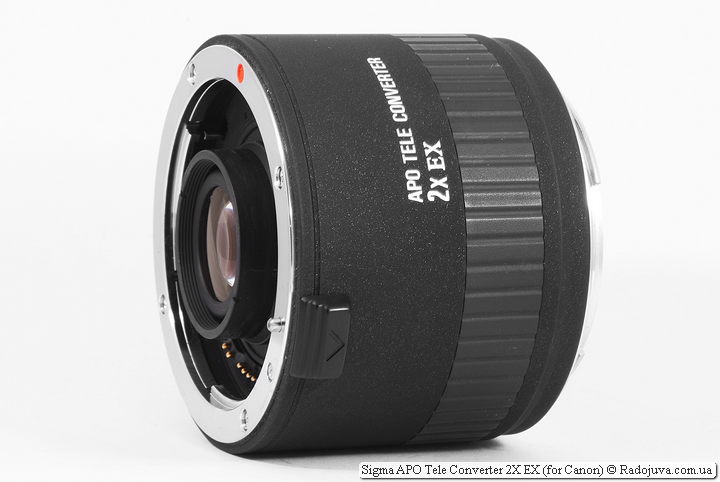
Sigma APO Tele Converter 2X EX Review
The Sigma APO Tele Converter 2X EX is often included with some Sigma lenses. There's an updated version, the Sigma APO Tele Converter 2X EX DG , specifically designed for use with digital cameras. This converter costs approximately $250, which is half the price of a similar converter from Canon.
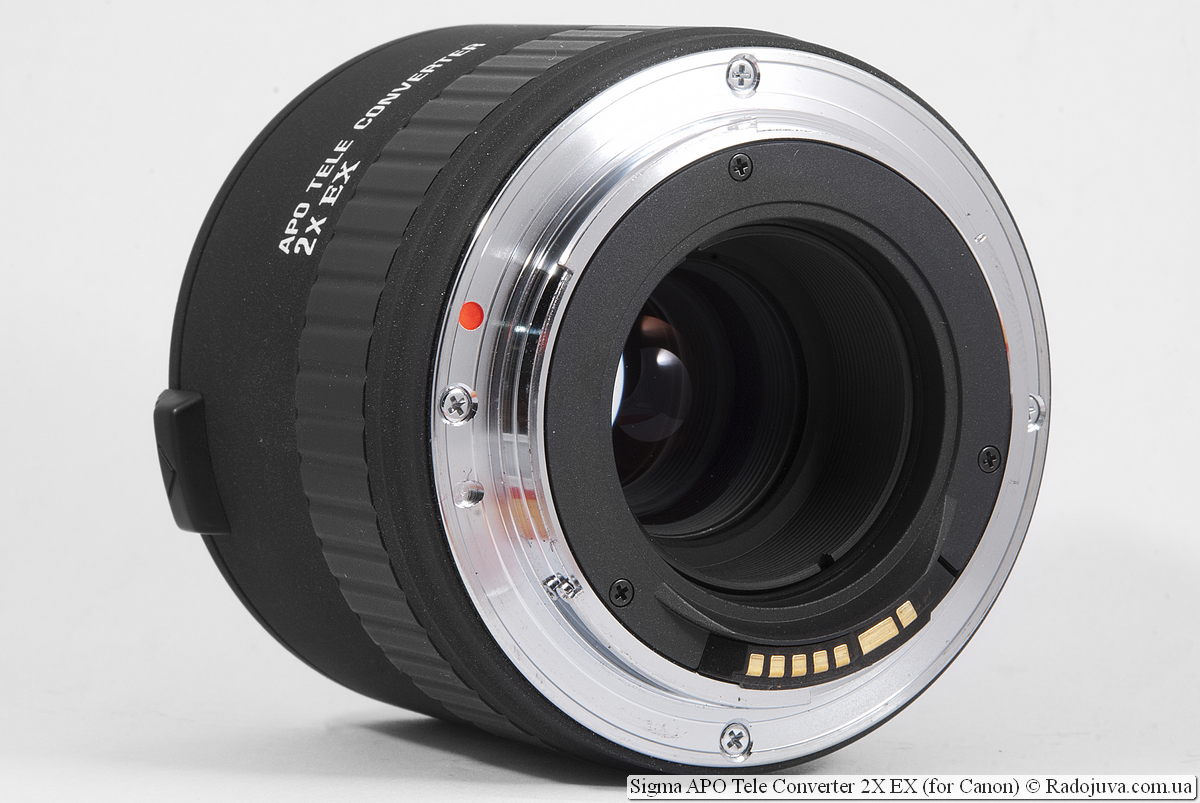
The Sigma APO Tele Converter 2X EX increases the focal length of a lens by 2x , doubling the f-number, and correspondingly decreasing the lens's aperture by 4x (2 stops). The Sigma APO Tele Converter 2X EX transmits the increased focal length and f-number to the camera, which are recorded in the EXIF file . The optical design consists of 6 elements in 5 groups. Weighing 230 grams, it feels like a solid, well-made Japanese product. The rear of the lens is rubberized.
The teleconverter works best with Sigma lenses. With native Nikon (in the Nikon version) and Canon lenses, autofocus is likely to be absent, and other issues (such as a lack of F-stop conversion) are possible. This issue is a major deterrent to purchasing the device. Compatibility with Sigma lenses can be found here.
For general information about how converters work and what they are used for, see the section ' What is a teleconverter and how does it work '.
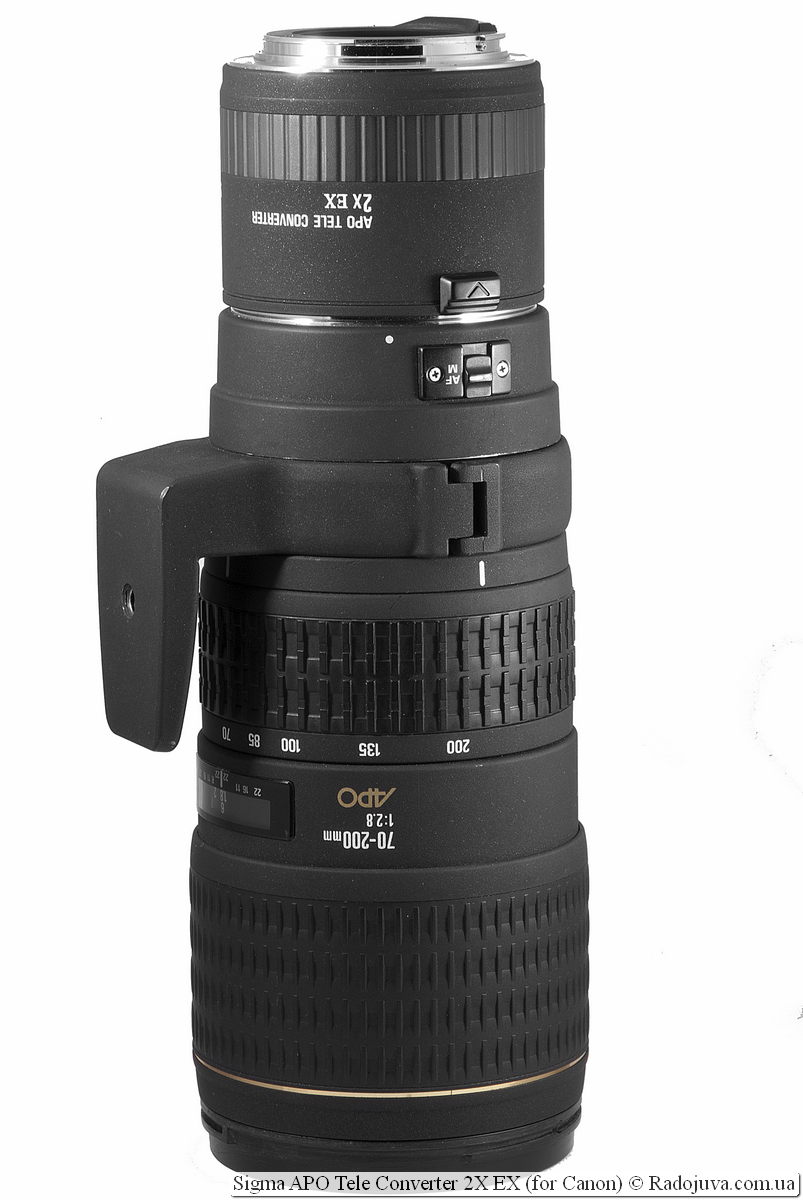
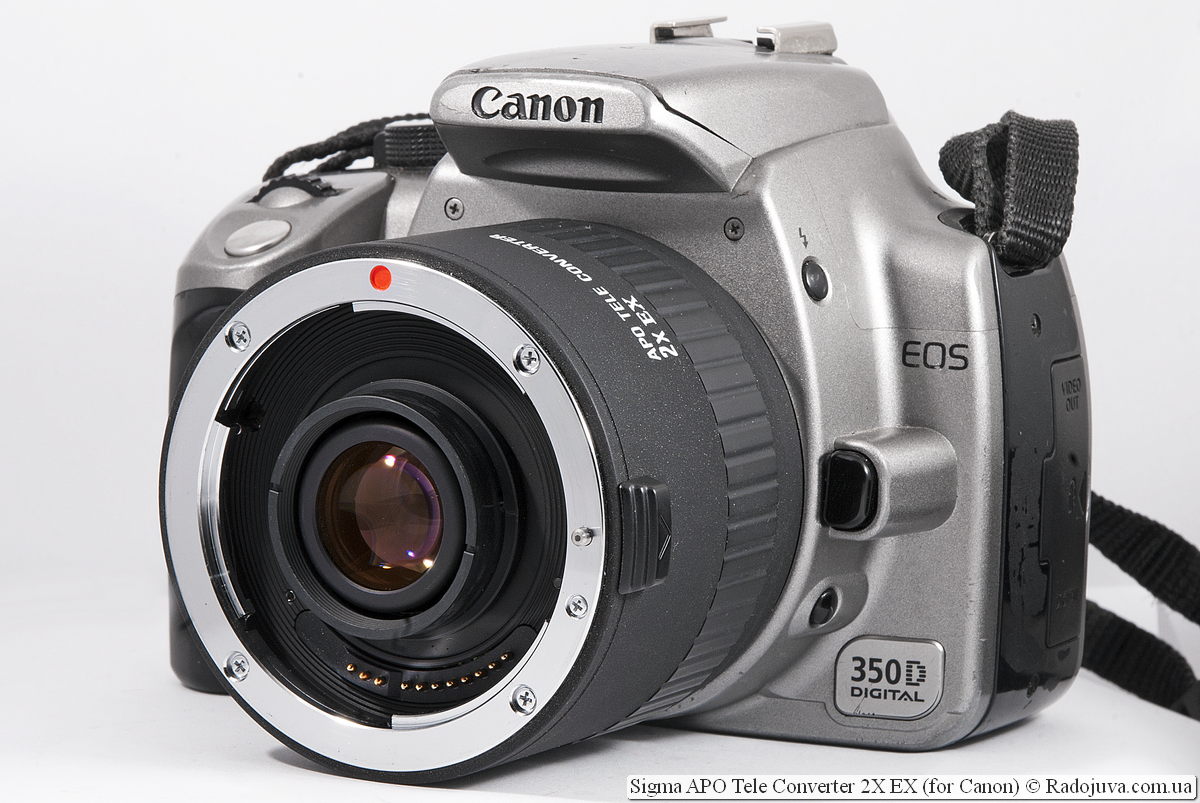


I used a teleconverter with the Sigma 70-200mm 1:2.8 APO EX HSM lens . While autofocus speed remained unchanged, image quality suffered slightly, primarily due to increased chromatic aberration . The teleconverter also turned the lens into a 140-400/5.6 telezoom , and the equivalent focal length on the Canon 350D became 224-640mm . Image stabilization was sorely needed during shooting.
Here's a link to the archive with the originals —177 MB, 25 photos in RAW format . The photo specifications for the website gallery and archive are listed here . A Sigma EX Multi-Coated UV 77mm Japan filter was used for the shots .
In general, I was satisfied with the quality of the created image. With a 70-200 lens and a twofold increase in focal length, it is very easy to shoot animals and distant objects.
Catalog of modern Canon converters can look at this link.
Comments on this post do not require registration. Anyone can leave a comment.
This material was prepared by Arkady Shapoval . The greatest support for the site is if you use links on this site, such as Amazon , when purchasing anything . It costs you nothing, but for this site, and therefore for my family, it's the main source of support.

Shoot at 500-600 mm, without stub, without autofocus (if not Sigma-lens). It’s hard to imagine something more masochistic :)
the word “stub” sounds cool, but a tripod can take a sharper photo than an included stabilizer. Personally, if I wanted to get a sharp photo, I turned off the stabilizer and put the camera on a tripod
MTO-500 is even worse, it also has a diaphragm 8 to all of the above.
You can imagine. MTO-1000. Shoot even more masochism without a tripod ...
Nikon released a new camera 1 V 3, new lenses were also introduced, in particular 70-300 ф4.5-5.6, I’m a little prokotor Nikon marketers who fundamentally disagree with you :)
The lens operates in a focal length range equivalent to 189–810 mm in 35 mm format. It allows you to easily make sports reports, shoot endless landscapes with high detail, as well as zoom in on remote wildlife objects. Thanks to the compact design of this super telephoto lens, hand-held photography is extremely convenient, and the lens retraction mechanism provides portability when moving. (from)
800mm shooting is extremely convenient! xDDD
Here is the release link http://nikon.ru/ru_RU/press_room/press_presentation.page?ID=templatedata%5Cru_RU%5Cnews_article%5Cdata%5CBV-PR-WWA-1NIKKOR-13032014
So, “you don’t fumble” :)
But nothing that he has an image stabilizer and autofocus, in contrast to what we are discussing?
I took pictures of birds from 200 meters flying with manual telephoto cameras with a focal length of 500mm-800mm without shaking - photo hunters, on the go, sit on autofocus and stub like a heroine ...
I wonder if there have been attempts, or is it possible to physically build a converter that preserves the aperture characteristic ... in theory, it should be a large device relative to the lens itself.
If I am not mistaken, then these attempts would be against the laws of physics, in particular - optics.
You are wrong :) On shutterless cameras with a crop factor of 1.5-2.0, you can use a device called Speed Booster. In fact, this device is the antipode of a teleconverter. The entire image that a full-frame lens produces is zoomed out and positioned on the zoomed out sensor. As a result, the lens aperture increases, sharpness increases and the wide angle remains a wide angle (i.e. 24mm full frame on the crop will give the same angle as on the full frame). This is not fiction, the devices are sold, you can connect Canon lenses at 4/3 or Sony Nex with autofocus support. But there are also disadvantages - not compatibility with all lenses, autofocus, due to the implementation of its logic in the converter chip, does not work so smartly.
ABOUT! Thanks for the info, you have to google it. Thanks!
The last photo was very cool.
Yes, the noble sparrows turned out!
Oh, well, it's just an "EGF rectifier".
Those. if we planted a 50mm f2.0 on a mirrorless with a crop of 1,5, we would get an EGF of 75 and a depth of field, equivalent to aperture of f3.5.
And this contraption projects the image of the lens onto the matrix so if it were 33,3 mm and f1,33, but we would not use this booster.
In fact, the image, aperture, depth of field and so on will be similar to using 50mm f2.0 on a full-frame device.
However, one should not forget that the “unauthorized” increase in the number of lenses in the optical scheme, the complication of its scheme has never made the image better.
And, by the way, this device does not cancel the decrease in aperture in any way when using a normal, increasing converter. There is no getting away from it yet.
If I understood correctly, this is also about Speed Booster ... And so.
The viewing angle will be the same as that of the same lens in full frame (+/-, adjusted for coefficient).
The aperture ratio will increase - the amount of light falling on the matrix will increase, earlier this light hit the space around the matrix, i.e. essentially did not participate in the formation of the image.
The depth of field will remain unchanged, as is the case with the teleconverter. After all, you either "shrink the picture" to fit it on a smaller matrix, or you cut out only the central part.
Sharpness will increase as the large image formed by the lens will be reduced to the size of the matrix. It falls when cutting out the central part of the image. There will also be a drop in sharpness due to the addition of an extra optical element, but an increase due to a decrease will block it. In addition, all HA will decrease (how they grow when using a teleconverter).
DOF will not change only if this “EGF rectifier” passes the intermediate image through frosted glass, like OVI in DSLRs. Otherwise, the DOF will change depending on the optimal characteristics of this “rectifier”. If you were holding dual-lens SLRs in which the viewfinder is matted only in the center, you will understand what I mean.
I would like to clarify about CA - alas, they are growing. Especially around the edge. So there is only aperture and angle in advantages.
It does not fit with Tamron: the frames of the lens blocks interfere with attaching the lens (((
By the way, your link to the compatibility page doesn't work, the correct one is here: http://www.sigmaphoto.com/lenses/lens-resources/teleconverter-compatibility
Dear Arkady
Question: is Nikon D7100 compatible with Sigma 18-200, f \ 3,5-5,6 zoom with Sigma APO Tele Converter 2X EX?
Thank you!
Selling this for $100, write to [email protected]
Hello everyone. Tell me, please, will the stabilizer work with sigma apo tele converter 2x ex dg canon ef + sigma 24-105 f4 arf for canon ef? I did not find the sigma information on the site. Thanks.