
For provided by lens Olympus Om-System Zuiko MC Auto-S 1: 1.4 f = 50mm many thanks to Alexey.

Review Olympus Om-System Zuiko MC Auto-S 1: 1,4 f = 50mm
The Olympus Om-System Zuiko MC Auto-S 1:1.4 f=50mm (hereinafter referred to as the Zuiko 1.4/50) is a good film 50mm lens with manual focus. The lens uses the Olympus OM mount. I used the Zuiko 1.4/50 on a Canon camera using the Olympus OM to Canon EOS adapter, maintaining infinity focus.
There are several main versions of the Olympus 50/1.4 for DSLR cameras:
- Olympus G.Zuiko Auto-S 1:1.4 f=50mm, mounting thread M42, for Olympus FTL cameras
- Olympus M-System G.Zuiko Auto-S 1:1.4 f=50mm, small quantities were produced
- Olympus OM-System G.Zuiko Auto-S 1:1.4 f=50mm, silver front
- Olympus OM-System G.Zuiko Auto-S 1:1.4 f=50mm, black front (view)
- Olympus OM-System Zuiko MC Auto-S 1:1.4 f=50mm (from this review)
- Olympus OM-System Zuiko Auto-S 1:1.4 f=50mm, multi-coated

Olympus Zuiko MC 50 1.4
Many versions of this lens were released. I received a Zuiko 1.4/50 with serial number 842794, which has a distinctly lilac coating on the front element. Despite its enormous aperture , the lens is very small and uses filters with a diameter of only 49 mm . It was made in Japan, and I have no complaints about the assembly. Externally, the Zuiko 1.4/50 is very similar to its younger brother, the Olympus OM-System Zuiko MC Auto-S 1:1,8 f=50mm.

Lens bokeh at full aperture
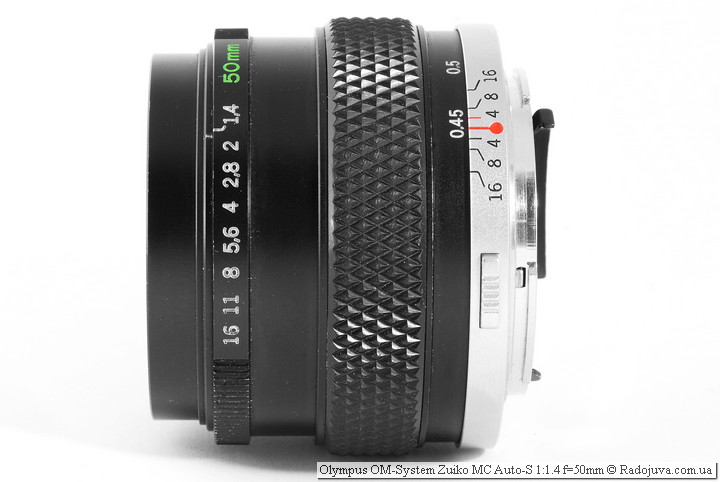
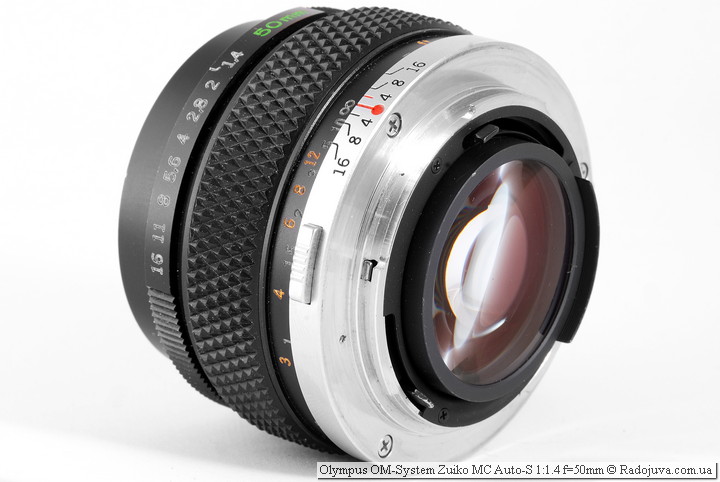
The rubberized focusing ring rotates 180 degrees . The minimum focusing distance is 45 cm . The lens has a focusing distance scale and a depth of field scale. Focusing is pleasant and easy. The front element does not rotate when focusing. The aperture control ring is located at the front of the lens. The aperture has eight blades . At apertures of f/2.0 and up to f/4.0, out-of-focus areas appear as if they were " circular sawtooth patterns ":

Flare in the form of a circular saw on a slightly covered diaphragm
The aperture closes to F / 16; there is a mark on the DOF scale for shooting in the infrared spectrum. Zuiko 1.4 / 50, like many similar Olympus lenses, also has an aperture repeater. The depth of field scale is located on a chrome ring, which adds some charm to the entire line of lenses :)
Olympus Zuiko MC 50 1.4
The Zuiko 1.4/50 at f/1.4 is soft, and getting sharp isn't easy, though shooting at f/1.4 with manual focus is always quite challenging. Stopping down the aperture brings sharpness back to normal. These days, such lenses are more interesting for their aperture and image quality than their sharpness.

Drawing. Close focusing distance
The drawing of the Zuiko 1.4 / 50 is pretty pretty, although not everyone likes the bokeh. The lens tolerates back and side light well, but sometimes you can catch a “rainbow” across the entire image field (an example of a photo is in the archive with the originals - a photo with a dog).
Olympus Zuiko MC 50 1.4
Here is a link to the archive with the originals - 120 MB, 18 images, the parameters of the photographs in the archive are indicated here.

Sample photo
Nowadays, in our digital age, a fast manual prime lens is typically used as a budget portrait lens on crop-sensor cameras. The Zuiko 1.4/50 equivalent focal length on Canon APS-C cameras is 80mm.

Olympus Zuiko MC 50 1.4
This lens can be easily mounted on any modern digital mirrorless camera. To install it, use the appropriate adapter/mount, which allows you to use lenses with the Olympus OM mount on the desired mirrorless system without any problems or limitations. Below is a list of systems/mounts with links to the necessary adapters/mounts: Sony E/FE/NEX , Canon RF/RF-S , Canon EF-M , Nikon Z , Nikon 1 , Leica L , FujiFilm GFX , FujiFilm X , Samsung NX , Micro Four Thirds.
A high-aperture prime can always be used in a variety of artistic designs; many amateur photographers stop at 50 / 1,8 or 50 / 1,4 class lenses as the first “creative” lens. I think with this Zuiko 1.4 / 50 you won't be bored in the open air :)
This material was prepared by Arkady Shapoval . The greatest support for the site is if you use links on this site, such as Amazon , when purchasing anything . It costs you nothing, but for this site, and therefore for my family, it's the main source of support.

Thank you for the article!
Arkady, thanks for the review.
I just didn’t understand, the kid riding on an ice slide was shot on a fully open aperture of 1,4 ?? Or is the actual aperture not indicated?
This is a manual lens, the F value in EXif is not recorded and, accordingly, I do not indicate the aperture value on which it was shot, because it’s just too lazy to record or memorize for each picture. The specified image was taken with either F / 1.4 or F / 2.0
yes, how such a huge depth of field can turn out at 1,4 or 2,0? From the kid to the stone wall a few meters. Even the end of the wall is almost in focus. It's more like f9 or something like that.
1. principle of hyperfocal plane 2. Look at ISO 3. Look at shutter speed :)
This is unlikely 1.4. On a sunny day, when I open my Fujinon to 1.4 to blur something, the exposure at iso100 turns out to be up to 1/16000. And here, it seems, too, the sun (although the dark wall in the frame and the shadows are long - not noon). So it's more like f / 2.
Is that a kid? In my opinion, this is a girl.
By the way, it’s not at all difficult to adapt this lens (like the other Zuiko) to Nikon without any lens adapters. At the same time, it is not necessary to have knowledge and skills in plumbing. Here is a ready-made solution: http://www.ebay.com/itm/360713354100?ssPageName=STRK:MEWNX:IT&_trksid=p3984.m1497.l2649 . This adapter is essentially the back of the lens. You just need to install it instead of your own. At the same time, the difference in the working distance between the Olympus Om and Nikon F, which is 0,5 mm, is leveled. The instruction is here: http://www.leitax.com/conversion/Olympus-OM/Zuiko-5014/index.html
PS This adapter is suitable for almost all Olympus Om-System Zuiko lenses. For Zuiko MC Auto-S 1: 1.8 f = 50mm does not fit exactly, at least without a file.
Arkady, thank you for the useful information. I have been grazing on your site many times already.
I used such a lens for a long time for shooting slides, when I worked at the institute. Moreover, it is very sharp with an open lens, it was convenient to photograph paintings in museums, and reproduction photography was also convenient, i.e. as a macro lens. I bought it cheaply from a "teapot", but the choice was not accidental, one defense engineer was engaged in approximately the same testing and repair of equipment. He showed me the results of his tests where in the first place was exactly ZUIKO (seven serial numbers), behind it was Pentax AF, Canon FD-early version, and only then ZEISS, Canon FD-2 lens of later versions and the respected Nikon AF-in the end (photographed on one film and scanned). Similar results were in the tests of the F&V magazine, only there they tested autofocus.
tell me, the diaphragm blades are always open. How to cure this problem? thanks
ARKHIV ORIINALIV - good news, didn’t you share such a presentation of the photograph (and the Facebook likes button ..)?
I will sell the Olympus OM-System G. Zuiko Auto-S 50 mm f / 1,4 lens http://fotoselling.ru/products/13439276
Novosibirsk + by mail in Russia and abroad
__________
Our website: http://fotoselling.ru
Group in contact (more than 20000 participants): http://vk.com/fotoselling
Lenses, cameras, adapters and more
Cash on delivery, reviews, warranties, experience.
Good afternoon!
What do you recommend as a manual portraiture for the Olympus m4 / 3:
Olympus Om-System Zuiko MC Auto-S 1: 1.4 f = 50mm or Helios-77M-4.50mm f / 1.8 MC?
The price for them is about the same.
Thank you!
The Olympus Om-System Zuiko MC Auto-S 1: 1.4 f = 50mm is richer in color.
Tell me, does this lens go 4/3 ???
Through adapter
OM-M4 / 3
Which one to choose, 1.4 or 1.8 ???
I settled on these two, I can’t understand what will be better for portraits and landscapes? Somewhere they wrote that 1.8 is sharper.
Help please!
1.4 100%
In all things, it is better that this 1.4 -tot 1.8 wins only on the covered aperture 8 and then visually do not understand this, it is necessary to scan and carefully look for the difference.
On Sony A7s which one will be better. Nikon 50 ais 1,4, minolta 50mm 1,7 or this. And in general this is a crop of lenses, did I understand correctly?
no, these are not crop lenses. ais 1.4 just right
And why? Is he better than zuiko or minolty?
Excellent optics, and most importantly, everything inside is done wisely. That is. If 1.8 is sealed tightly, and you can clean the lens block, of course, but this is a natural disaster - see the description, not everyone has such a diagnosis, then this one can be disassembled down to the last screw.
Judging by the picture, it's a matter of taste. It depends on where the artist's hands came from.
In most cases, such optics need to be cleaned/helicoid lubrication needs to be changed/dirt needs to be washed off from the inside.
Unlike the models on 1.2, where all the open ones had useless soap, these, on 1.4, you can choose - there were really working ones.
Of all Canons/Pentaxes/Nikons and the second echelon, the first is Tomioka at 55, then probably this one, namely mc, the weakest Canon, Pentaxes are different and very optically floating. Nikons are bland, so, average. The rest are Minolta and Konica - they are already Narrower - under 60mm, 57/58 at 1.4, and also a big spread in quality. Some are sharp, some are not.
This one is small, cleverly made, everything is very cool inside, everything is convenient outside. There is no stop between 1.4 and 2, excellent microcontrast after 2.8. 4-5.6 is excellent on multi-pixel matrices, 2.0 still flies by. 2.8 is normal.
Tomioka's two is definitely working.
But it is 2 times bigger and heavier. And the sharpest of all that I have seen on 1.4 in general. Cream and pure cake according to the picture.
Ps - the new Sigma 50 1.4 contemporary for crop beats them all in sharpness/and in general in everything, taken together, and costs less. Shooting with it is a miracle on the Sony. But that's a completely different story...
Sigma 30 1.4 Contemporary, of course, was wrong).