
Cleaning the matrix is a vital necessity. Below are examples of a dirty matrix not for the faint of heart who suffer from heart disease, please do not read further.

Matrix cleaning. Article from Radozhiva.
One of the drawbacks of modern DSLR cameras compared to film cameras is that the camera sensor becomes dirty over time . Film cameras, however, use a new piece of film for each shot, so contamination is simply not a problem.
How to check the matrix of the camera for contamination?
Very simple. For this you need take a picture on the closed diaphragm of a plain background... The easiest way to do this is to put the camera in aperture priority mode (mode A or Av on the mode dial). Set the minimum allowable aperture value, this means that the F number should become the maximum, most often F16, F22, F32, F36. Turn off auto ISO and set the minimum allowable ISO value: most often it is ISO 50, ISO 100, ISO 200. After that, just take a picture.
Please note that the focal length of the lens will not affect the sensor dirt check. A solid background should be photographed only to make it easier to spot dirt on the sensor. A closed aperture will result in a long shutter speed ; it's best to mount the camera on a tripod or a stationary object. The shutter speed does not affect the check. If you don't have a tripod, you can simply photograph the blue sky.
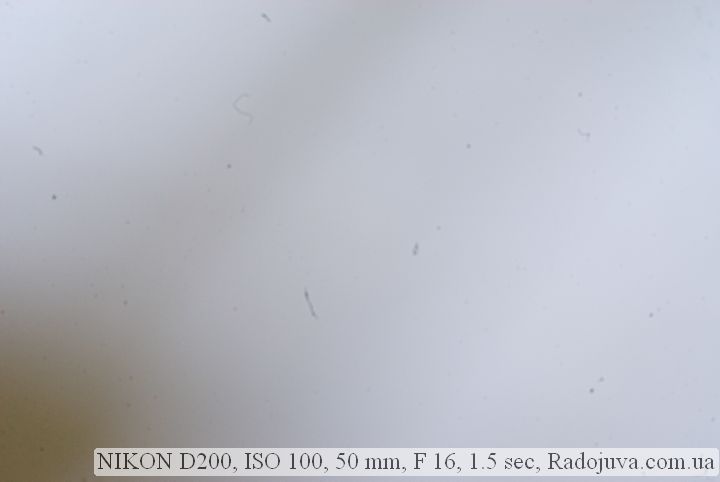
Dirt on the matrix
In the photo above, I made the settings ISO 100, F16, 50mm. In order to more clearly see all the fear and horror of a dirty matrix, you can set the maximum image contrast in the program editor. See below.
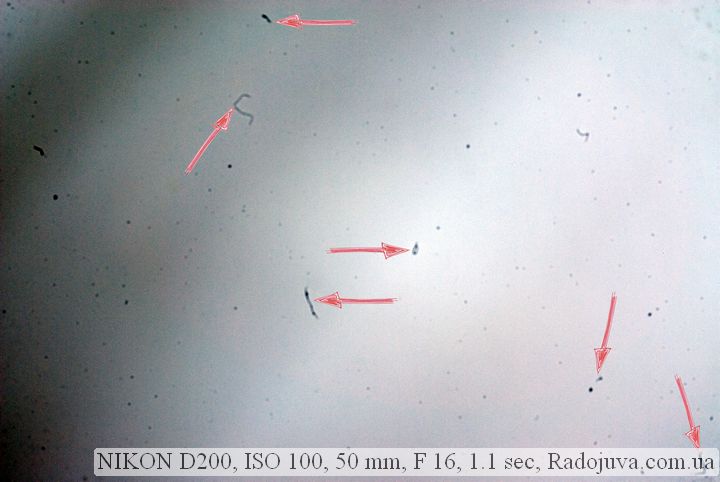
Dirt on the matrix
I used arrows to show the dirt that was on my Nikon D200 ; my Nikon D200 camera had not been cleaned for over a year.
Note: Don't be alarmed by a dirty sensor. At wide apertures (up to f/8.0), dirt will have virtually no impact on image quality. You can shoot at f/1.4-f/4.0 your entire life without worrying about sensor cleanliness.
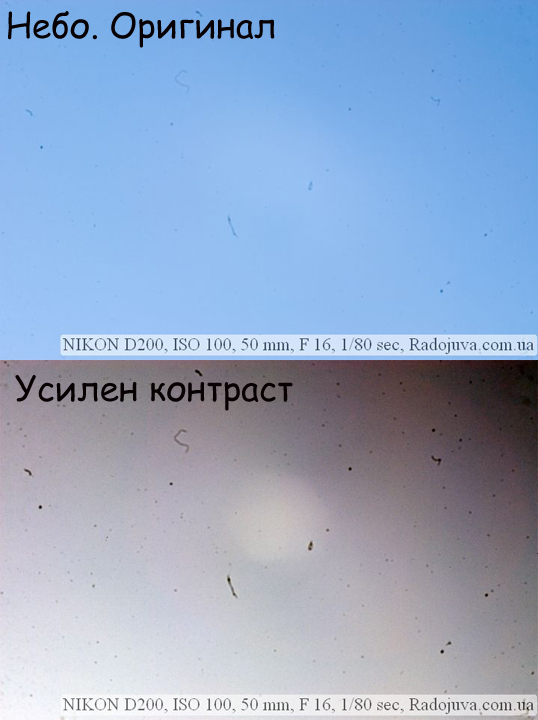
Contrast enhancement to see dirt
Do I need to clean the matrix?
Everyone decides for himself. I need a clean matrix, as I earn money for a living by photography. I often have to shoot scenes with a closed aperture (group portrait, landscape, photo for reviews), so I monitor the cleanliness of the matrix and try to take my cameras every 6 months to clean the matrix. Cleaning the matrix costs from 40 to 100 cu and takes 1-2 days. It is quite expensive, and the cleaning result does not always suit me. Therefore, I decided to do this business myself. For a more or less reasonable price of 60 cu I came across the Green Clear Sensor Cleaning System (Non full frame Size) for DSLR Cameras. The system allows cleaning about 80 times with a bottle and 3 times with special cleaning mop brushes.
Integrated matrix cleaning systems
It's become very popular to install sensor cleaning systems in DSLR cameras. My experience shows that such systems can't completely protect the sensor from dirt. Cleaning systems generally rely on the sensor vibrating and shaking off dust. But dirt isn't just dust; it can also include condensation stains and other things. Cleaning systems simply can't handle this. I had to send my Nikon D90 with a cleaning system in for service after a year of use with the cleaning function active. I often get cameras with cleaning systems, and I always see dirt on the sensor. So, cleaning systems as of 2012 can't provide the cleaning quality that manufacturers so ardently advertise.
Nikon CCD owners will find this article about a software method for combating dust and dirt on the matrix useful.

Green Clear Sensor Cleaning System (Non full frame Size) for DSLR
How I cleaned the matrix:
The Green Clear Sensor kit includes a can of some kind of gas, three dust suction tips and three sets of mops for cleaning. You need to read the instructions for the Green Clear Sensor or watch the training video. I also had a small Russian-language instruction in the kit. Most of all, it was difficult for me to install the valve on the cylinder - you first need to strangle it, and then tighten it.
- I collected a vacuum pump. By simply attaching a valve to the cylinder, to the valve an extension tube, to the tube one of the cleaning tips.
- Set up the camera in order to clean it.
- With the help of a pump, I sucked up dirt.
- Using a mop, I cleaned the sensor.
In fact, it’s a little scary to go to the matrix of the camera, but when you do this often, all fear disappears.
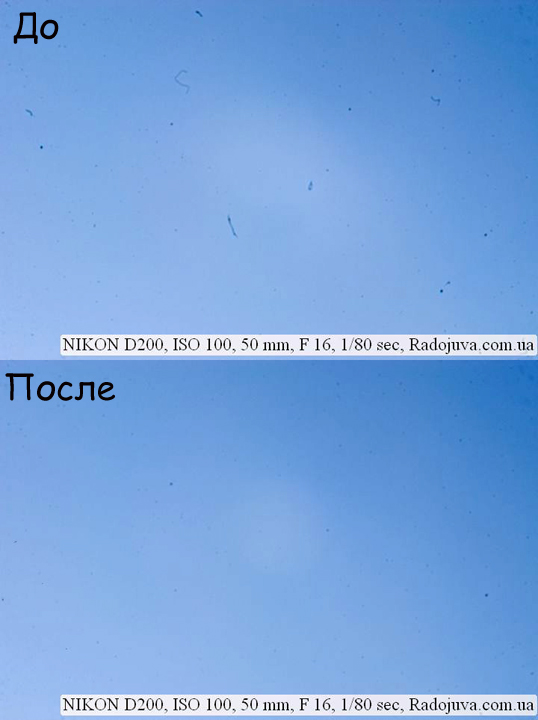
Before and after cleaning
Important: I recommend reading your camera's manual. To clean the camera's sensor, you need to raise the mirror in front of the sensor. There's a special feature for this, usually called "mirror lock" or "mirror lock for cleaning." On Nikon cameras, when this feature is activated by pressing the shutter button, the camera raises the mirror and remains in this position until the camera is turned off. If the battery charge is less than 60%, the mirror lock function will be disabled. Avoid using slow shutter speeds to clean the sensor. A friend of mine was cleaning the sensor at a shutter speed of 30 seconds and got carried away, causing the camera to lower the curtains and the mirror—no good came of it. Also, in this special mode, the camera doesn't take a photo—no power is supplied to the sensor, which also reduces the risk of damage.
Conclusions:
Sometimes you need to check the camera matrix for contamination and take the camera to a service, or clean the matrix yourself. Self-cleaning is 3-4 times cheaper for after-sales service. Built-in systems for cleaning the matrix from dirt can only postpone serious cleaning of the matrix in time.
Thank you for attention. Arkady Shapoval.

We contacted the service here https://comp-service.kiev.ua , they cleaned and tidied it up
Good afternoon, I want to understand how the aperture can affect the visibility of dust on the matrix? In my opinion, the dust on the matrix lies directly on the photocells (directly in contact with the photocells or microlenses of the photocells). In this case, the dust is always more than one pixel. Whether the light comes from one source or not does not matter in this case. Now, if the dust lies at some distance from the matrix, then yes, due to a non-point source, light can bypass the dust speck. It is interesting from a purely educational aspect. Thank you in advance.
A point on the matrix is formed by a set of rays from the rear lens of the lens. The narrower the beam of these rays, the less contribution is made by the obliquely incident rays, which means they are able to pass by the debris on the glass of the matrix. The smaller the aperture, the narrower the cone that forms the image of the point. You must also understand that in fact the garbage lies directly on the photocells of the matrix, and on the glass that covers these elements.