
This article describes the use of old Soviet and other manual optics on any Nikon digital-mirror and system cameras.
In this article, the terms "old optics", "manual optics", "old lenses", "Soviet lenses", "lenses without CPU" can be considered synonymous.

The Super-Multi-Coated TAKUMAR 1:1.8/55 ASAHI OPT. CO., JAPAN lens with an M42 thread mount is shown on a Nikon EL2 film SLR camera . Mounting is accomplished using an M42-to-Nikon F adapter, without the lens or chip.
Navigation:
- 'H' mount lenses
- Lenses 'Automatic' from cameras Kiev-10, Kiev-15
- Lens with interchangeable shank 'A'
- Lenses with M42 mounting thread
- Lenses with M39 mounting thread
- Lenses with 'K' mount
- Lenses with bayonet mount 'B' (Pentacon SIX), 'B' (Salute)
- Lenses from 'U' enlargers
- Lenses with a Contax-Kiev RF mount
- Other Soviet lenses
- Older Nikon 1 CX lenses and system cameras
- How to use such lenses on modern Nikon central control centers
- How to focus?
- How to control the diaphragm?
- exposure
- List of cameras that support auto metering
- List of cameras that do not support auto metering
- How to work with flash?
- How to shoot a video?
- Why use such lenses at all?
- Lens Guidelines for Nikon CZK
- Conclusions :)
- Another article of mine on Soviet optics
By and large, if you arm yourself to the teeth with files and similar tools, you can attach any old lens to modern Nikon cameras. The only difficulty is how he will shoot after that. If there is no desire to modify and alter lenses, then there are a number of lenses that can be used with Nikon cameras without any problems without any alterations.
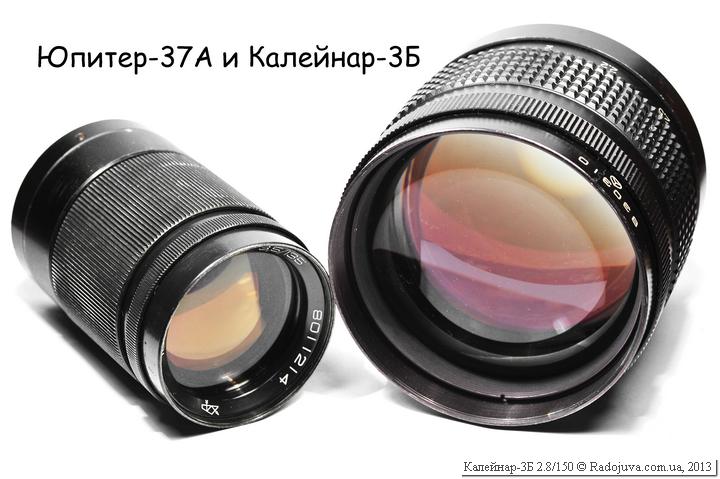
Jupiretr-37A and Kaleinar-3B
All Soviet lenses do not have automatic focusing and are manual focus lenses . These lenses are often referred to as " manual " lenses, or simply "manual lens," or "MF . "
All older lenses can be divided into several types based on the threads used to attach the lens to the camera. The threads (on the back of the lens) directly determine whether a Soviet lens can be attached to the Nikon system. The lens mount is also called a bayonet mount.
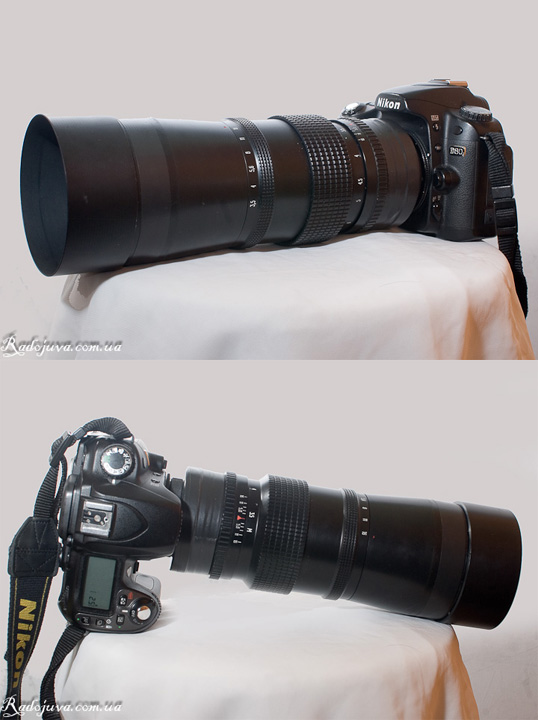
Soviet lens Jupiter-36V on a modern Nikon camera with two adapters
Nikon uses the Nikon F mount , which has been in use since 1961 and is virtually identical on all Nikon cameras. This is quite good news, as you can still take any of Nikon's oldest AI-S lenses for film cameras and use them on modern DSLRs.
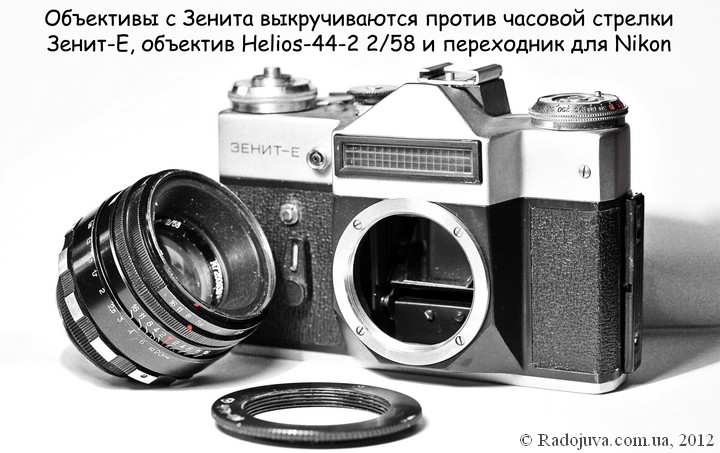
How to remove the lens from the Zenith
'H' mount lenses
There are currently many Soviet lenses that use the Nikon bayonet mount. There's also the N mount , which was copied from the Nikon F mount and is fully compatible. Cameras that used it include the Kiev-17 and Kiev-17m, Kiev-18, Kiev-19 and Kiev-19m, and Kiev-20 . This means that if you use lenses from these cameras, you won't have any problems mounting them on a Nikon. These lenses were most often designated with an "N" at the end of their name.
List of lenses with H mount (Nikon F) for which you do NOT need an adapter:
- MS Helios-81N 50mm F2.0 (triple name Arsat-H 50mm F2.0)
- Helios-81M 53mm F2.0
- MS Helios-123N 50mm F1.4 (second name Arsat-H 50mm F1.4)
- MS Zenitar-N 16mm F2.8 Fisheye
- MS Mir-73N 20mm F2.8 (second name ARSAT H 2,8 / 20)
- Mir-20N 20mm F3.5
- MS Mir-24N 35mm F2.o
- MS Kaleinar-5N 100mm F2.8 (second name ARSAT H 2,8 / 100)
- Tele-H 200mm F3.5
- MS Granite-11N 80-200mm F4.5 (second name Arsat 80-200 1: 4.5)
- MS Bearing-H 8mm F3.5 (Belomo EWP Fisheye Lens MC 8mm F3.5 H)
- MS Mir-47N 20mm F2.5
- MS Jasper-4N (I dream to find it and test it)
- MS Wave-8 50mm F1.2
- MS Zenitar N 50mm F1.7 (F2.0) (the availability of the H version is not known exactly)
- MS Amber 14H F2.8-4 28-85mm
Almost always, lenses with the “H” designation are AI-S lenses for Nikon, that is, they are completely identical to the old manual lenses from Nikon itself.
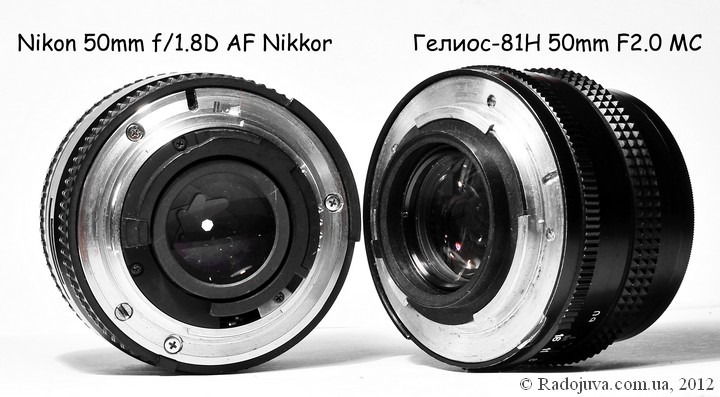
Almost the same mount on Nikon and Helios-81n
Cameras with mount Kiev-Avtomat
Important: The Kiev-10 and Kiev-15 cameras have an unusual, unique bayonet mount. Lenses for these cameras were most often labeled " Automatic ," such as the Helios-81-Automatic. They cannot be used with Nikon cameras. Adapters for these lenses do not exist. If you want to install such a lens, you will have to modify it yourself, which will lead to the problem of different flange focal distances between the Nikon and the Kiev-10 and -15. People often confuse the Kiev-10 and 15 cameras with their counterparts, such as the Kiev-19.
Here is the most complete list of such lenses:
- MIR-20 3.5 / 20 AUTOMATIC
- MIR-1 2.8 / 37 AUTOMATIC
- HELIOS 65 AUTOMATIC 2/50
- HELIOS-81 2/53 AUTOMATIC MACHINE He also HELIOS-81 2/50 AUTOMATIC MACHINE he is HELIOS 81 2/53 AUTOMATIC (name without a dash between 'Helios' and' 81 ′.)
- JUPITER-9 2/85 AUTOMATIC
- JUPITER-11 4/135 AUTOMATIC
- ERA-6 1.5 / 50 AUTOMATIC (suddenly !, prototype)
- RUBIN-2A 3.5 / 45-80 AUTOMATIC (prototype)
- GRANITE-11 4.5 / 80-200 AUTOMATIC (see)
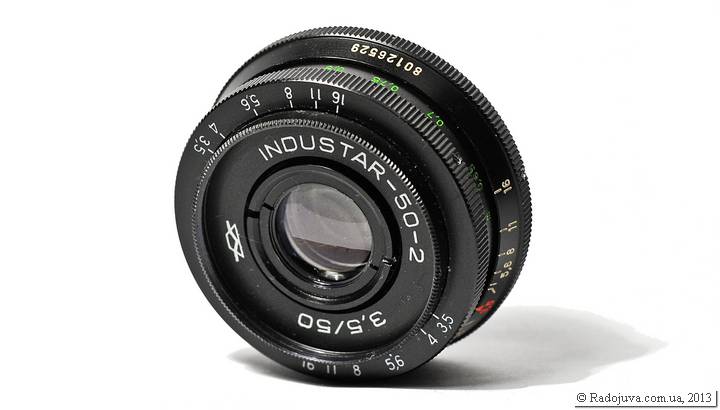
Little Industar
Lens with interchangeable shank 'A'
There are lenses with the letter "A" at the end of their designation . These lenses can use an interchangeable mount, as shown in the photo below.
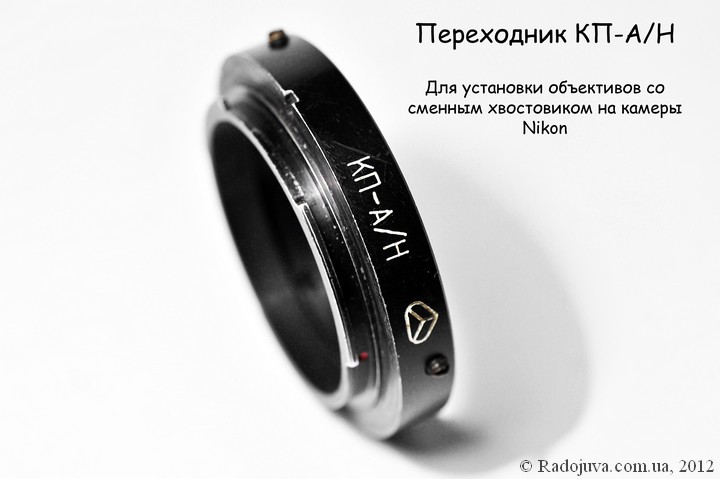
Adapter KP-A-N
An interchangeable lens mount is the rear part of the lens that can be changed depending on the camera it's intended for mounting on. For such lenses and Nikon cameras, the KP-A/N mount can be used.
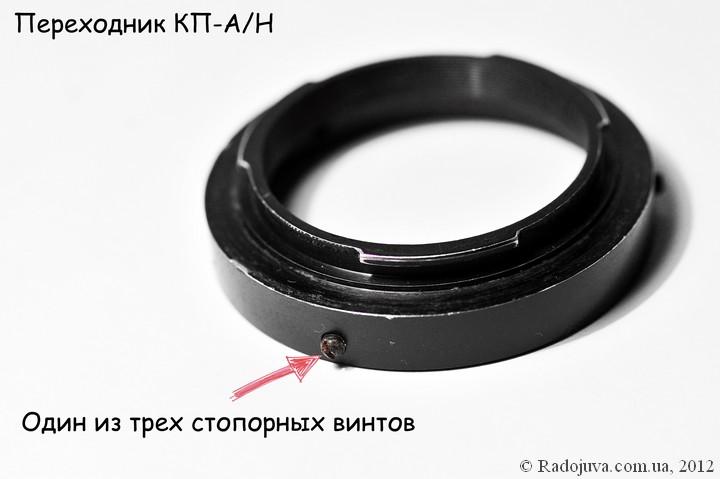
Adapter KP-AN, locking screw
With such an adapter it will be possible to obtain focusing at infinity and MDF while maintaining the focusing distance scale. Also, there are rumors that the “A” versions of lenses are technically better performed than their “A” counterparts.
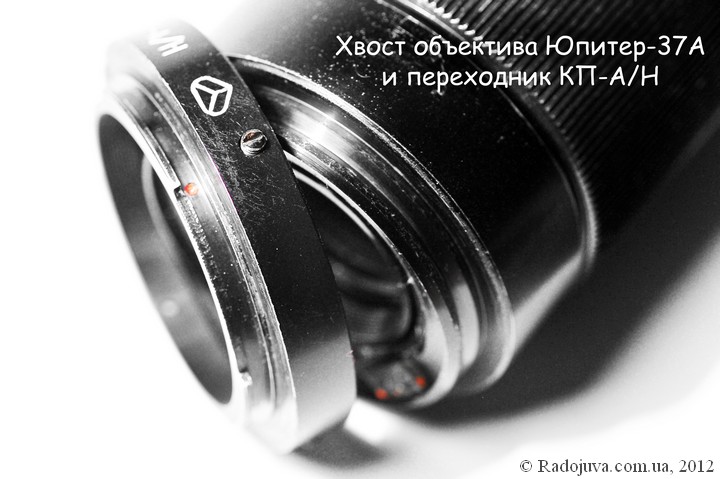
Adapter KP-A-N and lens with interchangeable shank
A list of some lenses with interchangeable shank “A”:
- Jupiter-37AM 135mm F3.5 MS
- Jupiter-37A 135mm F3.5
- Jupiter-11A 135mm F4 (there are other options, for example, Jupiter-11 under M39)
- Tair-11A 135mm F2.8
- World-10A 28mm F3.5
- Mir-1A 37mm F2.8 (available in other versions, for example Mir-1V under M42)
- Industar-61A 50mm F2.8 (is in other options, for example under Industar-61 L / Z MS under M42)
- Jupiter-21A 200mm F4.0 (is in other options, for example under M42)
- Tair-3A 300mm F4.5 (available in other versions, for example Tair-3 FS under M42)
- MS Bearing A 17mm F2.8
- MS Bearing A 8mm F3,5
- Jupiter-9A (there are other options, for example, Jupiter-9 under M39)
- Vega-13A 100mm F2.8
- Era-6A 50mm F1.5
- Tair-56A 150mm F2.8
- Telemar-22A 200mm F5.6 (is in other options, for example Telemar-22)
- 3M-4A 500mm F6.3
- 3M-5A 500mm F8 (may not have a replaceable shank)
- 3M-5CA 500mm F8 (may not have an interchangeable shank)
- 3M-6A 500mm F6.3 (may not have a replaceable shank)
- MTO-500A 550mm F8.5
- MTO-11 1000mm F10 (found and MTO-11A)
- MTO-11SA 1000mm F10
- MTO-1000A 1100mm F10.5
Important: The KP-A/N adapter is a copy of the T2 mount adapter. These adapters are functionally identical.
Where to buy the T2 mount adapter (KP-A / N)
The cheapest adapters can be ordered on aliexpress.com . You can buy the T2 to Nikon F adapter here.
Lenses with M42 thread
Next come lenses with an M42 thread , which poses some challenges when used with Nikon systems. The flange focal distance of the M42 is shorter than that of the Nikon, making focusing at infinity difficult . For mounting these lenses on Nikon cameras, there is a KP-42/N adapter and a KP-42/N adapter with a lens . These adapters are also known as M42-Nikon and M42-Nikon with a corrective lens.
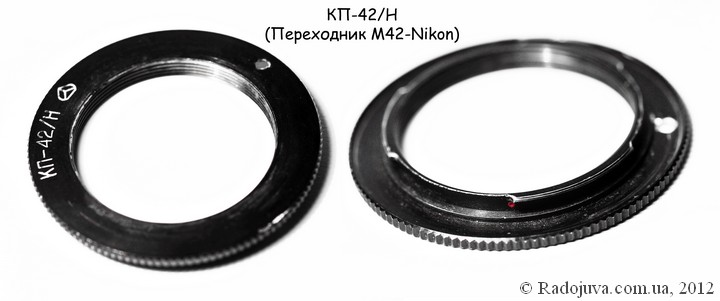
Adapter M42-Nikon
Using the standard KP-42/N adapter will disable infinity focusing. An adapter with a lens will allow focusing at infinity, but unfortunately, the lens will alter the optical design and image quality. More information about image quality using an adapter with a lens can be found here.
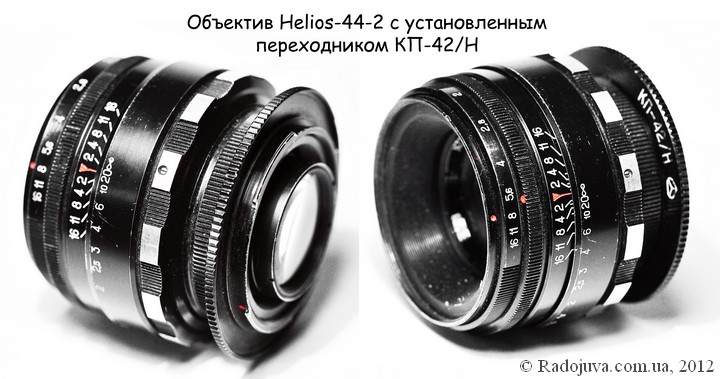
Lens with Nikon adapter installed
Note : The loss of infinity focusing means that when using a lens for M42 cameras with a lensless adapter, it will only focus out to several meters. The maximum focusing distance depends on the lens; for example, a Helios lens with a 50mm focal length will focus out to about two meters. A 300mm Tair-3 lens will focus out to 30 meters. The longer the focal length, the greater the maximum focusing distance with a lensless KP-42/N.
Please note: the M42-Nikon adapter without a lens also functions as a thin macro ring , so the minimum focusing distance of the lens with such an adapter is reduced, which facilitates better close-up shooting.
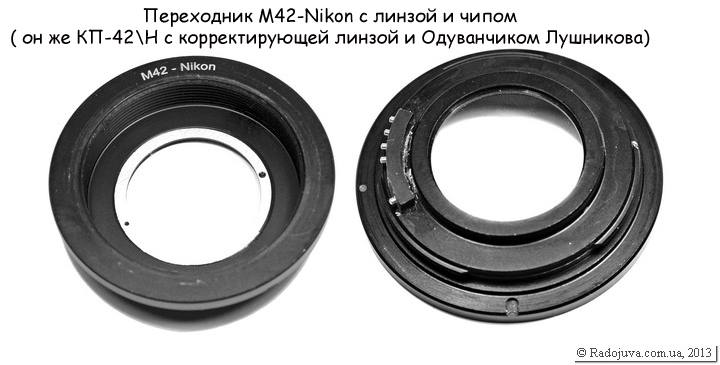
Lens adapter
Examples of lenses with M42 thread:
- Era-6M 1,5 / 50
- Helios-40-2 85mm F1.5
- Helios-44 58mm F2.0 (white, m39, Krasnogorsk, 13 petals)
- Helios-44 58mm F2.0 (white, m39, Krasnogorsk, 8 petals)
- Helios-44M 58mm F2.0 (two lenses: Valdai and KMZ)
- Helios-44-2 58mm F2.0 (two lenses: Valdai and MMZ)
- Helios 44-3 58mm F2.0 MS
- Helios-44M-4 58mm F2.0
- Helios-44M-5 58mm F2.0MC
- Helios-44M-6 58mm F2.0 MS
- Helios-44M-7 58mm F2.0MC
- Helios-77M-4 50mm F1.8 MC
- Helios-77M 50mm F1.8MS
- Jupiter-9 85mm f2.0
- Jupiter-38 75mm F4.0
- Mir-1V 37mm F2.8
- Tair 3 FS 300mm F4.5
- Granite-11M 80-200mm F4.5 MC
- Industar-61 LZ MS 50mm F2.8
- Zenitar-M 50mm F1.7
- Telemar-22 200mm F5.6
- Wave-9 50mm F2.8 MC MACRO
All of the above applies not only to Soviet lenses with the M42 mounting thread, but also to any other old lenses, for example:
- Carl Zeiss Jena Flektogon 2,8 / 35
- Carl Zeiss Jena DDR Tessar 2.8 / 50
- Carl Zeiss Jena DDR Tessar 2.8 / 50 (the black)
- Carl Zeiss Jena Tessar 1: 2.8 f = 50mm T (white)
- Carl Zeiss Jena MC Pancolar 1.8 / 50 DDR
- Pancolar 1.8 / 50 ausJena
- Carl Zeiss Jena Flexon 2/50
- Carl Zeiss Jena Biotar 1: 2 f = 5,8cm T
- Carl Zeiss Jena DDR MC Sonnar 3,5 / 135
- PENTACON auto 1.8 / 50 MULTI COATING
- PENTACON auto 2.8 / 135 MC
- PENTACON auto 2.8 / 29 MULTI COATING
- PENTACON 3.5 / 30
- Auto Revuenon 35mm 1: 2.8
- Auto Revuenon 1.8 / 50 Multi Coating
- Auto Revuenon 1: 2.8 f = 135mm
Where to buy the adapter M42-Nikon F?
The cheapest adapters can be ordered on aliexpress.com . You can buy an M42 to Nikon F adapter without a lens or chip here , with a lens but no chip here , with a chip but no lens here , and with a lens and chip here.
M39
There are M39 lenses from SLR cameras. To install them you need to use two adapters KP-42 / N + M39 / M42or one adapter M39-Nikon. Of course, there will be no infinity with such an installation.
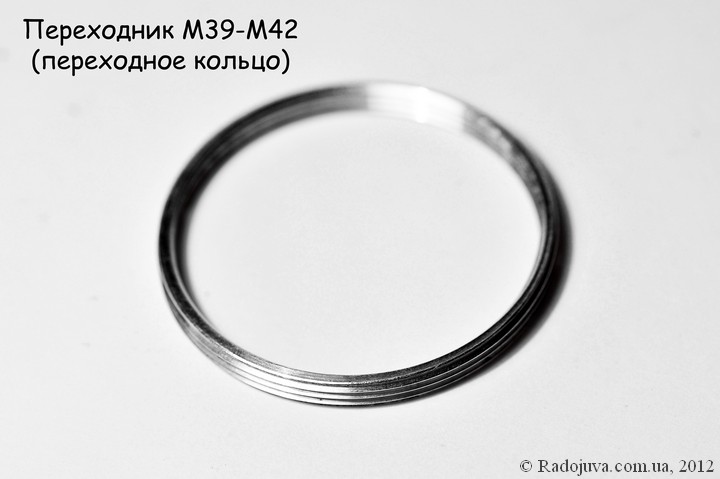
Adapter M39-M42
Note 2 : There are lenses from rangefinder cameras with an M39 thread . Rangefinder lenses should not be confused with DSLR lenses . Mounting rangefinder lenses on a Nikon system is possible, but focusing at infinity will be lost at a distance of just a few tens of centimeters. Such lenses are quite difficult to use on a Nikon system, and if used, it should only be for macro photography. For more details, see the section on using rangefinder lenses on DSLR cameras.
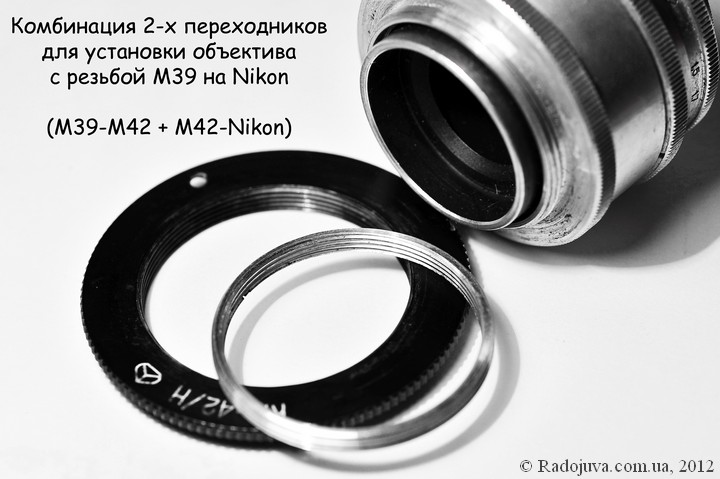
Using two adapters
Examples of M39 mount lenses
- Jupiter-9 85mm f2.0 (mirror version)
- Jupiter-11 135mm F4.0 (mirror version)
- Mir-1 37mm F2.8 (mirror version)
- Telemar-22 200mm F5.6 (mirror version)
- Industar-26m 50mm F2.8 P (rangefinder option)
- Jupiter-8 50mm F2.0 (m39, white, rangefinder)
- Jupiter-8 50mm F2.0 P (m39, white, rangefinder)
- Industar-26m 50mm F2.8 P rangefinder
- I-26m 52mm F2.8 rangefinder
- Industar-22 50mm F3,5 P rangefinder
Where to buy the adapter M39-Nikon F?
The cheapest adapters can be ordered on aliexpress.com . You can buy an M39-Nikon F adapter without a lens or chip here . You can also replace one M39-Nikon F adapter with two adapters: M42-Nikon F + M39-M42.
Lenses with 'K' mount
Some cameras, such as the Almaz-101, Almaz-102, Almaz-103, and Almaz-104, Zenit-KM, Zenit-Avtomat, Zenit-14, Zenit-AM, Zenit-AM-2, Zenit-AM-3, Zenit-APK, Zenit-APM, Zenit-122k, Zenit-212k, etc., had a K-mount, which is completely identical to the Pentax K- mount . Such lenses can be used on modern Pentax cameras, such as the Pentax K30 . To use lenses with a K-mount on Nikon cameras, a Pentax-Nikon adapter is required . Adapters are available with or without a lens. When using a Pentax-Nikon adapter without a lens, the ability to focus at infinity will be lost, just as with lenses with an M42 thread when using an adapter without a lens. The working distance of lenses with a K-mount and an M42 thread is the same, 45.5 mm.
Mostly Soviet lenses with the 'K' bayonet mount were removed from ' Almaz ' cameras; they have a good reputation, since this brand of cameras was highly valued at that time.
List of some Soviet lenses with K mount:
- MS Mir-47K 20mm F2,5
- MS Wave-10 35mm F1,8
- MS Wave 50mm F1,8
- MS Wave-4 50mm F1,4
- MS Vega-13 100mm F2,8
- MS Amber-12 35-100mm F3,5
- MS Mir-64 20mm F2.8
- MS Mir-20 20mm F3.5
- MS Mir-46 35mm F1.4
- MS Zenitar-K 16mm F2.8
- MS Zenitar-K 20mm F2.8
- MS Zenitar-K 28mm F2.8
- MS Zenitar-K 50mm F1.4
- MS Zenitar-K 50mm F1.9
- MS Zenitar-K 50mm F2.0
- MS Zenitar-K2s 50mm F2.0
- MS Zenitar-K 85mm F1.4
- MC APO Telezenitar-K 135mm F2.8
- MC APO Telezenitar-K 300mm F4.5
- MC Variozenitar-K 25-45mm F2.8-3.5
- MC Variozenitar-K 35-105mm F3.5-4.5
- MC Variozenitar-K 70-210mm F4
- MS Helios-77-4 50mm F1.8
Lenses with bayonet mount 'B' (Pentacon SIX), 'B' (Salute)
Lenses from medium-format cameras such as the Kiev-C, Kiev-60, and Pentacon-six can be used on Nikon cameras . These cameras have a "B" bayonet mount (Pentacon Six) . This requires a Pentacon 6/Nikon adapter , called the KP-6 . This adapter maintains infinity focus. Examples of such lenses include the Carl Zeiss Jena Sonnar 180 2.8 Pentacon Six.
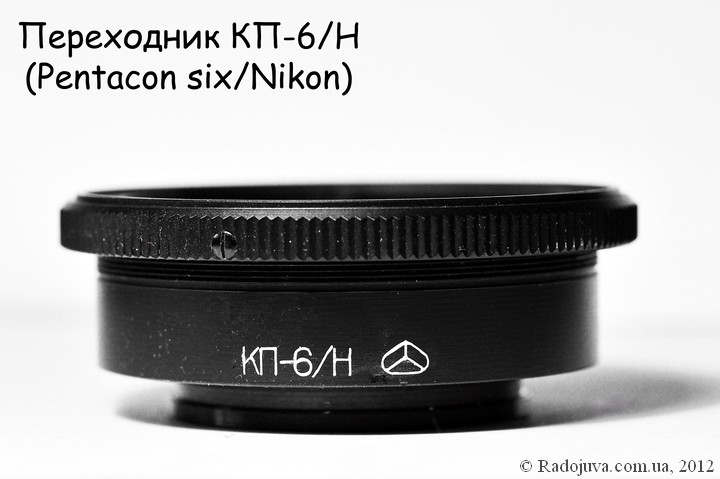
Adapter Pentacon 6 - Nikon
You can also use lenses from the Kiev 88/Salut medium-format cameras . These cameras have a "B" bayonet mount. These lenses require two adapters: a Kiev 88/Salut to Pentakon Six adapter and a Pentacon Six to Nikon adapter , or one KP-88/N adapter.
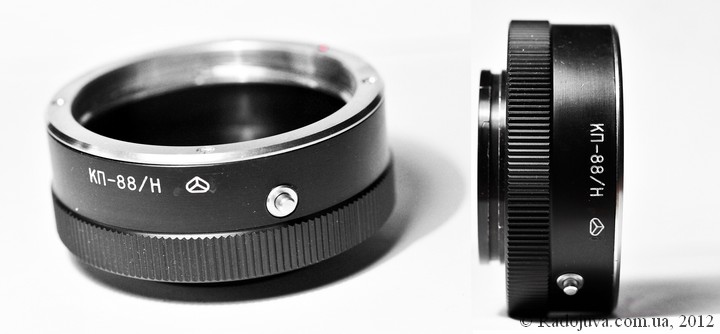
Adapter Salute 88 - Nikon
Note 3: Bayonet mounts "B" and "V" are different; they are not the same thing. People often make mistakes in identifying bayonet mounts.
Note 4: Adapters can often be combined. For example, there might be a Kiev 88/Salut to M42 adapter + KP-42/N adapter, and other combinations, depending on your needs. Most often, I encounter KP-A/42 + KP-42/N, which is incorrect; it can be replaced with a single KP-A/N adapter.
List of medium format Soviet lenses
- Jupiter-36V 250mm F3.5 (ARSAT B 3.5 / 250)
- Mir-3V 65mm F3.5
- MIR-26V 45mm F3.5 (Arsat B 45mm 1: 3,5)
- Mir-38B 65mm F3.5
- Industar-29 80mm F2.8
- Vega-12B 90mm F2.8
- Zodiac-8B 30mm F3.5
- MS Mir-69B 45mm F3.5
- MS Wave-3 80mm F2.8
- Vega-2 86mm F2.8
- Industar-24 105mm F3.5
- Industar-56 110mm F2.8
- MS Vega-28V 120mm F2.8
- ZM-3V 600mm F8
- Kaleinar-3B 150mm F2.8
- Tair-33 300mm F4.5
- Tele-5V 250mm F5.6
When using medium-format lenses on Nikon cameras, it remains possible to focus at infinity with lensless adapters. Medium format lenses have virtually no vignetting effect even on full-frame cameras.
Where to buy the PENTACON SIX - Nikon F adapter?
The cheapest adapters can be ordered on aliexpress.com . You can buy an adapter with a chip here , and an adapter without a chip here.
Lenses from 'U' enlargers
In the distant days when film reigned supreme, photographic enlargers were used for working with negatives and positives. Enlargers had a special lens that lacked a focusing ring. Such lenses often boast excellent optical performance, particularly high resolution. Taking photographs with such lenses is quite challenging, as without a focusing ring, achieving focus is very difficult. They are most often used as macro lenses, where classic focusing is not particularly necessary. The letter " U " is usually included in the lens name. Such lenses include:
Such lenses need conventional adapters for M39 or M42, which are described above.
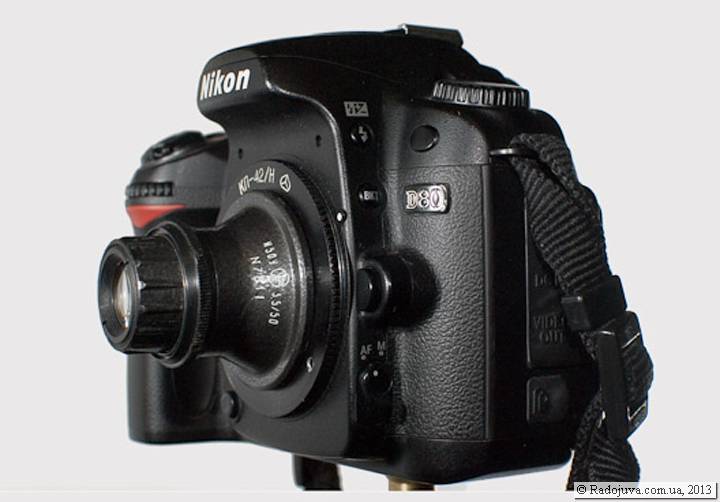
Zoom lens
Lenses with Contax-Kiev RF mount
Soviet rangefinder cameras Kiev-2, -2A, -3, -3A, -4M and -4AM, Kiev-5 (only external mount Contax-Kiev RF) and VTSVS / TSVVS (only internal mount) are equipped with the Contax-Kiev RF bayonet. Considering that these are rangefinder lenses, their use on SLR cameras is impossible. There are no adapters for Nikon cameras with Contax-Kiev RF mount. And the bayonet itself is quite specific, it consists of an inner and an outer part.
Lenses with internal mount Contax-Kiev RF:
- ZORKY ZK 1: 2 F = 5cm P, later renamed to 'JUPITER-8 ′
- JUPITER-8 1: 2 F = 5cm P (plant 'Arsenal' and KMZ)
- JUPITER-8M 2/50, aka JUPITER-8M 2/53 и JUPITER-8M 1: 2 F = 5cm P (there are actually other subversions)
- JUPITER-3 1: 1,5 F = 5cm P, aka JUPITER-3 1,5 / 50 and aka JUPITER-3 1,5 / 50 (ZOMZ)
- ZORKY ZK 1: 1,5 F = 5cm P, later renamed to 'JUPITER-3 ′
- HELIOS-103 1.8 / 53 (Arsenal plant)aka Helios-103 1.5 / 50 and aka Menopta 1.8 / 53
- ORCHID-3 F = 5,2cm 1: 1,5 (GOI, prototype)
- RUSSAR MR-2 5,6 / 20 (prototype)
Lenses with external mount Contax-Kiev RF:
- JUPITER-8 NB 2/50 (only suitable for Kiev-5)
- HELIOS-94 1,8 / 53 (only suitable for Kiev-5)
- ORION-15 6/28
- JUPITER-12 1: 2.8 F = 3.5cm P, aka JUPITER-12 2,8 / 35he is BK 1: 2.8 F = 3.5cm and he is the Sharp BK 1: 2.8 F = 3.5cm
- JUPITER-9 1: 2 F = 8.5cm P (Plant 'Arsenal'), aka JUPITER-9 2/85 (LZOS)
- JUPITER-11 1: 4 F = 13,5cm P (KOMZ), he JUPITER-11 4/135 (the latter has two identical options: KOMZ and KMZ)
- GOI SATELLITE-4 F = 2cm 1: 4.5 P (GOI, prototype)
- RECORD-4 0,9 / 52 (prototype, suitable only for Kiev-5)
- URANIUM F = 3,5cm 1: 2.5 (prototype)
- RECORD 1,8 / 50 (prototype)
- HELIOS-40 F = 8,5cm 1: 1.5 (prototypesuddenly!)
- RECORD-9 2.0 / 85 (prototype, later renamed JUPITER-9)
Other Soviet lenses
You can still find many non-standard lenses with different mount types. These days, you can mostly find cinema lenses, film projection lenses, film projector lenses, projector lenses, microscope lenses, and so on. In most cases, these lenses are very difficult to use and require significant modifications to mount on modern cameras.
Here are some of these lenses:
- 2/92 lens from the overhead projector Lati-60 / 60M
- F = 92 1: 2 lens from a slide projector Lety-60 / 60M
- MP RSFSR GLAVUCHTEHPROM Plant No. 6 77 mm lens from a filmoscope
- KO-120 120 mm F2.1 movie lens
Old Nikon 1 CX lenses and cameras
Nikon 1 mirrorless system cameras with a 2.7X crop factor include the Nikon 1 S1, Nikon 1 S2, Nikon 1 V1, Nikon 1 V2, Nikon 1 V3, Nikon 1 J1 , Nikon 1 J2, Nikon 1 J3, Nikon 1 J4, Nikon 1 J5, and Nikon 1 AW1 . Please note that the Nikon 1 AW1 cannot work with manual lenses at all; it requires a chip on the manual lens, but I haven't seen such a chip yet.
These cameras have a short flange focal distance, and any Soviet lens can be mounted on them. Usually the adapter is called 'bayonet / lens thread - Nikon 1'. With these cameras, you can focus to infinity using rangefinder lenses with an M39 mounting thread. True, these cameras do not know how to meter exposure with unchipped lenses. With their help it is difficult to focus, since they do not support the magnification of the image area with manual unchipped optics and in the video mode you also need to control the exposure pair yourself. But the built-in flash works without any problems. This is such a paradoxical system.
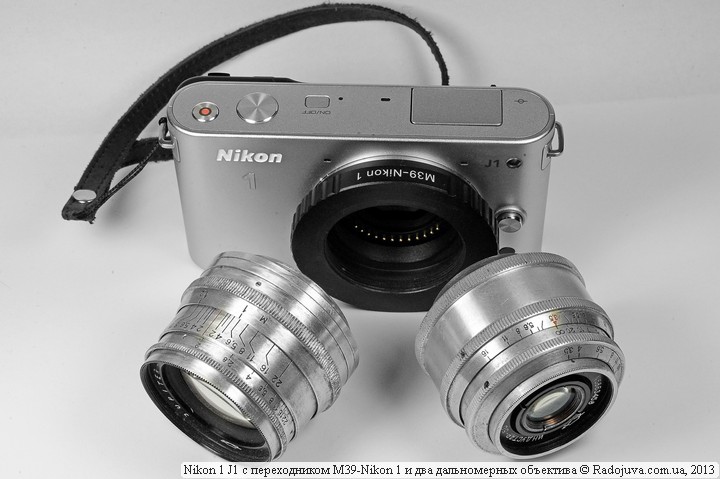
Adapter M39 - Nikon 1 Dual Lens
How to use old lenses without CPU contacts on modern Nikon digital SLR cameras?
Focus on non-CPU lenses
Forget about autofocus – with older lenses, only manual focusing (MF) is available. What will help you achieve sharpness is the green dot in the lower left corner of any Nikon DSLR . The dot looks like this . It works with any lens (and, in fact, without one). I recommend selecting the desired focus point from the available focus points and focusing from infinity to the desired value until the green dot lights up and stays lit. If you have trouble focusing, you can focus from the minimum focus value to the desired value, waiting for the green dot to light. If getting at least one sharp shot is crucial, I recommend using focus bracketing.
Please note : when working with manual optics, all Nikon digital zooms use single-point focusing only.
Please note: When working with lenses with an aperture smaller than F/5.6, the green focus dot is practically ineffective. For example, when using lenses with a small aperture , such as the MC MTO-11 1000mm F10.0 or the MC 3M-5CA 500mm F8, focus confirmation using the green dot does not work. Some Nikon cameras can provide focus confirmation at apertures up to F/8.0. This is only possible with the Nikon D4 , D4s, Df, D800 , D800E, D810 , D810a, D850, D600 , D610 , D7100 , D7200 , and D7500 – for more details, see the section on Nikon focusing systems.
Please note: the green dot is not a panacea. The green dot behaves differently with many lenses, and it may not always provide accurate focusing.
Some cameras have a mode live view (live view, live screen) - it's like in a regular soap box - aiming through a normal camera display. It is very convenient to zoom in (do 1 to 1) a certain area of the image and set sharpness from the approximate image. The zoom is done when Live View is on and the button with the 'magnifier plus' icon is pressed. Live View have the following cameras: Nikon D3100, D3200, D3300, D3400, D3500, D5000, D5100, D5200, D5300, D5500, D5600, D300, D300s, D500, D90, D7000, D7100, D7200, D7500, D600, D610, D700, D750, D780, D800,D800E, D810, D810a, D850, D3, D3s, D3x, D4, D4s, D5, D6, Df+ Z series. It is very convenient to use this mode with a tripod.
Please note: Zooming in and out of the Live View image is not available on Nikon 1 S1, Nikon 1 S2, Nikon 1 V1, Nikon 1 V2, Nikon 1 V3 , Nikon 1 J1, Nikon 1 J2, Nikon 1 J3, Nikon 1 J4, Nikon 1 J5, and Nikon 1 AW1 cameras. This feature has been specially reduced for the Nikon 1 series.
Interestingly, some Nikon cameras have an electronic rangefinder that works with manual optics. The rangefinder's function is that two arrows light up next to a green dot, indicating which direction to turn the focusing ring to achieve a sharp shot. Electronic rangefinders with manual optics don't work on all cameras, only on some, such as the Nikon D700 , D2x , and others. You can read more about focusing on Nikon cameras here.
Also, some lenses won't focus to infinity with certain adapters, limiting the focusing range. Often, some lenses can only be used for portraits or close-ups. In any case, the speed of focus will depend heavily on experience. If autofocus is crucial, a Lushnikov tangent can be used to achieve pseudo-autofocus ( a focus trap effect). In AF-A and AF-S focusing modes , the camera will only take a photo when focus is precisely achieved. The electronic rangefinder on lower-end cameras, such as the D3100 , D5100 , and others, will work with the Lushnikov tangent. For more details, see the Lushnikov tangent section.
Interesting: to simplify focusing through the viewfinder, you can install a special focusing screen. This screen replaces the one installed in the camera. The screen has special zones and properties that make focusing much easier. More details here . There are also interesting magnifying viewfinder attachments and external focusing screens for cameras with Live View support.
Iris control
When using old lenses on modern Nikon cameras, the aperture control remains completely manual or semi-automatic. There are several types of lenses with different types of iris control:
- Lenses that have only manual iris control, for example, Helios-44. Typically, such lenses have a diaphragm preset ring. Presetting helps a lot to speed up the shooting process. Such lenses are very easy to use on modern central controllers
- Lenses with automatic aperture control only, for example, Helios-44m-6. In this case, it will be necessary to deceive the lens and block a special lever that “pushes”, and thereby closes the aperture. It is not difficult to do it with improvised means, so the diaphragm can be controlled manually.
- Lenses with an aperture control mode switch M / A, for example, Helios-44m. In this case, just set the switch to M mode and manually control the iris
- Lenses without aperture control. Such lenses include very rare lenses, for example, Helios 92mm F2.0
- Auto Iris 'H' series lenses such as Granite-11N 80-200mm F4.5MC, with such lenses you need to set the value using the aperture control ring on the lens itself, and closing the aperture during shooting will be done by the camera itself.
- Native old Nikon lenses Pre-ai, AI, AI-S, AI-Converted. With such lenses, you need to set the value using the aperture control ring on the lens itself, and closing the aperture during shooting will be done by the camera itself.
In any case, the aperture value will need to be set using the dedicated aperture ring on the lens. The easiest way to do this on Nikon cameras is to use AI or AI-S- compatible lenses with automatic aperture, such as the MC Helios-81N 2/50 or Kaleinar-5N 2,8/100.
Please note: When installed on low-end Nikon cameras in "M" mode, the camera's display will show "F–" in the aperture value field. This is normal.
Metering
When working with the Nikon system, you will encounter exposure will not work on younger cameras.
Exact list of cameras that do not support auto metering with non-CPU lenses
Nikon D40, D40x, D50, D60, D70, D70s, D80, D90, D3000, D3100, D3200, D3300, D3400, D3500, D5000, D5100, D5200, D5300, D5500, D5600 и Nikon D100, D7500 (all of a sudden!) + Fujifilm FinePix S1 Pro, Fujifilm FinePix S2 Pro, S3 ProS3 Pro UVIR + Kodak DCS PRO 14n (and its modifications) and Kodak DCS Pro SLR / n (and its modifications) (this is the exact list). But with models D5200, D5300, D5500, D5600, D3500 can be used here's a life hack.
Exposure metering also doesn't work on Nikon 1 S1, Nikon 1 S2, Nikon 1 V1, Nikon 1 V2, Nikon 1 V3, Nikon 1 J1 , Nikon 1 J2, Nikon 1 J3, Nikon 1 J4, Nikon 1 J5, and Nikon 1 AW1 cameras . Manual lenses will only work with these cameras in M (manual) mode . In all other modes, an unmeasured lens won't be recognized by the camera, and an 'F–' (no lens) indicator will blink on the display. ISO, shutter speed, aperture, and flash power will need to be set manually. This is done by taking test shots; the histogram is very helpful ; it should have a normal shape without underexposure or overexposure.
Quick start guide for working with non-chip manual optics on Nikon amateur cameras:
- Put the camera in the manual control mode M using the mode dial on the top of the camera.
- Set the desired ISO sensitivity on the camera. Auto ISO sensitivity control does not work in such cameras and with such optics. The lower the ISO, the lower the noise level and the higher the photo quality. Try to shoot at the lowest ISO values.
- Set the desired aperture value on the lens. (How to control the diaphragm?)
- Set the shutter speed to the camera. Understanding of the approximate excerpts comes very fast with trial shots. You can use special tables, but it’s better to try several times.
- Focus and take a picture (How to focus?)
- Check the picture - if it is underexposed (dark) - then you should slow down the shutter speed, for example, from 1/1000 of a second to take 1/500 of a second. If the picture is overexposed, then you should reduce the shutter speed, for example, from 1/320 of a second to make 1/640 of a second. How badly you need to adjust excerpts You can approximately look at the histogram.
- If manipulation with shutter speed do not give the desired result, start over by choosing a different ISO or aperture value.
- If you are shooting in low light conditions, turn on the flash. Set the desired flash output manually using the selection method.
Measurement exposure available only in older cells:
Exact list of cameras that support automatic exposure metering with non-CPU lenses
D200, D300, D300s, D500, D600, D610, D700, D750, D780, D800,D800E, D810, D810a, D850, D7000, D7100, D7200, D1, D1h, D1x, D2x, D2xs, D2h, D2hs, D3, D3x, D3s, D4, D4s, D5, D6, Df+ Fujifilm FinePix S5 Pro, IS Pro+ Z series
These cameras are equipped with an aperture rheostat and can be used in aperture priority mode (A mode), while AI and AI-S- compatible lenses will have semi-automatic aperture control. The D1, D1h , and D1x cameras can only use spot or average-weighted metering ; other higher-end cameras can use matrix metering if the lens parameters are correctly specified in the camera menu.
Note: For the cameras listed above, find the 'Non-CPU Lenses' or 'Non-CPU Lenses' option in the camera menu and set your lens parameters there (focal length and maximum aperture – this information is usually written on the lens itself). If you're using a zoom lens, I recommend setting the maximum focal length and the minimum F-number available at that focal length. A little tip for using PRE-AI lenses can be found here.
Important: When changing the aperture value, you don't need to change the settings in the 'Non-CPU Lenses' menu. Exposure metering will work fairly accurately regardless of the aperture setting. It's highly recommended to only use the 'Non-CPU Lenses' settings when using TTL flash.
When exposure metering is critical, you can attach a Lushnikov Dandelion , which will communicate with the camera and make the camera think it's a native lens with microprocessor contacts. For AI-S lenses with a Lushnikov Dandelion, you can control the aperture directly from the camera and work in any mode, including automatic camera control (green zone). Focus trapping will also work. However, I don't recommend bothering with the Dandelion; it's better to learn to shoot in 'M' mode.
Flash work
On younger cameras Nikon D40, D40x, D50, D60, D70, D70s, D80, D90, D3000, D3100, D3200, D3300, D3400, D3500, D5000, D5100, D5200, D5300, D5500, D5600 и Nikon D100, D7500 built-in and external flash will only work in manual flash control mode. Do not confuse manual camera control. In this case, you will need to set the flash power yourself. In the menu, the power is set from 1 \ 1 to 1 \ 128. For example, a power of 1 \ 32 indicates that the flash will only work at one-thirty-second of full power. On senior cameras D200, D300, D300s, D600, D610, D700, D750, D780, D800,D800E, D810,D810a, D7000, D7100, D7200 + Z series the flash will operate in normal TTL auto mode. On cameras D1, D1h, D1x, D2x, D2xs, D2h, D2hs, D3, D3x, D3s, D4, D4s, D5, D6, Df, D850, D500, Z7, Z6 should only be used external flash. Attention: flash Nikon SB-300, Nikon SB-400 can not be used with non-studded lenses and some cameras, for example, Nikon D80, D70 etc. (which do not support flash control from their menu).
Important: Nikon SB-900 , SB-910 , SB-800 , and SB-5000 flashes support a unique aperture-priority auto flash mode , which allows the flash to be used in 'A' mode with all cameras. This means older lenses can be used without problems in low-light conditions with any Nikon camera, as these flashes can meter exposure automatically, but you will still need to shoot in manual mode. All standard TTL auto flash modes are available on all Nikon external flashes for older camera models.
Shooting videos on Nikon cameras and old lenses
Cameras that can shoot video: Nikon D5000, D90, D3100, D3200, D3300, D3400, D3500, D5100, D5200, D5300, D5500, D5600, D3s, D300s, D500, D4, D4s, D5, D6, D800,D800E, D810, D810a, D850, D7000, D7100, D7200, D7500, D600, D610 + Z series can record video with old manual lenses without any problems. exposure adjusted automatically even amateur Nikon D90, D5000, D5100, D3100 etc.
Note 6: To shoot video on Nikon D90 , D5000, D5100 , D3100 , D3200 , D3300 , D3400 , D3500 , D5200 , D5300 , D5500 , and D5600 cameras , they must first be set to "M" mode. When shooting video, focus remains manual, and aperture control is also manual. For AI-S-compatible lenses, you must first set the aperture value and then start video recording or Live View mode.
Note 7: Nikon 1 S1, Nikon 1 S2, Nikon 1 V1, Nikon 1 V2, Nikon 1 V3, Nikon 1 J1 , Nikon 1 J2, Nikon 1 J3, Nikon 1 J4, Nikon 1 J5, and Nikon 1 AW1 mirrorless cameras require manual adjustment of shutter speed , aperture, and ISO when shooting video. The Nikon 1 series has limited exposure metering capabilities in both photo and video modes.
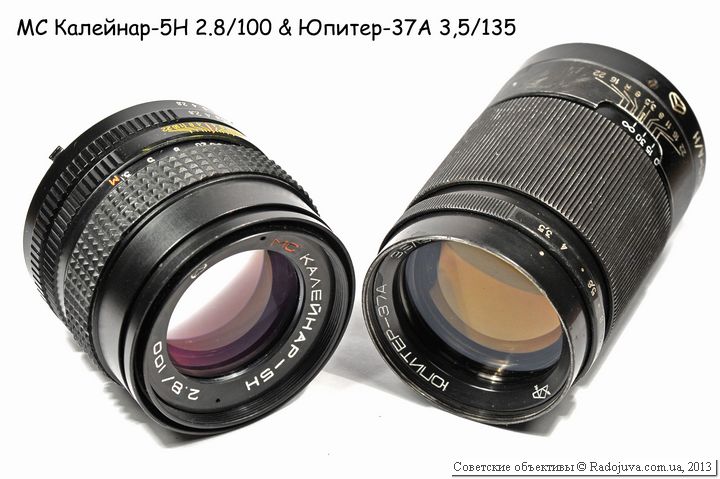
Two great portrait lenses
Why is all this necessary?
And due to the fact that now Soviet and other old optics can be bought, roughly speaking, for a penny and playing, you can get better masterpieces than on the Nikkor 135mm F2.0 DC. And manual optics gives more understanding about the shooting methods, develops a different approach to the whole process of photographing, makes you take pictures more deeply and more thoughtfully.
As they say, love is not just for you, you have to deal with it, the same applies to Soviet and other old lenses.
What manual lens to choose for a start?
I'm often asked which manual focus lens to buy. There's no definitive answer , as each lens is designed for different purposes. However, if you need my advice, I recommend lenses for modern Nikon cameras that don't require adapters, offer excellent value, and are easy to find and use.
From Soviet lenses:
- Helios-81N 50mm F2.0 MC - very sharp, fast, suitable for portraits on DX cameras, gives an interesting picture with twisted bokeh. I recommend it as the first Soviet lens. No adapter required.
- Helios-123Н 50mm F1.4 МС - Super fast, good for DX portraits, good bokeh, great for creative shots. No adapter required.
- Granite-11N 80-200mm F4.5 MC - an inexpensive Soviet zoom lens, easy to use and commercially available. No adapter required.
- Jupiter-37AM 135mm F3.5 MS и Jupiter-37A 135mm F3.5 with a KP-A / N shank (both versions of MS and not MS are good) - a good portrait lens, gives a very high-quality picture. Requires KP-A \ N shank.
- Jupiter-21A 200mm F4.0 with KP-A / N shank - tele lens, will help to reach distant objects. The image quality is very high.
- Tele-H 200mm F3.5 - good fix telephoto. No adapter required.
- Jupiter-11A 135mm F4.0 - a good portrait lens, an alternative to Jupiter-37A
- Tair-11A 135mm F2.8 - an excellent portraitist. Requires KP-A \ N shank.
- Mir-73N 20mm F2.8 MS - a wide-angle high-aperture lens for those who need a wide viewing angle. No adapter required.
- Zenithar 16mm F2.8 MC Fisheye - ultra-wide-angle fast lens with a unique distortion of the perspective of the "Fisheye" class. No adapter required.
- MS Bearing 3,5 / 8A - a unique circular fisheye lens for full-motion cameras.
- Kaleinar-5N 100mm F2.8 MS - super sharp short high-aperture telephoto. One of the best. Dear. Very high image quality. No adapter required.
- Mir-24N 35mm F2.0 MC - good standard high-aperture fix. No adapter required.
- MS Vega-28 120 / 2,8 - Medium format lens, on full frame and crop cameras can serve as an excellent portrait lens. Installed using a special adapter with the ability to focus to infinity.
- For Nikon 1 system cameras, they are perfect and cheap rangefinder lenses like Jupiter-8 2/50
I recommend you take a look at the page with voting for the best Soviet portrait lens and the best Soviet fifty-kopeck lens.
From Nikon lenses (Nikkor, Nippon) for creativity:
- Nikon 50mm f / 1.4 Nikkor-S Auto NON-AI - a good old fifty dollars. There are many modifications, almost all of them are very good.
- Nikon 100mm f / 2.8 Series E - good and not very expensive portrait lens
- Nikon 105mm f / 2.5 Nikkor AI - great portrait lens, price bites a little, but worth it.
- Nikon 135mm f / 2.8 Nikkor-Q Auto Non-Ai or any Nikon 135 / 2.8 is a good portrait lens.
- Nikon 180mm f / 2.8 ED Nikkor AI-S - a dream lens, a good prime telephoto lens, a super-portrait lens. Relatively expensive.
- Nikon 200mm f / 4 NIKKOR-Q - an inexpensive, pleasant long-focus fix.
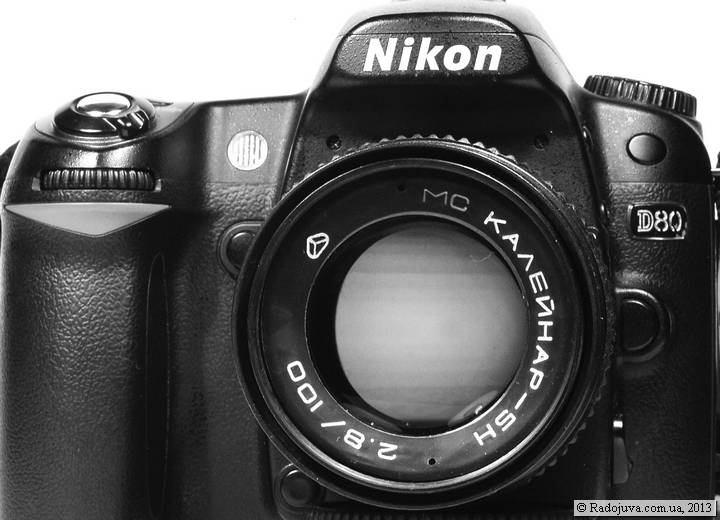
MS Kaleinar-5n lens on a Nikon D80 camera
For publicity:
The largest catalog of lenses and photographic equipment is on G. Abramov's website, " Stages of Development of Domestic Camera Industry ."
Also, a large selection of Soviet lenses on the website http://www.fotorox.ru/.

Personal experience:
I've written quite a bit of text with a lot of confusing terms and various subtleties and nuances for beginners. Don't think it's all that complicated. It's all very simple; just use a manual lens for a day or two. If you're unsure whether you'll be able to work with such a lens, you can try the following test. The gist of the test: turn off autofocus on your camera or lens, switch to M mode, turn off auto ISO, and set the flash to manual mode. This will give you the equivalent of a manual lens. Try shooting with manual shutter speed and aperture settings and manual focus. If you can do this, you'll be able to work with older lenses as well. Good luck!
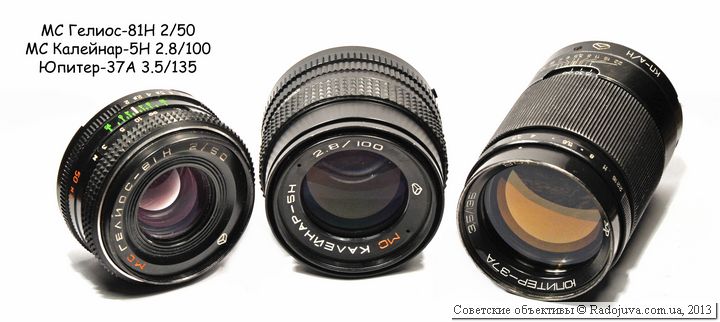
Popular Soviet lenses
Conclusion:
Old lenses found their rebirth on modern digital SLR cameras. Many old manual lenses can be used on Nikon cameras without adapters while maintaining functionality. The quality of the created image at a low cost makes the old manual optics very, very attractive for amateurs and professionals.
Another article of mine on Soviet optics is here.
Comments on this post do not require registration. Anyone can leave a comment.This material was prepared by Arkady Shapoval . The greatest support for the site is if you use links on this site, such as Amazon , when purchasing anything . It costs you nothing, but for this site, and therefore for my family, it's the main source of support.

Good evening! Are there any adapters M-39 WITH LENS under Nikon in nature? I searched everything, I found only the usual one like this http://ali.pub/42ro2c
If someone has information, please share the link!
You can put the m39-m42 adapter on the m42-nik adapter with a lens.
Those. what will be the sequence? 1 Carcass-2 adapter M42 with lens - 3 adapter M39-M42- 4 lens itself. Do I understand correctly?
Yes, absolutely right.
Thank you!
I apologize, but according to the design I have described, the focus on infinity will also be absent, or will the lens on the M-42 give something?
Duplicate here. do not think. that I am a bot)
The question is quite simple.
Tair lens, but without ponytail and with M39 thread
Through M42 + M42 / M39 focuses at infinity, quite a bearable picture (expected). Focuses at infinity on both crop and full frame. BUT on a full frame vignette + deterioration of the picture at times. Although the lens is mirrored. That is, it behaves like a normal DX lens on a full frame. What this is connected with, maybe with the specific scheme of Tair himself.
And is it possible to correct this somehow by adjusting the camera?
Thank you!
I started to write a lot of comments, although I don't have such a habit - I just read materials on this wonderful site.
:-)
Dear Maria, your problem may be related to an unsuccessful adapter lens: the quality of the Chinese manufacturers is unstable. I can use one of my m42-nik adapters only on crop, although this is an expensive Kipon.
There may be some conflict between the objective lens and adapter lens. I have something similar with the installation of the Zeiss-Tessar 2,8 / 45 Kontax-box on Nikon - the corners of the frame become blurred, although again the expensive adapter “K&F Concept”. In general, it seems to me that some manufacturers have begun to produce crop adapters. On I-Baye some sellers write that adapters are for, for example, Nikon-d7100, etc., while others are for Nikon-d700, d610, etc. Although, it seems, the adapters are the same.
“Native old lenses Nikon Pre-Ai, Ai, AI-S, AI-Converted. With such lenses, you need to set the value using the aperture control ring on the lens itself, and the shutting down of the aperture during shooting will be done by the camera itself. ”
Is it true that auto-exposure on the D7100 crop will be impossible, and it will only be possible to pick it up empirically? Are there any solutions to this problem?
For AI lenses, everything will work automatically, including metering exposure at different aperture values
Hello, Arkady. Is T2 exactly identical to KP-A / N? Ordered this morning under Jupiter-37A, because the old Soviet ones could not be found, at sane prices. I arrived, it looks similar, but its diameter is larger than that of the gearbox, and as a result, you can’t pinch it with adjusting screws, the difference in diameter is almost 4 mm. Either I misunderstood you, or the Chinese didn’t send it right)
I screwed it somehow, and even works, but everything is kept on three screws, of dumb quality. And not very much like "identical" = (
This is normal in the sense that it is conditionally identical, since it does not copy the Soviet adapter, but is used on similar systems. But it gives the main thing - focusing to infinity. I also put on the Ju-37 - it was fixed, it never flew off and did not even loosen. If in doubt, you can either look for bolts more genuinely, or come up with some kind of gasket. It's all simple - no need to disassemble, grind, etc.
PS Infinity with easy flight, keep this in mind.
Infinity in the afternoon I will check. I just thought that they would be the same in size, and I was very surprised at what had arrived, and it was not very convenient to center on the eye, because of such a difference in diameters.
And native optics under T2, is it screwed into the inner liner?
I don’t know, I only know that the inner liner has an M42 thread, that is, you can screw a lens with such a thread into it. Just don’t know why)
There it’s like m42x0.75, and ordinary lenses m42x1.0 have a thread. So you don’t especially screw it in.
Screwed in, checked, just did not find application. Now he gave the T2 shank, since he acquired a camera of another system.
PS T rings are used to attach the camera to the telescopes (if their design allows it). There are still telephoto lenses that are without a mount and attach to the camera like telescopes. There was once an idea to shoot through a pipe, but it did not come to practical implementation.
There is a 3mm difference. It is advisable to put the gasket, since with it certainly the alignment will be. For example, I cut a strip from a tube from under the sealant.
Moreover, I did not have infinity, I went to the turner ...
I looked now, there is no infinity. The range can be 100 meters, with a stretch, and that's it, it does not focus further. Apparently, you also need to grind.
So look at the scale on the lens, where infinity begins after the 30 meter mark. … 15 meters - 30 meters - infinity. That is, somewhere around 45 meters is the edge of the focusing, everything further is “infinity”.
So it makes sense to me to look at the scale, I looked in live. It focuses to a certain range, and then soap without focus just goes on. Although a few years ago, on the same lens, with a native shank, it was focused on the same objects without problems. Like mirrorless sweat later.
This is the flight over infinity. It focuses on ... 15 m - 30 m - to infinity, but no fixation occurs on it, the ring still scrolls a little, which gives a defocus.
It seemed to me during the flight, you turn a little back, and it hits. And here it doesn’t work out, unfortunately, it just doesn’t reach her :)
Then it's weird. Everything worked well for me in a bunch of Nikon D70s + Yu-37. It was necessary to bring the ring back a bit.
Others
Good afternoon! The question is. There is a Helios-44m, I used it with a conventional adapter ring on Nikon D80. Of course, it was impossible to shoot anything except large portraits. Now I'm updating to Nikon D750, do I understand correctly that I can shoot at least waist-deep? And I can only grow up with a ring with a lens with a loss of quality? And one more thing: dandelion is just a replacement for a chip, right I understand?
Nikon SLR cameras, in principle, are not intended for installing third-party manual glasses on them due to the too long working distance. you need a kenon or sony or bzk. or just take your own manual nikkors and forget about this bottle Soviet glass)) in essence the question - yes, when changing the crop to a full frame, the angle of view of the lens will become wider by the crop factor, for nikon it is 1.5, that is, it will become what and should be. "Dandelion Lushnikov" is the original name, but in fact it is a small microcontroller, a chip on a printed circuit board glued to an adapter. for nikon cameras, it is necessary so that exposure metering is turned on on younger cameras. for older cameras, it is not needed, the camera can shoot like that.
Well, if you really need this Helios, really take any, the cheapest Canon. In this case, you will have metering and infinity, and you will not need to glue a dandelion.
Hello! Thank you very much for the work done in explaining the manual optics of the USSR. I want to ask about the transition from 42M to Nikon mount, an adapter, using a lens on a film camera. For example, the same Jupiter 21M 4 / 200mm. Will it insist on infinity on Nikon FM or is this a problem only with digital mirrors and mirrorless?
Now I have the opportunity as a hobby to use film photo cameras of Japanese brands. Nikon, Pentax, Minolta. And how experiments use the optics of the USSR.
so, after all, the working length of any Nikon SLR camera is the same. so problems with non-native optics will also be similar.
Good afternoon. I've been looking for a telephoto lens for Nikon D5300 for a long time, but modern lenses are expensive. I learned from your articles that there is
lenses Tair-3 and Tair-33.
Please tell me if they fit my Nikon.
Thank you in advance for your reply.
https://radojuva.com/photo-review/#tair
Fits with matching adapter
Need an M42 with a lens?
Good afternoon. Please tell me if there is any possibility, or adapters, so that, on the contrary, a modern Nikon lens can be attached to a Zenit film camera? thanks in advance.
There are Nikon F to M42 adapters, but they are very difficult to find.
firstly, a modern lens of any system cannot be placed on any old film camera - how to operate it ?? secondly, if you take an old nikkor screwdriver, then, in theory, you can put it somewhere other than nikon. more precisely, not even in theory, but in practice, it is installed on a large number of modern digital cameras. but nothing can be put at the zenith. unless, again, in theory, someone grinds out the adapter. only with the flange you will need to do something. thirdly, why is all this? now you can buy a Nikon film camera for a penny, which is an order of magnitude better than any Soviet camera.
The most logical option is to buy Kiev 19. Normal viewfinder with exposure meter, beautiful body, cheap price. Any Nikkor with a diaphragm control ring is suitable without any dancing with a tambourine.
MC Peleng 3,5 / 8A is a unique circular fisheye lens for full-motion cameras. Correct
I put it on NICON D3100 with HELIOS-44M-4 ring. After that, the lens does not open, and the display shows “no lens attached”.
The reason?
What do you mean “the lens won't open”? The inscription on the display is because the lens has no electronic connection with the camera and the camera “does not see” it. Shoot in M mode, shutter speed, aperture, and ISO manually.
that is why the kenon is much more convenient for manual optics. there the exposure meter works even on an open mount.
Tell me what are the differences when working with old optics on NIkon Z cameras?
The difference is that the flange focal length of these cameras is much shorter than that of DSLRs and you can use lenses from rangefinder cameras as well. The only question is the adapters.
Hello, Arkady! I am very interested in your opinion about the following: I had a Nikon D3100 and work with manuals, namely, the selection of the exposure took place as you described, by trial and error. This had to be done because in the LV screen d3100 for some reason adjusts the brightness itself, regardless of the actual exposure. But having bought the D5200, I was happy to find that in LV mode it shows a real picture that will turn out if you press the shutter. Those. when changing the exposure, manually opening and closing the aperture, changing the shutter speed, the screen darkens or brightens accordingly, which was not the case on the d3100 (there it always kept the same brightness, or rather changed it, but then adjusted it). In fact, the problem of the lack of autoexposure with manual optics in the LV mode disappears in principle. So, for some reason, this is not written anywhere, not as a difference, at least between the D5200 and the D3100, or what happens on the D5200 in exactly the same way. And it's not at all clear why select it if you turned on LV and see the resulting picture? It is just as interesting whether in the entire line of D3 ... well, and D5 ... so? Or is it that I can, where that in the settings have turned-under-turned and what I do not understand?
Good afternoon, not in all. Only with some cameras, most likely only with d5200-d5600
Maybe you need to cover this topic in more detail? - because I say it again: this is heaven and earth. The pursuit of the D7X00 due to autoexposure with manuals in principle disappears, especially since there is no rotary screen, and the D5X00 has a big “+”. I myself suffered for a long time between them, but in the end the rotary screen won out and there was such an unexpected surprise. After all, focusing is still better and more accurate on the screen with a magnifying glass (the point in the VI often smears) and the selection of the exposure (shutter speed) with the wheel is only a couple of seconds without any tests. Maybe someone will respond with other models, like yours with the above?
Ok I'll take a note on this
It will be very good, it can be useful to many. There are some facets in the form of exposure not shorter than 1/30, I did not check the long one. Changing the ISO also affects the picture. You have created a very good site, Arkady, we can safely say “popular”. It's nice to participate in improving it)
I added a note about this https://radojuva.com/2021/06/exposure-metering-with-ai-s-non-cpu-and-d5200-5300-5500-5600/ and posted the information in the relevant articles. Thanks for the tip.
You're welcome. Now at least I myself will know that this function can also be turned off inadvertently)
If I understand you correctly, then on the flashed D5100 in manual mode, LV also immediately shows a change in exposure, ISO, shutter speed, etc.
Good afternoon.
I noticed a strange feature in the behavior of the D7000 camera with Helios 81H: a clear overexposure occurs at apertures 8 and less. From 2 to 5,6 - everything seems to be normal, and then the camera starts to bully the ISO, you have to apply compensation up to -3, ... but this is only when using VI, if you shoot through LV - on the same scenes and under the same lighting - there is less iso and there is no overexposure.
The lens is registered in the camera, the camera sees it ...
Mode "A"; ISO-AUTO from 100; max shutter speed 1/30.
What could be the reason?
PS: with "native" 24-120 and 70-300 everything works fine.
Some Helios have other accesses and not quite AI (that is, not linear control of the jump rope displacement)
And why, when switching to LV, the exposure parameters are normalized?
And if the aperture on the lens is closed at 11, on the info-screen F11 ... what is the nonlinearity
I look in the VI - ISO 5000, I raise the mirror, LV turns on - ISO 1200
I just want to understand the physics of the process.
Conducted experiments in similar conditions with Kalinar-5 and Nikkor 35-70 - everything works fine, at all aperture values when using VI and LV, the exposure metering is accurate.
Under the N mount, there was another interesting lens Yantar 20N 35-200 I don’t remember the aperture ratio, I saw it live only once when I was still shooting with Kyiv-19.
3,5-4,5
Does it make sense (and is it doable by just unscrewing and screwing to switch the mounts) to switch an AI-S lens mount with an AI mount to get AI-s functionally on a Nikon D700 body. I would like to do this to my 200mm micro f4 classic lens.
What functionality do you want exactly?
Good evening! I have a Miranda EC 135mm 2.8 lens, and I can't find out what kind of mount it is and are there NIKON adapters for it?
Good evening! This system is also called Miranda, there are hardly any adapters for Nikon DSLRs (if there are, they will be with a lens that worsens the image), Nikon mirrorless ones should be available, but they will probably be rare and expensive.
Muchas gracias por su artículo, nos permite utilizar lentes estupendos con muy baja inversión. Saludos
Good afternoon. How is it more correct to focus manually (turn the ring) - from infinity or vice versa to infinity?
Without a difference.
Tell me please. The MS Helios 81n2/50 lens fits well on the Nikon D3000. doesn't want Nikon D 90. what is the problem? and what needs to be done to install it on the d90.
File down the skirt of the aperture control ring, details here and here.